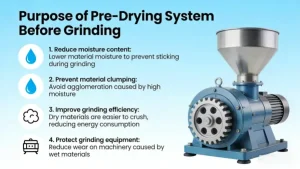
A pre-drying system before grinding serves several critical purposes, primarily focused on improving efficiency, product quality, and equipment protection. Its main functions include:
-
Moisture Reduction for Efficient Grinding:
- Many materials (like biomass, minerals, grains, or chemicals) contain inherent moisture. High moisture content makes materials sticky, ductile, or tough, causing them to clog grinding mills, adhere to grinding media/screens, and significantly reduce grinding efficiency.
- Pre-drying reduces the moisture content to an optimal level (often below 10-15%, depending on the material), making the material more brittle and easier to fracture. This leads to higher throughput, lower energy consumption per ton of ground product, and finer or more consistent particle sizes.
-
Preventing Clogging and Blockages:
- Wet materials tend to agglomerate or paste together during grinding, leading to blockages in the mill inlet, outlet, classifiers, or conveying systems. Pre-drying minimizes this risk, ensuring smoother operation and reducing downtime for cleaning.
-
Improving Product Quality:
- Excessive moisture can lead to uneven grinding, resulting in a wider particle size distribution. Pre-drying helps achieve a more uniform final product.
- For certain applications (e.g., fuel pellets, specific chemical processes, food ingredients), strict moisture specifications are required for the final product or downstream processes. Pre-drying ensures the feed meets these requirements before grinding even begins.
- It can also help prevent microbial growth or spoilage in organic materials during storage or processing.
-
Protecting Equipment:
- Grinding wet, abrasive materials can accelerate wear on mill liners, hammers, rollers, and other components. Reducing moisture can mitigate some of this wear.
- Preventing clogging also reduces mechanical stress on the grinding equipment and associated motors.
-
Enhancing Downstream Processes:
- If the ground material is intended for further processing like pelleting, briquetting, calcination, or chemical reactions, having a consistent and low moisture content from the start (after pre-drying and grinding) is often crucial for the efficiency and quality of those subsequent steps.
In essence: The pre-drying system prepares the raw material by removing excess water, transforming it into a state that is physically more suitable for efficient, effective, and trouble-free grinding, ultimately saving energy, protecting equipment, and ensuring a higher quality final product.