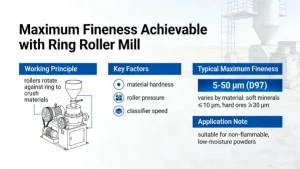
The maximum fineness achievable with a ring roller mill (also known as a vertical ring roller mill, Raymond mill, or pendulum roller mill) depends on several factors, including mill design, material properties, classifier efficiency, and operating parameters. However, general industry benchmarks are as follows:
✅ Typical Fineness Range
-
Standard operation: 80–400 mesh (≈177 µm down to 38 µm)
-
With high-efficiency dynamic classifier:
-
Up to 600–800 mesh (≈25–20 µm)
-
-
Maximum practical fineness:
-
D97 ≈ 10–15 µm (equivalent to ~1200–1500 mesh) — only under optimized conditions
-
🔹 Note: Achieving D97 < 10 µm consistently is very challenging in conventional ring roller mills due to aerodynamic and mechanical limitations.
📌 Key Limiting Factors
-
Classifier Efficiency
-
Traditional static (sieve/air) classifiers limit fineness to ~45 µm.
-
Turbo or dynamic air classifiers are required for sub-20 µm products.
-
-
Grinding Force & Bed Thickness
-
Ring roller mills rely on medium-pressure grinding (compared to high-pressure vertical roller mills).
-
Ultrafine particles (<10 µm) require repeated recirculation, reducing throughput and increasing wear.
-
-
Material Hardness & Moisture
-
Soft materials like calcium carbonate (Mohs 3) can be ground finer than hard minerals (e.g., quartz).
-
Moisture >1–2% causes clogging and agglomeration, limiting fineness.
-
-
Airflow Dynamics
-
Fine particles need sufficient upward airflow for transport to the classifier.
-
Below ~10 µm, particles behave more like aerosols and may not separate efficiently.
-
🔄 Comparison with Other Mills
💡 Practical Recommendation
For calcium carbonate or similar soft minerals:
-
A modern ring roller mill with a high-speed turbo classifier can reliably produce D97 = 12–15 µm.
-
If your target is D97 < 10 µm (e.g., for paper coating or specialty plastics), consider:
-
Pre-grinding in a ring roller mill + finish grinding in a jet mill or stirred mill.
-
Or switch to a high-pressure vertical roller mill (HPGR-type) with advanced classification.
-
Maximum fineness in a ring roller mill: ~10–15 µm (D97) under optimal conditions with dynamic classification. Beyond that, alternative technologies (jet mills, wet stirred mills) are more efficient and economical for ultrafine grinding.