A grinding circuit mass balance is a fundamental calculation in mineral processing used to quantify the flow of material through a grinding mill and its associated classification equipment (e.g., hydrocyclones, screens, air classifiers). It ensures that the “Mass In” equals the “Mass Out” across every unit operation, allowing engineers to optimize throughput, particle size distribution (P80), and energy efficiency.
Here are the key parameters required to perform an accurate grinding circuit mass balance:
1. Flow Rates (Solid and Slurry)
These are the primary variables solved for in the balance.
●
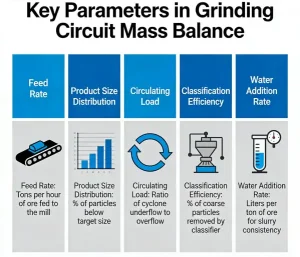
Fresh Feed Rate (FF): The rate of new ore entering the circuit (tons/hour or tph).
●
Circulating Load (CLCL): The rate of coarse material returned from the classifier to the mill inlet. This is often expressed as a percentage of the fresh feed (e.g., 250% CL).
●
Mill Discharge Rate: The total flow leaving the mill (Fresh Feed + Circulating Load).
●
Classifier Oversize (Returns): The flow rate of material failing the cut point and returning to the mill.
●
Classifier Undersize (Product): The final product flow rate leaving the circuit.
●
Slurry Flow Rate: The total volume of slurry (solids + water) moving through pipes and pumps (m3/hrm^3/hr).
2. Solids Content and Density
Since grinding is often done in a slurry (wet) or with air transport (dry), density is critical for converting between volumetric and mass flows.
●
Solids Specific Gravity (SGsolidSG_{solid}): The density of the ore itself (e.g., Graphite ≈\approx 2.2–2.3 g/cm³; Iron Ore ≈\approx 5.0 g/cm³).
●
Slurry Density / % Solids by Weight:
○
Mill Feed Pulp Density: Critical for determining mill hold-up and power draw.
○
Mill Discharge Pulp Density: Usually lower than feed due to added water or rheology changes.
○
Classifier Feed/Underflow/Overflow Densities: Essential for calculating separation efficiency.
●
Water Addition Rates: The amount of process water added at the mill feed, mill discharge, or cyclone feed to control viscosity and transport.
3. Particle Size Distribution (PSD)
The mass balance is typically performed on specific size fractions (size-by-size balance) to determine separation efficiency.
●
Feed P80: The size at which 80% of the fresh feed passes.
●
Product P80: The target grind size (e.g., 75 microns for flotation, 10 microns for ultrafine graphite).
●
Cut Point (d50d_{50} or d97d_{97}): The particle size where the classifier splits the flow 50/50 (or 97/3 for ultrafine air classifiers).
●
Size Fraction Masses: The mass flow of specific intervals (e.g., +100 mesh, -100/+200 mesh, -200 mesh) in every stream.
4. Separation Efficiency Parameters
These define how well the classifier is working.
●
Bypass Factor: The fraction of fine particles that incorrectly report to the coarse return stream (short-circuiting).
●
Sharpness Index: A measure of how precise the separation is (ideal = 1.0).
●
Corrected Efficiency (EcE_c): The efficiency of the classifier excluding the bypass effect.
●
Partition Curve: The probability of a particle of a given size reporting to the underflow (returns).
5. Mill Internal Parameters (For Dynamic Balances)
If the balance includes the mill internals (not just input/output):
●
Ball/Grinding Media Charge: Total mass and size distribution of the media.
●
Mill Hold-up: The total mass of material inside the mill at any instant.
●
Residence Time: How long material stays in the mill (Volume / Volumetric Flow).
●
Breakage Distribution Function (BB): How particles break into smaller sizes per unit of energy.
●
Selection Function (SS): The rate at which particles of a certain size are broken.
6. Energy Parameters (Often linked to Mass Balance)
●
Specific Energy Consumption (kWh/tkWh/t): Energy used per ton of new feed or per ton of product.
●
Bond Work Index (WiWi): A measure of the ore’s resistance to grinding, used to predict the power required for the calculated mass flow.
The Fundamental Equations
In a standard closed-circuit ball mill with a hydrocyclone or air classifier, the mass balance relies on these core equations:
1. Overall Mass Balance: F+R=M=O+UF + R = M = O + U (Where FF=Fresh Feed, RR=Returns, MM=Mill Discharge, OO=Overflow/Product, UU=Underflow/Returns) Note: In a steady state closed circuit, R=UR = U.
2. Water Balance: WF+Wadd=WO+WUW_F + W_{add} = W_O + W_U
3. Size-by-Size Balance (for fraction ii): F⋅fi+R⋅ri=M⋅miF \cdot f_i + R \cdot r_i = M \cdot m_i M⋅mi=O⋅oi+R⋅riM \cdot m_i = O \cdot o_i + R \cdot r_i (Where f,r,m,of, r, m, o represent the fraction of material in size interval ii for each stream).
4. Circulating Load Calculation: CL(%)=RF×100=oi−mimi−ri×100CL (\%) = \frac{R}{F} \times 100 = \frac{o_i – m_i}{m_i – r_i} \times 100 (Calculated using a size fraction where separation is distinct, usually near the cut point).
Why These Parameters Matter for Your Graphite Application
Given your focus on graphite-mill.com:
1.
Ultrafine Targets: For producing 1500–2500 mesh graphite, the Air Classifier Cut Point (d97d_{97}) and Bypass Factor are the most critical parameters. A high bypass means you are re-grinding already fine material, wasting energy and generating heat (which can oxidize graphite).
2.
Purity: Mass balances help track water addition and lining wear. If the balance shows unexpected mass gains in iron fractions, it indicates liner/media wear contaminating the high-purity graphite.
3.
Capacity Planning: Accurate Circulating Load calculations prevent overloading the mill. Graphite is soft; excessive circulating load can lead to “cushioning,” where too many fines prevent the media from impacting the coarse particles effectively.
Would you like a sample calculation template for a graphite vertical roller mill circuit?