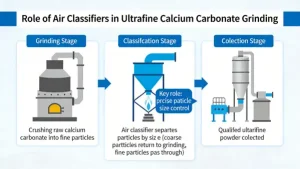
Air classifiers play a critical role in the production of ultrafine calcium carbonate (UFCC) by ensuring precise particle size control, high product purity, and efficient separation during and after the grinding process. Here’s a detailed breakdown of their role:
1. Particle Size Classification
- Objective: Ultrafine calcium carbonate typically requires a narrow particle size distribution—often below 2 µm (D97 < 2 µm) for applications in paper, plastics, paints, and pharmaceuticals.
- Function: Air classifiers separate ground particles based on aerodynamic size (a function of particle mass and drag), allowing only particles within the target size range to exit as final product.
- Mechanism: Centrifugal force (from rotating vanes or wheels) and airflow work together—coarse particles are thrown outward and recirculated to the mill, while fine particles are carried by the air stream to collection.
2. Integration with Grinding Systems
- In modern UFCC plants, air classifiers are often integrated directly with mechanical mills (e.g., ball mills, stirred media mills, or jet mills) in a closed-circuit configuration.
- This setup enables:
- Continuous recirculation of oversized particles back to the mill for further grinding.
- Energy efficiency, as only necessary grinding occurs (no over-grinding of already-fine particles).
- Stable product quality, due to real-time size control.
3. Enhancement of Product Purity
- Air classification is a dry, physical separation method, avoiding contamination from liquids or additives (unlike wet classification).
- It helps remove agglomerates or loosely bonded clusters, improving dispersion properties.
- In some systems, multi-stage classification can separate impurities (e.g., silica or iron-containing minerals) if they differ significantly in density or shape.
4. Optimization of Process Efficiency
- High-efficiency turbo or dynamic air classifiers allow sharp cut points (high selectivity), reducing the amount of off-spec material.
- Adjustable parameters (rotor speed, airflow rate, feed rate) enable flexible production of different grades from the same raw material.
- Reduced wear and lower energy consumption compared to repeated wet processing and drying steps.
5. Support for Surface-Treated Calcium Carbonate
- After dry surface treatment (e.g., with stearic acid), air classifiers help deagglomerate and classify the coated particles without damaging the coating—critical for performance in polymer composites.
In ultrafine calcium carbonate production, air classifiers are indispensable for achieving consistent sub-micron to few-micron particle sizes with high efficiency and purity. Their integration into closed-loop grinding systems represents a cornerstone of modern dry-processing technology for mineral fillers.