CaCO3
JACAN

How to recycle and reuse process gases in a closed grinding system

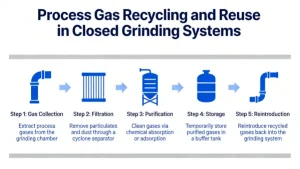
For mineral closed grinding systems (CaCO₃, graphite, etc.), process gas is reused via a closed-loop circulation system to save energy, lower emissions and stabilize grinding conditions. 1. Typical Closed-Loop Flow Mill → Classifier → Dust removal → Cooling / heat recovery → Circulation fan → Back to mill 2. Key Processes & Equipment Full Enclosure & Gas CollectionUse sealed ducts, mills and collectors to capture all exhaust gas with almost no leakage. Dust Purification (essential) Primary: Cyclone (separate coarse particles) Secondary: Baghouse / pulse filter (remove fine dust)Only clean gas can be stably recycled. Temperature & Heat ManagementInstall a heat exchanger to: Cool recycled gas (avoid overheating product/equipment) Recover waste heat for preheating raw material. Gas RecirculationA high-efficiency centrifugal fan…

For mineral closed grinding systems (CaCO₃, graphite, etc.), process gas is reused via a closed-loop circulation system to save energy, lower emissions and stabilize grinding conditions.

1. Typical Closed-Loop Flow

Mill → Classifier → Dust removal → Cooling / heat recovery → Circulation fan → Back to mill

2. Key Processes & Equipment

  1. Full Enclosure & Gas CollectionUse sealed ducts, mills and collectors to capture all exhaust gas with almost no leakage.
  2. Dust Purification (essential)
    • Primary: Cyclone (separate coarse particles)
    • Secondary: Baghouse / pulse filter (remove fine dust)Only clean gas can be stably recycled.
  3. Temperature & Heat ManagementInstall a heat exchanger to:
    • Cool recycled gas (avoid overheating product/equipment)
    • Recover waste heat for preheating raw material.
  4. Gas RecirculationA high-efficiency centrifugal fan maintains flow and pressure.Typical recirculation rate: 85–95%.
  5. Atmosphere & Makeup Gas
    • Small makeup gas (air or N₂ for inert conditions) compensates leakage.
    • For combustible powders (e.g., graphite), monitor and control O₂ level for safety.

3. Advantages

  • Fan energy consumption reduced by 30–50%
  • Near-zero dust emission
  • Stable grinding atmosphere (temperature, humidity, oxygen)
  • Lower operating cost

4. Operation Notes

  • Keep slight positive pressure to reduce outside air intrusion.
  • Regularly clean filters to avoid high pressure drop.
  • Automate monitoring of O₂, temperature and flow.
About Us:
With over 20 years of dedicated expertise in ultrafine grinding technology, we deliver high-performance machinery that matches the precision and reliability of leading German and Japanese brands—at only 1/3 of their cost.

Beyond Equipment, We Deliver Total Confidence:
We provide Free Material Testing to ensure precise equipment selection, followed by professional on-site installation and comprehensive training. Our 24/7 technical support team ensures your production line remains efficient and worry-free.

Schedule Material Trial & Get a Customized Solution from Us
How to select the liner plates for a calcium carbonate ball mill
Selecting the right liner plates for a calcium carbonate (CaCO3) ball mill requires careful consideration...
What is the difference between mechanical and jet milling for ultrafine CaCO3?
For ultrafine CaCO3 (typically <5 μm), jet milling delivers cleaner, narrower PSD, better shape control,...
How to cool the grinding zone in high-intensity milling
To cool the grinding zone in high-intensity milling, combineequipment-integrated cooling systems,direct heat extraction techniques,process optimization,...