Preventing overgrinding in a ball mill when processing calcium carbonate (CaCO₃) is essential to maintain product quality, reduce energy consumption, and avoid unnecessary wear. Overgrinding leads to excessive fines, broad particle size distribution (PSD), agglomeration, and higher operational costs.
Here are practical strategies to prevent overgrinding in a ball mill for calcium carbonate:
1.Optimize Mill Residence Time
-
Issue: Longer retention time = finer particles → overgrinding.
-
Solution:
-
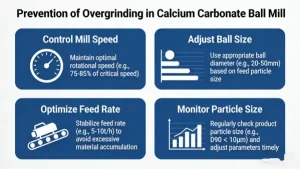
Adjust feed rate: Increase throughput to reduce material dwell time.
-
Control slurry density (in wet grinding): Maintain optimal solid concentration (typically 60–75% solids by weight). Too low → longer grinding time; too high → poor grinding efficiency.
-
2.Use Proper Ball Charge Design
-
Ball size distribution must match the target fineness:
-
Coarse feed → larger balls (e.g., 60–80 mm).
-
Fine product → mix of medium/small balls (e.g., 20–40 mm).
-
-
Avoid excessive small balls, which promote overgrinding of already-fine particles.
-
Regularly inspect and replenish ball charge to maintain optimal size distribution.
3.Install or Optimize a Classifier (Closed-Circuit Grinding)
-
Use an air classifier (dry) or hydrocyclone (wet) in a closed-circuit configuration.
-
Only coarse particles are returned to the mill; fine product is removed immediately.
-
This prevents already-ground fines from re-entering the mill and being overground.
✅ Key benefit: Tighter particle size distribution and energy savings.
4.Monitor and Control Product Fineness in Real Time
-
Use online particle size analyzers (e.g., laser diffraction sensors) to adjust:
-
Feed rate
-
Mill speed
-
Classifier speed (if applicable)
-
-
Set automatic feedback loops to maintain target PSD (e.g., D97 = 10 µm).
5.Optimize Mill Operating Parameters
-
Mill speed: Operate at 70–85% of critical speed. Too high → excessive impact; too low → inefficient grinding.
-
Grinding media filling ratio: Typically 25–35% of mill volume. Overfilling increases collision frequency → overgrinding.
-
Liner design: Use liners that promote cascading (not cataracting) motion for gentler, more controlled grinding.
6.Add Grinding Aids (for Dry or Wet Systems)
-
Dry grinding aids (e.g., stearates, fatty acids):
-
Reduce agglomeration and coating on balls/liners.
-
Improve dispersion, allowing easier removal of fines.
-
-
Wet grinding dispersants (e.g., polyacrylates):
-
Stabilize slurry, prevent reagglomeration.
-
Enhance separation efficiency in hydrocyclones.
-
⚠️ Note: Choose food/pharma-grade additives if producing precipitated or ground calcium carbonate (GCC/PCC) for sensitive applications.
7.Avoid Excessive Recirculation Load
-
In closed-circuit systems, keep circulating load within design limits (typically 100–300%).
-
Too high a recirculation load increases residence time of fines → overgrinding.
8.Pre-Screen or Pre-Classify Feed Material
-
Remove oversize or undersize fractions before milling.
-
If feed already contains fine particles (< target size), bypass them around the mill (if feasible).
Summary Checklist:
td {white-space:nowrap;border:0.5pt solid #dee0e3;font-size:10pt;font-style:normal;font-weight:normal;vertical-align:middle;word-break:normal;word-wrap:normal;}
| Strategy | Action |
| ✅ Closed-circuit with classifier | Prevents fines from regrinding |
| ✅ Optimize ball size & charge | Match media to desired fineness |
| ✅ Control residence time | Adjust feed rate & slurry density |
| ✅ Real-time PSD monitoring | Enable dynamic control |
| ✅ Use grinding aids | Reduce agglomeration & coating |
| ✅ Maintain proper mill speed/fill | Avoid excessive energy input |
By implementing these measures—especially closed-circuit operation with efficient classification and proper ball charge management—you can significantly reduce overgrinding, improve product consistency, and lower energy use in calcium carbonate ball milling.
Preventing overgrinding in a ball mill when processing calcium carbonate (CaCO₃) is essential to maintain product quality, reduce energy consumption, and avoid unnecessary wear. Overgrinding leads to excessive fines, broad particle size distribution (PSD), agglomeration, and higher operational costs.
Here are practical strategies to prevent overgrinding in a ball mill for calcium carbonate:
1.Optimize Mill Residence Time
-
Issue: Longer retention time = finer particles → overgrinding.
-
Solution:
-
Adjust feed rate: Increase throughput to reduce material dwell time.
-
Control slurry density (in wet grinding): Maintain optimal solid concentration (typically 60–75% solids by weight). Too low → longer grinding time; too high → poor grinding efficiency.
-
2.Use Proper Ball Charge Design
-
Ball size distribution must match the target fineness:
-
Coarse feed → larger balls (e.g., 60–80 mm).
-
Fine product → mix of medium/small balls (e.g., 20–40 mm).
-
-
Avoid excessive small balls, which promote overgrinding of already-fine particles.
-
Regularly inspect and replenish ball charge to maintain optimal size distribution.
3.Install or Optimize a Classifier (Closed-Circuit Grinding)
-
Use an air classifier (dry) or hydrocyclone (wet) in a closed-circuit configuration.
-
Only coarse particles are returned to the mill; fine product is removed immediately.
-
This prevents already-ground fines from re-entering the mill and being overground.
✅ Key benefit: Tighter particle size distribution and energy savings.
4.Monitor and Control Product Fineness in Real Time
-
Use online particle size analyzers (e.g., laser diffraction sensors) to adjust:
-
Feed rate
-
Mill speed
-
Classifier speed (if applicable)
-
-
Set automatic feedback loops to maintain target PSD (e.g., D97 = 10 µm).
5.Optimize Mill Operating Parameters
-
Mill speed: Operate at 70–85% of critical speed. Too high → excessive impact; too low → inefficient grinding.
-
Grinding media filling ratio: Typically 25–35% of mill volume. Overfilling increases collision frequency → overgrinding.
-
Liner design: Use liners that promote cascading (not cataracting) motion for gentler, more controlled grinding.
6.Add Grinding Aids (for Dry or Wet Systems)
-
Dry grinding aids (e.g., stearates, fatty acids):
-
Reduce agglomeration and coating on balls/liners.
-
Improve dispersion, allowing easier removal of fines.
-
-
Wet grinding dispersants (e.g., polyacrylates):
-
Stabilize slurry, prevent reagglomeration.
-
Enhance separation efficiency in hydrocyclones.
-
⚠️ Note: Choose food/pharma-grade additives if producing precipitated or ground calcium carbonate (GCC/PCC) for sensitive applications.
7.Avoid Excessive Recirculation Load
-
In closed-circuit systems, keep circulating load within design limits (typically 100–300%).
-
Too high a recirculation load increases residence time of fines → overgrinding.
8.Pre-Screen or Pre-Classify Feed Material
-
Remove oversize or undersize fractions before milling.
-
If feed already contains fine particles (< target size), bypass them around the mill (if feasible).
Summary Checklist:
| Strategy | Action |
| ✅ Closed-circuit with classifier | Prevents fines from regrinding |
| ✅ Optimize ball size & charge | Match media to desired fineness |
| ✅ Control residence time | Adjust feed rate & slurry density |
| ✅ Real-time PSD monitoring | Enable dynamic control |
| ✅ Use grinding aids | Reduce agglomeration & coating |
| ✅ Maintain proper mill speed/fill | Avoid excessive energy input |
By implementing these measures—especially closed-circuit operation with efficient classification and proper ball charge management—you can significantly reduce overgrinding, improve product consistency, and lower energy use in calcium carbonate ball milling.