Grinding calcium carbonate (CaCO₃) to a 5-micron (μm) particle size is a fine/ultra-fine grinding process, typically used for precipitated calcium carbonate (PCC) or ground calcium carbonate (GCC) in industries like plastics, coatings, papermaking, and inks. The 5μm specification refers to the D97/D50 particle size (97% or 50% of particles pass 5μm, per industrial standards); clear particle size requirements must be confirmed first.
Below is a systematic, industrial-scale process for grinding CaCO₃ to 5μm, including equipment selection, process parameters, key controls, and precautions (lab-scale methods are also briefly included for R&D).
Core Principle
5μm grinding of CaCO₃ relies on wet grinding (dominant for industrial production) rather than dry grinding. Dry grinding struggles to reach 5μm due to:
Severe particleagglomeration (fine CaCO₃ has high surface energy).
Low grinding efficiency and high energy consumption.
Severe dust pollution and equipment wear.
Wet grinding disperses CaCO₃ in an aqueous medium (with dispersants) and uses grinding media to apply shear/impact forces to break particles, achieving precise 5μm sizing with high efficiency and low agglomeration.
I. Industrial-Scale Wet Grinding Process (Mainstream for 5μm CaCO₃)
This process is suitable for mass production (tonnage to ten-thousand tonnage scale) and produces high-quality 5μm CaCO₃ with narrow particle size distribution (PSD).
Pre-Grinding (Coarse Milling)
First, crush raw CaCO₃ (ore/GCC/PCC) to a 200~325 mesh (45~74μm) coarse powder as the feed material for fine grinding:
Equipment: Jaw crusher → Cone crusher → Raymond mill/Roller mill (dry coarse grinding).
Requirement: Uniform feed particle size (no large lumps >100μm) to avoid overloading fine grinding equipment.
Wet Grinding (Core Step for 5μm)
Key Equipment: Horizontal Bead Mill (Sand Mill)
The horizontal bead mill is the most widely used and efficient equipment for 5μm CaCO₃ wet grinding (vertical bead mills are optional for small-scale production). It features high grinding intensity, continuous production, and easy PSD control.
Critical Bead Mill Configuration for 5μm CaCO₃:
| Component | Specification for 5μm Grinding | Reason |
| Grinding Media | Zirconia beads (ZrO₂) with 0.8~1.2mm diameter (or 1.0~1.5mm for D50=5μm) | Small-diameter zirconia beads have high specific surface area, providing more grinding contact points; high hardness (Mohs 8~9) resists wear and avoids contamination of CaCO₃. |
| Rotor Type | Pin-type/Disks-type high-shear rotor | Generates strong turbulent flow and shear force to break fine CaCO₃ agglomerates/particles. |
| Chamber Volume | 10~1000L (customized for production scale) | Continuous production for industrial needs; large chambers for high throughput. |
Wet Grinding Process Parameters (Optimized for 5μm CaCO₃)
The slurry system is the core of wet grinding—slurry concentration, dispersant dosage, and grinding speed/time directly determine whether 5μm is achieved.
Slurry Preparation
Dispersion medium: Deionized water (tap water is acceptable for general-grade CaCO₃; avoid hard water with high Ca²+/Mg²+ to prevent scaling).
Slurry concentration: 60~70% solid content (wt%). Too low → low production efficiency and high energy consumption; too high → high slurry viscosity, poor fluidity, and insufficient grinding.
Dispersant addition: 0.2~0.8% of CaCO₃ mass (key to preventing agglomeration).Recommended dispersants: Sodium polyacrylate (SPA, most common), sodium hexametaphosphate (SHMP), or polycarboxylate dispersants. Add dispersant first to water, stir to dissolve, then add coarse CaCO₃ powder and stir to form a uniform slurry (use a high-shear mixer for 10~20min).
Grinding Operation Parameters
Grinding speed: 15~30m/s (peripheral speed of rotor). Adjust based on bead size (smaller beads = moderate speed to avoid bead breakage).
Grinding time/number of passes: 1~3 passes through the bead mill (continuous production). For batch grinding: 30~60min (determine by on-line particle size testing).
Slurry flow rate: 50~200L/h (per 10L mill chamber). Match flow rate with grinding speed—too fast → insufficient grinding; too slow → over-grinding and high energy consumption.
On-Line Particle Size MonitoringUse a laserparticlesize analyzer (e.g., Malvern Mastersizer) for real-time sampling and testing. Stop grinding when the D97/D50 reaches 5μm to avoid over-grinding.
Post-Processing (After Wet Grinding)
The ground 5μm CaCO₃ slurry needs post-treatment to meet industrial application requirements (slurry or powder form):
Option 1: Direct Slurry Product (for coatings/inks)
Filtration: Use a 100~200 mesh filter screen to remove large impurities/bead fragments.
Homogenization: Stir the slurry again to ensure uniform PSD.
Packaging: Store in sealed tanks (add a small amount of preservative if long-term storage is needed to prevent microbial growth).
Option 2: Dry Powder Product (for plastics/rubber)
Concentration: Use a centrifugal dewaterer or filter press to increase slurry solid content to 80~90%.
Drying: Use a spray dryer (best for 5μm CaCO₃, no agglomeration) or flash dryer (for general-grade). Drying temperature: 100~120℃ (avoid high temperature to prevent dispersant decomposition).
Deagglomeration: Pass the dried powder through a pin mill/airclassifier for mild grinding to break loose agglomerates formed during drying (critical to retain 5μm size).
Packaging: Sealed packaging (use moisture-proof bags to avoid hygroscopic agglomeration).
II. Lab-Scale Grinding Method (for R&D/Small-Scale Testing)
For lab preparation of 5μm CaCO₃ (100g~10kg), use a small vertical bead mill or planetary ball mill (wet grinding mode):
Planetary ball mill (batch wet grinding):
Grinding media: 0.5~1.0mm zirconia beads (ball-to-powder ratio = 5:1~10:1).
Slurry concentration: 50~60%, dispersant dosage: 0.3~0.5%.
Grinding speed: 300~500rpm, grinding time: 60~120min.
Small bead mill (continuous): Same parameters as industrial scale (adjust flow rate/speed for small chamber volume).
Post-treatment: Centrifuge → freeze dry (best for lab, minimal agglomeration) → laser particle size testing.
III. Key Equipment Alternatives (for Special Scenarios)
If the production scale is small (e.g., <1000 tons/year), the following equipment can be used for 5μm CaCO₃ grinding (lower efficiency than horizontal bead mills):
Vertical Stirred Bead Mill: Simple structure, low investment, suitable for small-batch production.
ColloidMill: For low-grade 5μm CaCO₃ (wider PSD, not recommended for high-end applications like coatings).
High-Pressure Homogenizer: Suitable for nano-CaCO₃ grinding, optional for 5μm (high energy consumption).
Note: Dry grinding is not recommended for 5μm CaCO₃. If dry grinding is mandatory (special process), use a jet mill with a classifier + dry dispersant (e.g., stearic acid), but the product will have severe agglomeration, and the actual particle size after dispersion is hard to reach 5μm.
IV. Critical Quality & Process Controls (Avoid Common Failures)
Prevent
The most common failure: Grinding reaches 5μm in slurry, but agglomerates to >10μm after drying.
Solutions: Optimize dispersant dosage, use spray drying (instead of oven drying), and add a post-drying deagglomeration step.
Avoid Equipment Contamination
Use zirconia grinding media/lining (instead of glass/steel beads) to prevent Fe/ Si contamination (critical for high-grade CaCO₃ in electronics/coatings).
Regularly check for bead breakage and filter slurry to remove fragments.
Control
Narrow PSD (required for high-end applications): Use a classifier with the bead mill, or optimize grinding speed/flow rate to avoid over-grinding of fine particles and under-grinding of coarse particles.
Wide PSD (acceptable for general-grade): Single-pass bead mill grinding is sufficient.
Reduce Energy Consumption
Optimize feed particle size (200~325 mesh is the best balance; finer feed = lower grinding energy).
Control slurry concentration and dispersant dosage to ensure optimal fluidity.
Use energy-efficient bead mills (frequency conversion speed regulation).
V. Raw Material Requirements
GCC (ground calcium carbonate): High purity (CaCO₃ ≥95%), low impurity content (Fe₂O₃ <0.1%, SiO₂ <0.5%)—high SiO₂ causes severe equipment wear.
PCC (precipitated calcium carbonate): Already has fine primary particles (1~3μm); wet grinding is mainly for deagglomeration to achieve 5μm secondary particle size (lower grinding energy than GCC).
Raw material moisture: <0.5% (for coarse grinding) to avoid agglomeration during pre-processing.
VI. Typical Technical Indexes of 5μm CaCO₃ (Industrial Grade)
| Index | Specification |
| Particle size | D97 ≤5μm (or D50=5μm, per customer requirement) |
| Purity (CaCO₃) | ≥95~99% |
| Whiteness | ≥85~98% (depends on raw material) |
| Moisture (powder) | ≤0.5% |
| Viscosity (slurry) | 500~2000 mPa·s (65% solid content) |
VII. Industrial Application Notes
The 5μm CaCO₃ produced by wet grinding has good dispersibility (key advantage over dry grinding), making it suitable for high-end applications (e.g., water-based coatings, plastic masterbatches, paper coating).
For ultra-highwhitenessrequirements (e.g., papermaking), use high-whiteness calcite ore (whiteness ≥95%) and avoid iron-contaminated equipment/grinding media.
For oil-based systems (e.g., solvent-based inks), replace water with organic solvents (e.g., ethanol, mineral oil) and use oil-based dispersants (e.g., fatty acid esters) for wet grinding.
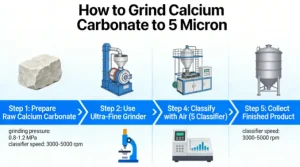
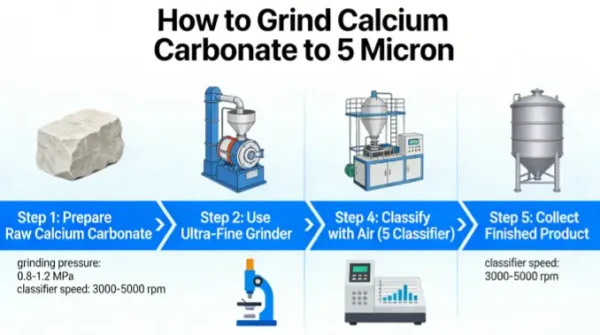
RawCaCO₃ → Coarse crushing → Raymond mill (200~325 mesh) → Slurry preparation (60~70% concentration + 0.2~0.8% dispersant) → Horizontalbeadmill (0.8~1.2mm zirconia beads, 15~30m/s speed) → Laserparticlesize testing (5μm) → Filtration → Spray drying/dewatering + flash drying → Deagglomeration → 5μm CaCO₃ powder/slurry.
This process ensures stable 5μmparticlesize, narrowPSD, high production efficiency, and lowagglomeration—the mainstream solution for industrial 5μm CaCO₃ grinding worldwide.