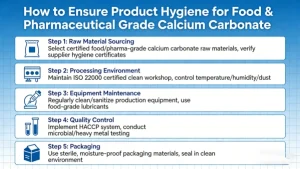
Ensuring hygiene and safety for food-grade & pharmaceutical-grade CaCO₃ requires strict control over raw materials, production environment, equipment, process, microbiology, and packaging, in full compliance with food safety regulations (e.g., GB 1886.214) and pharmaceutical GMP standards.
1. Raw Material Control
- Use high-purity, natural calcite ore with low heavy-metal content, mined from pollution-free areas.
- Strictly test incoming raw materials for:Heavy metals (Pb, As, Hg, Cd, Cr)Microorganisms (total plate count, coliform, Salmonella, mold & yeast)
- Reject any ore near industrial pollution, waste, or contaminated soil.
2. Production Environment Hygiene
- Separate food/pharma-grade production lines from industrial-grade lines to avoid cross-contamination.
- Use cleanroom / GMP-grade workshops with:Air purification and filtrationControlled temperature & humidityRegular environmental microbial monitoring
- Staff must follow hygiene rules: clean uniforms, disinfection, health certificates, no jewelry, restricted movement.
3. Equipment & Pipeline Hygiene
- Use food/pharma-grade materials: 304 / 316L stainless steel, non-toxic, corrosion-resistant.
- Equipment design: no dead corners, smooth surface, easy to clean.
- Implement CIP (Clean-in-Place) and regular sanitization; no residual detergent or lubricant.
- Use dedicated magnetic separators to remove metal impurities.
4. Process Hygiene Control
- Grinding: Use only food/pharma-approved grinding aids & dispersants; prohibit industrial additives.Wet grinding is preferred for better hygiene and less dust pollution.
- Purification: Multi-stage filtration & classification to remove coarse impurities and foreign matter.
- Drying: Use clean hot air; avoid direct contact with fuel fumes. Pharma-grade often uses spray drying under aseptic conditions.
- Sterilization: Optional thermal sterilization or UV treatment to reduce microorganisms.
5. Microbiological Control
- Strictly limit:Total aerobic plate countColiformsSalmonella (must be absent)Mold and yeast
- Monitor microorganisms in real time during production.
6. Packaging & Storage
- Use food/pharma-grade, sealed, non-toxic packaging materials; avoid secondary pollution.
- Store in a dry, clean, ventilated warehouse, away from chemicals, odors, pests, and toxic materials.
- Follow FIFO (First In, First Out) management.
7. Quality & Traceability
- Test every batch for purity, heavy metals, and microorganisms before release.
- Establish a complete traceability system: raw material batch → production → inspection → delivery.
- Maintain records for food safety and GMP compliance.