PSD control requires a coordinated approach across grinding mill parameters, classification efficiency, process conditions, and automated monitoring/control. Focus on manipulating mill speed, media size/charge, classifier settings, feed rate, and pulp density to achieve your target PSD while balancing energy use and throughput.
🎯 Fundamentals of PSD Control
Particle size distribution (PSD) is defined by metrics like d10, d50, d90, P80 (80% passing size), and span (width of distribution). Effective control involves:
- Balancing grinding intensity with classification sharpness
- Optimizing circulating load (typically 200-250% for ball mills)
- Minimizing oversize (coarse tramp material) and fines (unnecessary ultra-fine particles)
- Maintaining consistent feed characteristics (size, hardness, moisture)
🔧 Grinding Mill Parameter Control
1. Mill Speed
- Critical speed ratio: Typically 70-80% of critical speed for ball mills
- Faster speeds: Increase impact energy, producing finer grind and wider PSD
- Slower speeds: Promote attrition grinding, yielding narrower PSD with fewer fines
- VFDs enable precise speed adjustment for different materials/grind targets
2. Grinding Media Optimization
| Media Parameter | Effect on PSD |
|---|---|
| Size distribution | Graded charge (large:medium:small balls) matches particle reduction through mill |
| Large balls | High impact force for coarse feed, wider PSD |
| Small balls | Increased surface area contact, finer grind, narrower PSD |
| Media density | Higher density (e.g., steel vs. ceramic) increases energy transfer |
| Charge volume | 30-40% of mill volume; higher charge increases grinding efficiency (up to point) |
Best Practice: Use multisize ball charges (e.g., 45mm:35mm:25mm = 35:35:30 for fine grinding) to optimize breakage across all particle sizes.
3. Mill Loading & Feed Rate
- Steady feed rate: Prevents overloading/underloading, maintaining consistent residence time
- Underloading: Causes media-on-media wear, uneven PSD, excessive fines
- Overloading: Reduces grinding efficiency, coarser product, higher power draw
- Load sensors: Monitor mill fill level for closed-loop control
🧩 Classification System Adjustments (Closed Circuit)
1. Hydrocyclone Control (Most Common in Mineral Processing)
| Parameter | Effect on Cut Size (d50) | PSD Impact |
|---|---|---|
| Vortex finder diameter | Directly proportional | Larger = coarser overflow |
| Spigot diameter | Inversely proportional | Smaller = finer overflow |
| Inlet pressure | Directly proportional | Higher pressure = finer cut |
| Pulp density | Higher density = coarser cut | Adjust with dilution water |
| Number of cyclones in operation | More cyclones = higher throughput | Balance with individual cyclone efficiency |
Key Formula: log d₅₀(c) = VF/2.6 – spig/3.5 + P/18.7 – Wf/100 + constant
2. Dynamic Air Classifiers (Cement, Fine Chemicals)
- Rotor speed: Higher speed = finer product (reduces max particle size)
- Airflow rate: Balances separation efficiency and throughput
- Blade angle: Adjusts classification sharpness and PSD shape
3. Spiral Classifiers
- Rake speed: Faster speed = more coarse material returned to mill
- Pool depth: Deeper pool = finer overflow
💧 Process Fluid & Circulating Load Management
1. Water Addition & Pulp Density
- Wet grinding: Water acts as both transport medium and grinding aid
- Dilution water: Controls pulp density in sumps and cyclone feed
- Higher density: Increases grinding efficiency but can coarsen classification
- Lower density: Improves classification sharpness but reduces mill throughput
- Rule of Thumb: Adjust water to maintain cyclone feed density 35-45% solids for optimal classification
2. Circulating Load Optimization
- Definition: Ratio of material returned to mill vs. new feed (typically 200-250%)
- Higher load: Increases mill efficiency but may reduce throughput
- Lower load: Increases throughput but may coarsen product
- Control via classifier settings: Faster classifier speed = lower circulating load
- Critical for PSD: Balances residence time to avoid overgrinding (fines) or undergrinding (coarse)
📊 PSD Measurement & Monitoring
| Technique | Application | Resolution |
|---|---|---|
| Laser diffraction | Wet/dry samples, online/offline | Submicron to mm range |
| Sieving | Coarse particles (>45μm) | Low cost, good for quality control |
| Online analyzers | Real-time process control | PGNAA, laser, acoustic sensors |
| Particle size cameras | Visual confirmation of PSD | Qualitative, complements quantitative methods |
Best Practice: Implement online PSD analyzers for closed-loop control, with offline lab analysis for calibration/verification.
🤖 Advanced Control Strategies
1. Multivariable Control Systems
- Manipulate mill speed, feed rate, water addition, classifier settings simultaneously
- Maintain constant product fineness while maximizing throughput
- Use MPC (Model Predictive Control) for complex interactions
2. AI & Machine Learning
- Neural networks predict PSD from process parameters
- Expert systems diagnose PSD deviations and recommend adjustments
- Reinforcement learning optimizes parameters for energy efficiency while meeting PSD targets
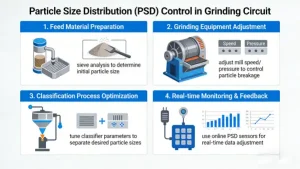
3. Closed-Loop Automation Workflow
- Measure feed size, hardness, and composition
- Monitor mill power, load, and pressure
- Analyze cyclone overflow PSD in real-time
- Adjust classifier speed, water addition, and mill parameters
- Validate results with lab analysis and refine control model
🛠️ Troubleshooting Common PSD Problems
| Issue | Root Cause | Solution |
|---|---|---|
| Product too coarse | – Undergrinding
– Low circulating load – Inadequate media charge |
– Increase mill speed/media charge
– Optimize classifier for finer cut – Reduce feed rate |
| Excessive fines | – Overgrinding
– High circulating load – Too many small media |
– Decrease mill speed
– Adjust classifier for coarser cut – Add larger media to charge |
| Wider than target PSD | – Inconsistent feed
– Poor classification – Improper media sizing |
– Stabilize feed rate/composition
– Improve classification sharpness – Implement graded media charge |
| PSD drift over time | – Media wear
– Liner degradation – Process parameter changes |
– Regular media replacement
– Monitor liner wear – Implement adaptive control |
📋 Step-by-Step PSD Control Implementation
- Define target PSD: Establish d10, d50, d90, P80, and span requirements based on downstream process needs
- Characterize ore/feed: Test grindability (Bond work index), mineralogy, and moisture content
- Optimize mill parameters:
- Select appropriate media size distribution
- Set mill speed to 70-80% of critical speed
- Establish optimal charge volume (30-40%)
- Configure classification system:
- Calculate initial cyclone dimensions/settings based on target d50
- Set circulating load to 200-250% for ball mills
- Implement process control:
- Install online PSD analyzer for real-time monitoring
- Set up water addition control to maintain consistent pulp density
- Deploy automated control system for parameter adjustments
- Monitor and refine:
- Regularly sample and analyze product PSD
- Adjust parameters based on energy efficiency and product quality trade-offs
- Re-optimize media charge as wear occurs
✅ Final Recommendations
- Prioritize classification: Sharp classification is often more impactful for PSD control than mill adjustments alone
- Implement graded media: Multisize charges consistently outperform monosize for balanced PSD
- Invest in online monitoring: Real-time data enables proactive adjustments, reducing off-spec product
- Optimize circulating load: Balance mill efficiency and throughput to avoid overgrinding/undergrinding
- Adopt advanced control: MPC systems handle complex interactions for stable, consistent PSD
By integrating these strategies, you can achieve precise PSD control that maximizes both product quality and process efficiency.