Iron contamination is a common and critical quality issue during the grinding of calcium carbonate (CaCO₃). Even trace amounts of iron (Fe²⁺/Fe³⁺) can significantly reduce the product’s whiteness and brightness, and may compromise its safety and performance in high-end applications such as food, pharmaceuticals, optical films, premium coatings, and toothpaste. Therefore, systematic measures must be implemented to prevent or minimize iron contamination.
1. Main Sources of Iron Contamination
| Source | Description |
|---|---|
| 1. Wear from grinding equipment | Metal components (e.g., steel balls, liners, hammers, classifier wheels) generate iron particles through high-speed friction. |
| 2. Iron-bearing impurities in raw ore | Natural ores like calcite or marble may contain magnetite, hematite, or other iron minerals. |
| 3. Conveying and storage systems | Iron particles can be introduced via wear from carbon steel pipes, silos, or valves. |
| 4. Environmental dust | Airborne metallic particles in the workshop may fall into the product. |
2. Key Measures to Prevent Iron Contamination
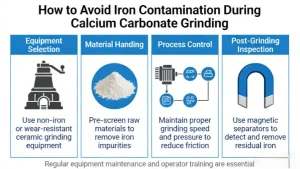
✅ 1. Use Non-Metallic or Wear-Resistant Grinding Equipment
Grinding media: Replace steel balls with ceramic beads (e.g., zirconia ZrO₂ or alumina Al₂O₃).
Liner materials: Line grinding chambers and classifiers with high-performance polymers (e.g., polyurethane), ceramics, or silicon carbide.
Preferred equipment types:
Jet mills (air classifiers): No mechanical contact → virtually zero iron contamination (ideal for high-purity or nano CaCO₃).
Stirred media mills / bead mills with ceramic linings and zirconia beads.
Avoid standard carbon-steel Raymond mills unless producing low-grade fillers.
✅ 2. Raw Ore Pretreatment and Iron Removal
Magnetic separation: Use high-intensity magnetic separators (≥10.000 Gauss) after crushing and before grinding to remove magnetic minerals.
Froth flotation: For high-purity products, further reduce Fe₂O₃ content (down to <50 ppm).
Washing: Remove iron-rich surface clays and dust.
✅ 3. Non-Metallic Material Handling and Storage
Use 316L stainless steel (low iron leaching) or engineering plastics (e.g., PE, PP) for pipelines.
Apply food-grade coatings or ceramic linings to silos and packaging contact surfaces.
Avoid carbon steel hoppers, screw conveyors, or unlined chutes.
✅ 4. Install Multi-Stage Magnetic Separation Systems
Add magnetic separators at critical points in the production line:
Inlet: Permanent magnetic drum (coarse removal)
Post-grinding: High-gradient magnetic separator (HGMS) to capture weakly magnetic micron-sized particles
Pre-packaging: Pipeline magnetic rods or grid-type magnetic traps (final polishing)
📌 Typical target: Final product with Fe₂O₃ ≤ 50–100 ppm (high-end applications require ≤ 20 ppm).
✅ 5. Regular Maintenance and Cleaning
Inspect equipment wear regularly and replace worn parts promptly.
Clean dead zones to prevent old material buildup and oxidation.
Install filters in the air-recirculation system to block iron-laden dust.
3. Iron Content Requirements by Application
| Application | Max Allowable Fe₂O₃ | Iron Control Requirement |
|---|---|---|
| General plastic filler | ≤ 300 ppm | Basic magnetic separation |
| Premium coatings / inks | ≤ 100 ppm | High-intensity magnetic separation + ceramic grinding |
| Food-grade / toothpaste-grade | ≤ 50 ppm | HGMS + jet mill + 316L stainless steel system |
| Pharmaceutical / electronic grade | ≤ 20 ppm | Fully non-metallic process + cleanroom environment |
4. Methods for Iron Content Testing
X-ray Fluorescence (XRF): Rapid screening; accuracy ~ ±10 ppm
Inductively Coupled Plasma Optical Emission Spectroscopy (ICP-OES): High-precision quantification (detection limit <1 ppm)
Colorimetric methods (e.g., 1.10-phenanthroline spectrophotometry): Low-cost option for routine QC
Conclusion
Preventing iron contamination in calcium carbonate grinding hinges on a three-pronged strategy: “source control + equipment upgrade + process protection.”
Source: Select low-iron ore and apply strong pre-magnetic separation.
Equipment: Use jet mills or ceramic-lined grinding systems.
Process: Implement full non-metallic material contact, multi-stage magnetic separation, and rigorous cleaning protocols.
By adopting these measures, manufacturers can consistently produce high-whiteness (≥95%), low-iron calcium carbonate powders that meet the stringent purity and safety demands of premium markets.