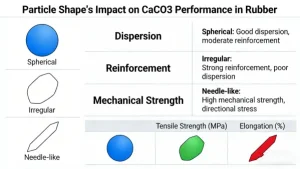
The particle shape of calcium carbonate (CaCO₃) is a critical, shape-specific factor that dictates its performance in rubber compounds. It primarily modifies the filler’saspect ratio(anisotropy), specific surface area, dispersion behavior, filler-filler network formation, stress transfer efficiency, and interfacial interaction with the rubber matrix. These changes directly impact the mechanical properties, processability, dynamic performance, and durability of final rubber products. Below is a detailed breakdown of how common CaCO₃ particle shapes influence rubber performance:
1. Isometric (Low Anisotropy) Particles
Particles with nearly equal dimensions in all three axes (aspect ratio ≈ 1) deliver balanced processability and moderate-to-good reinforcement, with minimal performance anisotropy.
Cubic CaCO₃
-
Core characteristics: Typically calcite-type precipitated CaCO₃ (PCC), with uniform cubic crystal structure, moderate specific surface area, and evenly distributed surface active sites.
-
Performance impacts:
-
Reinforcement: Provides reliable semi-reinforcing effects, evenly improving tensile strength and 300% modulus. Its regular structure minimizes stress concentration, with far less sacrifice to elongation at break than irregular or high-aspect-ratio fillers.
-
Processability: Excellent dispersibility and low structural viscosity. It does not form strong filler-filler networks, so it only slightly increases compound Mooney viscosity, ensuring stable mixing flow and consistent curing behavior.
-
Other benefits: Improves dimensional stability and surface smoothness of rubber products, reducing molding shrinkage.
-
-
Typical applications: General rubber goods, tire cord compounds, seals, and light-colored rubber products.
Spherical CaCO₃
-
Core characteristics: Typically vaterite-type PCC, with submicron/nano-scale perfectly spherical structure, high specific surface area, and minimal anisotropy.
-
Performance impacts:
-
Reinforcement: At the same particle size, it delivers superior tensile strength and toughness compared to cubic and chain-shaped CaCO₃. Its high specific surface area creates more contact sites with rubber molecules, enhancing interfacial adhesion; the spherical structure also blunts crack tips and inhibits crack propagation, boosting tear resistance.
-
Processability: Optimal flowability, with a unique “ball bearing effect” that significantly reduces compound viscosity and mixing energy consumption. It maintains excellent processability even at high filler loadings, with the weakest Payne effect (lowest filler network formation) and minimal dynamic heat build-up.
-
Other benefits: Delivers exceptional surface gloss, scratch resistance, and dimensional consistency of finished products.
-
-
Typical applications: High-end light-colored rubber goods, precision seals, low-heat-build rubber components, and latex products.
Spindle/Ellipsoidal CaCO₃
-
Core characteristics: The most common industrial PCC morphology, with a short ellipsoidal structure (aspect ratio ≈ 3–5), higher specific surface area than cubic CaCO₃, and a rough surface.
-
Performance impacts:
-
Reinforcement: Better reinforcing effect than cubic PCC. Its moderate aspect ratio improves stress transfer efficiency, enhancing modulus, tear strength, and abrasion resistance while retaining good elongation.
-
Processability: Well-balanced dispersibility and compound viscosity, offering an optimal trade-off between processability and reinforcement with high cost-effectiveness.
-
-
Typical applications: Tire sidewalls, conveyor belts, hoses, shoe soles, and other general semi-reinforcing rubber products (the most widely used PCC morphology in the rubber industry).
2. High Aspect Ratio (High Anisotropy) Particles
Particles with one or two dimensions significantly smaller than the others (aspect ratio >10) deliver exceptional reinforcement and rigidity, but with higher processing difficulty and anisotropic performance.
Acicular/Needle/Fibrous CaCO₃ (Whiskers)
-
Core characteristics: Aragonite-type single-crystal CaCO₃ whiskers, with an ultra-high aspect ratio (≈10–30), length of 20–80 μm, diameter of 0.5–2 μm, and high intrinsic mechanical strength.
-
Performance impacts:
-
Reinforcement: The strongest reinforcing effect among all CaCO₃ morphologies, approaching the performance of semi-reinforcing carbon black. Its fibrous structure forms a continuous mechanical skeleton in the rubber matrix, drastically increasing tensile strength, modulus, tear strength, and flexural rigidity. It also bridges cracks to prevent propagation, greatly improving fatigue resistance and abrasion performance, especially under dynamic friction conditions.
-
Processability: Higher processing difficulty. High aspect ratio leads to particle entanglement and strong filler network formation, which significantly increases Mooney viscosity, raises mixing energy consumption, and reduces flowability. Surface modification (e.g., silane coupling agents, stearic acid) is required to improve dispersion and rubber compatibility.
-
Other benefits: Remarkably improves heat resistance, dimensional stability, and creep resistance, reducing thermal shrinkage of finished products.
-
-
Typical applications: High-end wear-resistant rubber products, brake friction materials, conveyor belt cover compounds, tire treads, and high-impact rubber components.
Chain-like CaCO₃
-
Core characteristics: Aggregates of nano-scale cubic CaCO₃ particles linked in a chain structure, with an aspect ratio of ≈5–20, similar to the aggregate structure of carbon black.
-
Performance impacts:
-
Reinforcement: Good reinforcing effect. Its chain structure forms a three-dimensional penetrating filler network, significantly increasing compound modulus and hardness, with excellent creep resistance; however, it causes a more pronounced drop in elongation at break than isometric particles.
-
Processability: Strong Payne effect and high filler-filler interaction lead to high compound viscosity, difficult dispersion, and easy agglomeration, requiring strict surface modification and mixing processes. Its high surface activity can slightly accelerate the curing rate.
-
-
Typical applications: High-hardness rubber products, sealing gaskets, and damping rubber materials.
3. Platelet/Flake CaCO₃
-
Core characteristics: Two-dimensional flake structure with nano-scale thickness, micron-scale lateral dimensions, and an ultra-high planar aspect ratio (≈10–50).
-
Performance impacts:
-
Reinforcement: Moderate reinforcing effect. Its “laminated” structure in the rubber matrix significantly improves barrier properties (gas/liquid impermeability), while also increasing modulus, hardness, and tear resistance. The planar structure effectively disperses stress, enhancing scratch and abrasion resistance.
-
Processability: Prone to orientation along the flow direction during extrusion/calendering, resulting in anisotropic mechanical properties (lower transverse strength than longitudinal strength). Moderate dispersion difficulty, with higher compound viscosity than isometric particles, requiring surface modification to improve wettability with rubber.
-
Other benefits: Excellent weathering and UV aging resistance, as the laminated structure blocks UV radiation and moisture penetration, extending product service life.
-
-
Typical applications: Rubber seals, waterproof membranes, weather-resistant rubber products, and anti-corrosion hoses.
4. Irregular/Angular CaCO₃
-
Core characteristics: Ground calcium carbonate (GCC), produced by grinding natural limestone, with irregular broken angular structure, wide particle size distribution, low specific surface area, and smooth but sharp-edged surfaces.
-
Performance impacts
-
Reinforcement: Primarily used as an incremental filler, with negligible reinforcing effect. Sharp edges create severe stress concentration, acting as crack initiation points, which often reduce the tensile strength, elongation, and fatigue resistance of rubber compounds.
-
Processability: Excellent flowability and ultra-low oil absorption. It has minimal impact on compound viscosity, maintains good processability even at ultra-high loadings (100–250 phr), and disperses quickly during mixing, with an overwhelming cost advantage.
-
Other drawbacks: Poor surface finish and high molding shrinkage of finished products, with limited dimensional stability.
-
Typical applications: Low-cost filled rubber goods, rubber floor tiles, gaskets, non-load-bearing structural parts, or blended with reinforcing PCC to balance cost and performance.
Key Rules for Shape Selection
-
Aspect ratiois the dominant factor: Modulus, hardness, and stiffness increase with rising aspect ratio, while processability and elongation at break generally decrease.
-
Dispersionis prerequisite for reinforcement: High-aspect-ratio and nano-scale CaCO₃ require surface modification to achieve good dispersion; otherwise, agglomeration will degrade rather than improve rubber performance.
-
Stress concentration control: Regular, smooth shapes (spherical, cubic) minimize stress concentration and preserve toughness, while sharp irregular shapes increase defect risks.
-
Application-specific matching:
- For high-performance reinforcement: Prioritize acicular CaCO₃ whiskers or modified nano spherical CaCO₃.
- For balanced processability and cost: Choose spindle or cubic PCC.
- For high-fill, low-cost formulations: Use irregular GCC, often blended with reinforcing PCC.
- For barrier/weathering resistance: Select platelet CaCO₃.
- For low dynamic heat build-up and high surface finish: Opt for spherical CaCO₃.