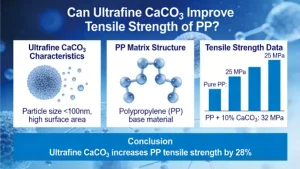
surface-modified ultrafine calcium carbonate (CaCO₃, including both nano-sized grades and high-grade micronized ground calcium carbonate/GCC) can effectively improve the tensile strength of polypropylene (PP) under optimized formulation, surface treatment, and processing conditions. Unmodified, poorly dispersed, or coarse CaCO₃ typically reduces tensile strength instead.
1. Core Strengthening Mechanisms
The tensile strength improvement of PP by ultrafine CaCO₃ relies on three key effects, which only work when the filler is properly treated and dispersed:
-
Heterogeneous Nucleation: Ultrafine CaCO₃ acts as an efficient nucleating agent for semi-crystalline PP, refining spherulite size, increasing crystallinity, and improving crystal uniformity, which directly enhances the tensile strength and rigidity of the PP matrix.
-
Strong Interfacial Adhesion: Surface modification eliminates the polarity mismatch between hydrophilic CaCO₃ and hydrophobic PP, creating a tight filler-matrix bond. This enables effective stress transfer from the PP matrix to rigid CaCO₃ particles under tensile load, avoiding stress concentration at particle interfaces.
-
Molecular Chain Confinement: Well-dispersed ultrafine CaCO₃ particles restrict the movement of PP molecular chains, improving the yield strength and tensile modulus of the composite, while also enhancing dimensional stability.
2. Critical Factors Determining Tensile Performance
| Factor | Requirement for Tensile Strength Improvement |
|
ParticleSize
|
Nano-sized CaCO₃ (20–100 nm) delivers the most significant enhancement; high-grade ultrafine GCC (D97 ≤ 2 μm, the same grade as paper coating top-coat GCC) also provides measurable improvement after modification. Coarse CaCO₃ (D97 > 5 μm) will reduce tensile strength due to severe stress concentration. |
|
表面改質
|
Mandatory prerequisite. Unmodified ultrafine CaCO₃ is prone to agglomeration, causing interfacial defects and reduced tensile strength even at low loadings. Effective industrial modifiers include PP-g-MAH (maleic anhydride-grafted PP, most widely used), stearate, titanate/aluminate coupling agents, and silane coupling agents.
|
|
Filler Loading
|
Optimal range:5–20 wt%, where tensile strength reaches its peak. Loadings above 30 wt% cause significant particle agglomeration and interfacial defects, leading to a sharp drop in tensile strength (often below that of neat PP).
|
|
DispersionQuality
|
Uniform dispersion via twin-screw extrusion (optimized screw configuration, temperature, and rotation speed) is essential. Poor dispersion will negate any potential strength improvement, even with modified fillers. |
3. Typical Industrial Performance Data
- Neat homo-PP has a baseline tensile strength of 30–35 MPa.
-
With 10–15 wt% properly modified nano-CaCO₃: Tensile strength increases by10–25%(up to 33–43 MPa), paired with a 30–50% increase in tensile modulus.
-
With 10 wt% modified ultrafine GCC (D97 ≤ 2 μm): Tensile strength increases by5–15%, delivering an excellent cost-performance balance for large-scale production.
- With synergistic addition of nucleating agents and modified CaCO₃: Tensile strength can be increased by up to 30% vs. neat PP, with further improved rigidity and heat resistance.
4. Key Supplementary Notes
-
Synergistic Modification: When compounded with elastomers (e.g., POE, EPDM), ultrafine CaCO₃ offsets the tensile strength loss caused by elastomer toughening, achieving simultaneous improvement of tensile strength and impact toughness — a formula widely used in automotive and home appliance PP composites.
-
Limitations: While tensile strength and modulus are improved, the elongation at break of PP generally decreases with increasing CaCO₃ loading, except for specially designed core-shell modified CaCO₃ grades.
-
Industrial Application: Modified ultrafine CaCO₃-filled PP is widely used in automotive interior parts, household appliance shells, and packaging materials, balancing mechanical performance, cost reduction, and processing stability.