Industrial-Proven Mill Types for Dual-Fineness Production
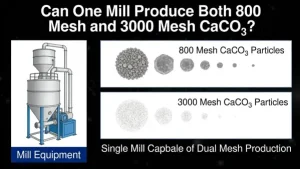
These mill types are widely used in the CaCO₃ industry and can flexibly switch between 800 mesh and 3000 mesh production via parameter adjustment:
-
Ultrafine Ring Roller Mill (Pendulum Mill)
This is the most cost-effective and widely adopted solution for this application. Models like the GKH3000X are explicitly designed for a fineness range of 800~3000 mesh for CaCO₃ processing, with a production capacity of 1~7 t/h depending on the target fineness. HGM series ultrafine ring roller mills also support adjustable fineness from 325 mesh up to 3000 mesh, equipped with a variable-frequency high-precision turbine classifier (the core component for fineness control). By tuning the classifier rotor speed, air volume, and grinding pressure, operators can seamlessly switch between 800 mesh and 3000 mesh production, making it ideal for small-to-medium GCC plants with diverse order requirements.
-
Ultrafine Vertical Roller Mill (VRM)
HLMX series ultrafine vertical mills support a finished particle size range of 3~22μm (corresponding to ~600~4000 mesh), fully covering 800 and 3000 mesh CaCO₃ production. These mills offer higher throughput for large-scale production, with adjustable grinding pressure, air flow, and dynamic separator speed to switch between fineness levels, and feature better energy efficiency than traditional ball mills for ultrafine grinding.
-
Closed-Circuit Ball Mill with High-Precision Air Classifiers
A ball mill paired with multi-stage variable-frequency air classifiers can also produce both 800 and 3000 mesh CaCO₃, with a controllable particle size range of 5~45μm. This configuration excels at large-scale, continuous production, and can manufacture multiple product grades by adjusting classifier rotor speed. However, it has higher energy consumption than ring roller mills for 3000 mesh ultrafine production.
-
Wet Stirred Bead Mill (Sand Mill)
For wet-process CaCO₃ production, stirred bead mills deliver an extremely narrow particle size distribution and can flexibly produce 800 mesh to 3000 mesh (and finer) products by adjusting grinding media size, agitator speed, and slurry residence time. This is the preferred solution for high-end applications with strict particle size requirements, such as coatings, inks, and pharmaceutical-grade CaCO₃.
Non-Feasible Mill Types
Standard coarse grinding equipment cannot reliably produce both fineness levels, including:
- Conventional Raymond mills: Maximum stable fineness is typically 400~600 mesh, and cannot achieve consistent 3000 mesh ultrafine powder production.
- Open-circuit ball mills without precision classification systems: Cannot control particle size accurately enough for 3000 mesh CaCO₃, resulting in an extremely wide particle size distribution and high energy waste.
- Hammer/impact mills: Only suitable for coarse powder up to 200~400 mesh, with no ability to produce ultrafine grades.
Critical Operational & Technical Considerations
-
Classification System is the Core Determinant
The final fineness of CaCO₃ powder is primarily controlled by the classifier, not the grinding mill itself. Stable 3000 mesh production requires a high-speed, variable-frequency turbine classifier with high separation precision to effectively cut off coarse particles and ensure strict compliance with d97≈5μm specifications. For 800 mesh production, the classifier operates at a lower rotor speed with looser separation parameters.
-
SignificantCapacityTrade-off
For the same mill system, the output of 3000 mesh CaCO₃ will be drastically lower than 800 mesh. For example, a mill that produces 7 t/h of 800 mesh CaCO₃ may only yield 1~2 t/h of 3000 mesh product. This is due to the longer grinding time required, higher recirculation ratio of under-ground material, and stricter classification limits for ultrafine powder.
-
Auxiliary SystemCompatibility
- Air handling system: Adjustable air volume and pressure are mandatory, as 3000 mesh ultrafine powder requires lower air velocity for effective pneumatic transport and separation.
- Dust collection: A high-efficiency pulse bag filter with ultra-fine filtration capacity is required to capture 3000 mesh powder, preventing product loss and environmental emissions.
- Wear resistance: Grinding components (rollers, rings, liners, grinding media) must use high-wear-resistant alloy materials, as ultrafine grinding significantly accelerates component wear.
-
Production Mode
In most industrial practice, the mill switches between 800 mesh and 3000 mesh production via batch parameter adjustment, rather than simultaneous online production of both grades. Simultaneous production is technically possible with a multi-stage split classification system, but this requires more complex equipment configuration and is rarely used in commercial CaCO₃ processing.
Industrial Practice Note
For small and medium-sized GCC plants with diverse, small-batch orders, single-mill multi-fineness production using an ultrafine ring roller mill is a standard, cost-effective solution. For large-scale, high-volume production, dedicated mills for each fineness level are preferred to maximize production efficiency and batch consistency, even though the technical feasibility of a single mill is well-proven in the industry.