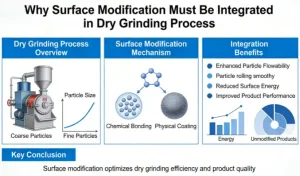
Surface modification is not a secondary post-processing step but a core, integrated operation in the dry grinding of calcium carbonate (CaCO₃) and other non-metallic minerals—its integration is driven by the intrinsic technical limitations of dry grinding, the performance requirements of industrial applications, and economic efficiency of production. Below is a systematic analysis of the essential reasons for this integration, combined with the material characteristics and grinding mechanics of CaCO₃:
Eliminates Surface Adhesion and Agglomeration Caused by Dry Grinding
Dry grinding relies on mechanical forces (impact, shear, extrusion) to reduce CaCO₃ particle size, but this process generates two critical problems that directly limit grinding efficiency and product quality:
Mechanical activation ofparticlesurfaces: Fine grinding breaks the ionic bonds of CaCO₃ crystals, exposing a large number of unsaturated bonds, free electrons, and active functional groups on the particle surface. These active sites make fine CaCO₃ particles highly prone to van der Waals force and electrostatic adhesion.
Particleagglomeration (secondary aggregation): For ultrafine CaCO₃ (D97 < 5 μm), the specific surface area increases exponentially with reduced particle size. Adhered fine particles form hard agglomerates that cannot be dispersed by mechanical grinding alone, leading to a “grinding limit”—continuing to grind only consumes energy without further reducing particle size, and even causes over-grinding of coarse particles.
Integration of surface modification solves this problem: Modifiers (e.g., stearic acid, titanate coupling agents) are added during grinding to quickly adsorb on the newly generated active surfaces of CaCO₃ particles, forming a monomolecular or multimolecular hydrophobic protective layer. This layer blocks the active sites, neutralizes surface charges, and reduces interparticle attraction—effectively preventing agglomeration and ensuring that the ground fine particles remain in a dispersed state, breaking the “grinding limit” and realizing efficient preparation of ultrafine CaCO₃.
Improves Grinding Efficiency and Reduces Energy Consumption
Dry grinding of CaCO₃ is a high-energy-consumption process (the energy efficiency of mechanical grinding is only 1%–5%, with most energy converted into heat and mechanical loss). Integrating surface modification directly optimizes the grinding kinetics and reduces energy waste:
Lubrication effect between particles: Organic modifiers with long hydrocarbon chains act as a “lubricant” between CaCO₃ particles and between particles and grinding media (steel balls, ceramic beads). This reduces friction and adhesion between the grinding medium and materials, as well as between particles, making the mechanical force of grinding more effectively act on particle fragmentation rather than useless friction.
Promotesparticlefragmentation: Dispersed fine particles do not cover the surface of coarse particles, ensuring that the grinding medium can fully contact and impact coarse particles, accelerating the grinding process.
Shortens grinding time: The elimination of agglomeration and improvement of grinding efficiency mean that the target particle size can be achieved in a shorter time. Industrial practice shows that integrating surface modification in dry grinding of CaCO₃ can reduce energy consumption by 20%–40% and increase production capacity by 15%–30% compared with post-grinding modification.
In addition, the heat generated by dry grinding can promote the chemical reaction between the modifier and the CaCO₃ surface (e.g., the esterification reaction between stearic acid and the hydroxyl groups on the CaCO₃ surface), improving the modification efficiency and reducing the amount of modifier used.
Realizes “One-Step Production” and Optimizes the Industrial Production Process
Post-grinding surface modification (separate grinding then modification) has obvious technical and process defects for dry-process CaCO₃ production:
Re-agglomeration in the transfer process: Ground fine CaCO₃ particles are easy to re-agglomerate during transportation, storage, and feeding into the modification equipment, resulting in poor modification effect (the modifier cannot fully contact the primary particles).
Increased process links and costs: Additional modification equipment (e.g., high-speed mixer), conveying systems, and labor are required, which increases investment in fixed assets, floor space, and production and operation costs.
Secondary pollution risk: Multiple material transfers increase the risk of introducing impurities (e.g., dust, metal scraps), affecting the purity of CaCO₃ products (especially for high-end applications such as plastics, papermaking, and coatings).
Integrated grinding and modification realizes a one-step production process of “grinding + modification + dispersion” in a single grinding equipment (e.g., vertical mill, airflow mill, mechanical impact mill with modification function). The entire process is completed in a closed system, which not only eliminates the re-agglomeration and pollution in the transfer process but also simplifies the process flow, reduces equipment investment and operation costs, and improves the continuity and automation of production—this is the core reason for its industrialization promotion.
Ensures the Interface Compatibility of CaCO₃ with Organic Matrices
The primary application of modified CaCO₃ is as a functional filler in organic systems (plastics, rubber, coatings, adhesives, etc.). Unmodified CaCO₃ has a hydrophilic and oleophobic surface (due to the polar hydroxyl groups on the surface), which leads to poor compatibility with non-polar or low-polar organic matrices:
The interface between CaCO₃ and the organic matrix has high tension, leading to poor bonding;
CaCO₃ particles are easy to agglomerate in the matrix, forming stress concentration points, which reduce the mechanical properties (tensile strength, impact strength) of the composite material;
The dispersion of CaCO₃ in the matrix is poor, affecting the processing performance (melt flowability) and appearance quality (gloss, flatness) of the product.
In-situ surface modification during dry grinding achieves molecular-level bonding between the modifier and the CaCO₃ surface: the polar group of the modifier (e.g., carboxyl group, hydroxyl group) reacts with the active sites on the CaCO₃ surface to form a stable chemical bond, while the non-polar group (hydrocarbon chain) is oriented toward the outside, converting the CaCO₃ surface from hydrophilic to lipophilic/hydrophobic. This modified surface matches the polarity of the organic matrix, significantly improving the interface compatibility, dispersion, and bonding force between CaCO₃ and the matrix—ensuring that the CaCO₃ filler can exert the dual effects of cost reduction and performance enhancement in the product, which is the fundamental requirement for its industrial application.
Enhances the Comprehensive Performance and Added Value of CaCO₃ Products
Different industrial fields have personalized performance requirements for CaCO₃ fillers (e.g., oil absorption value, whiteness, dispersibility, compatibility with specific resins). Integrating surface modification in the dry grinding process can customize the surface properties of CaCO₃ according to application needs, and at the same time protect the inherent properties of CaCO₃ from damage during grinding:
Reduction of oil absorption value: The protective layer formed by the modifier on the CaCO₃ surface fills the micropores and gaps of the particles, reducing the oil absorption value of the product—this is crucial for coatings (reducing resin consumption) and plastics (improving processing fluidity).
Protection ofwhiteness: Dry grinding generates heat and mechanical stress, which may cause slight yellowing of CaCO₃ (due to surface carbonization or impurity activation). The modifier forms a protective layer in time to isolate the active surface from air and grinding media, avoiding secondary pollution and thermal damage, and maintaining the high whiteness of CaCO₃.
Customization of surface properties: By selecting different types of modifiers (stearic acid for general plastics, titanate coupling agents for engineering plastics, silane coupling agents for coatings), the surface properties of CaCO₃ can be tailored to the needs of different downstream industries, realizing the transformation of CaCO₃ from ordinary filler to functional filler and significantly increasing the product added value (the price of modified ultrafine CaCO₃ is 2–5 times that of unmodified coarse powder).
Adapts to the Environmental and Technical Requirements of Modern Dry Processing
Compared with wet grinding, dry grinding of CaCO₃ has the advantages of no wastewater discharge, low water and energy consumption for drying, and suitable for large-scale continuous production—this is the main development direction of CaCO₃ processing under the background of green manufacturing. However, dry grinding’s inherent defects (agglomeration, low efficiency) can only be solved by integrating surface modification:
Green production: The integrated process is completed in a closed system, which reduces dust emission and modifier volatilization, meeting the environmental protection requirements of industrial production; the dosage of modifiers is reduced (10%–20% less than post-modification) due to in-situ reaction, reducing raw material waste.
Adaptation to ultrafine grinding trends: With the downstream industries (e.g., new energy plastics, high-grade coatings) increasing demand for ultrafine CaCO₃ (D50 < 2 μm), dry grinding without surface modification cannot prepare qualified ultrafine products—only the integrated process can realize the industrial production of dry-process ultrafine modified CaCO₃.
For the dry grinding of calcium carbonate, surface modification is not an optional “optimization step” but a technically necessary and economically indispensable integrated operation. Its core value lies in solving the intrinsic defects of dry grinding (agglomeration, low efficiency, high energy consumption), realizing the one-step preparation of high-performance modified CaCO₃, and matching the performance requirements of downstream organic systems. At the same time, the integrated process optimizes the production flow, reduces costs, improves product added value, and adapts to the development trends of green manufacturing and ultrafine powder processing in the non-metallic mineral industry.
In summary, the integration of surface modification and dry grinding is a fundamental technical innovation in the CaCO₃ processing industry—it links the particle size reduction and surface functionalization of CaCO₃, realizing the unification of grinding efficiency, product quality, and industrial benefits.
Professional Supplementary Note
The key to the integrated process is the timing and dosage of modifier addition (generally added when the CaCO₃ particle size reaches 10–20 μm, the active surface is fully exposed) and the matching of grinding equipment and modification process (vertical mills, mechanical impact mills, and airflow mills are the main equipment for integrated dry grinding and modification of CaCO₃, with different adaptabilities for coarse, fine, and ultrafine powder production).