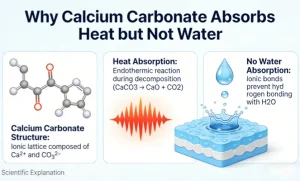
The fact that calcium carbonate absorbs heat is determined by its thermodynamic characteristics and chemical change rules, while its almost non-absorbent property to water is governed by its physical structure and chemical properties. The principles behind these two phenomena belong to different categories, and the specific explanations are as follows:
I. Reasons Why Calcium Carbonate Absorbs Heat
The heat absorption behavior of calcium carbonate mainly occurs during thermal decomposition or phase transition processes, and its core lies in the thermodynamic nature of endothermic reactions/processes:
1. Endothermic Characteristic of Thermal Decomposition
Calcium carbonate decomposes at high temperatures (about 825℃) to produce calcium oxide and carbon dioxide:

The enthalpy change (ΔH) of this reaction is positive, which means the reaction must absorb a large amount of heat from the outside to proceed. The reason is that breaking the stable ionic bonds (the interaction between Ca²⁺ and CO₃²⁻) in the calcium carbonate crystal requires energy consumption.
2. Heat Absorption in Physical Processes
Even without chemical decomposition, when calcium carbonate is heated, the particles (ions) inside its crystal move more vigorously, and it will also absorb heat from the environment, showing physical heat absorption (such as temperature rise and thermal expansion). However, the magnitude of this heat absorption is much smaller than that of heat absorption in chemical decomposition.
II. Reasons Why Calcium Carbonate Hardly Absorbs Water
Calcium carbonate is a typical substance that is insoluble in water and non-hygroscopic, mainly due to two aspects:
1. Chemical Aspect: Poor Solubility and No Hydration Reaction
Calcium carbonate has extremely low solubility, with a solubility of only about 0.0014g per 100mL of water at 20℃, so the dissolution process is almost negligible.
It does not undergo hydration reaction with water (i.e., it cannot form hydrated ions or hydrate crystals). Salts that are easy to absorb water, such as calcium chloride and magnesium sulfate, can combine with water molecules to form stable hydrates. However, calcium carbonate has high ionic bond strength, so water molecules cannot effectively destroy its crystal structure, nor can they form stable hydrated structures with Ca²⁺ and CO₃²⁻.
2. Physical Aspect: No Pores or Adsorption Structure
Natural calcium carbonate (such as calcite and marble) or industrial light calcium carbonate, if not subjected to special porous treatment, has a dense crystal structure and no micropores or surface active sites that can adsorb water molecules, so it cannot retain water through physical adsorption like activated carbon or silica gel.
Supplementary Note
It should be noted that although calcium carbonate does not absorb water, it can react with acidic aqueous solutions (such as hydrochloric acid and acetic acid) to produce soluble calcium salts, water and carbon dioxide. This process is completely different from “water absorption”.