Intensive grinding (ultrafine / high-energy grinding) of calcium carbonate (CaCO₃, mainly calcite) converts a large amount of mechanical energy into heat and causes strong mechanochemical effects. Below are its thermal behaviors, structural changes, and practical impacts.
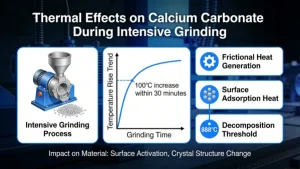
1. How Heat Is Generated
During high-speed stirring, impact, shear and compression:
- Mechanical work → friction + collision → bulk temperature rise
- New surfaces are created → surface energy increases
- Lattice deformation → stored strain energy
In dry grinding, temperature can easily rise to 60–120 °C;
In wet grinding, slurry temperature is lower (usually 40–70 °C) due to water cooling, but still significant.
2. Main Thermal & Mechanochemical Effects
(1) Lattice distortion & amorphization
Heat + mechanical stress causes:
- Crystal lattice distortion, defects, and strain
- Partial transformation from crystalline calcite to amorphous CaCO₃
- Increased surface activity and reactivity
(2) No thermal decomposition (important)
Pure CaCO₃ thermally decomposes at ~825 °C:
CaCO₃ → CaO + CO₂
Grinding temperature never reaches this level, so no CaO formation during normal grinding.
(3) Surface property changes
- Higher specific surface area & surface energy
- More surface hydroxyl groups (–OH)
- Stronger adsorption, easier dispersion or agglomeration
(4) Particle morphology evolution
Heat softens the surface slightly;
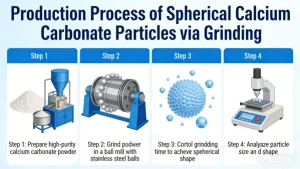
With attrition-dominated grinding, particles become rounder / more spherical (as you asked earlier).
3. Undesirable Side Effects of Overheating
- Severe agglomeration (especially dry grinding)
- Accelerated wear of grinding media & lining
- Dispersants / grinding aids may volatilize or degrade
- Slight drop in whiteness if impurities oxidize
- Higher energy consumption
4. How to Control Thermal Effect
- Use wet grinding for better cooling
- Equip mill with jacket cooling / chilled water
- Optimize speed, filling ratio, and grinding time
- Use heat-stable dispersants