The crushing and grinding process for calcium carbonate (CaCO₃) varies depending on the raw material type—ground calcium carbonate (GCC) or precipitated calcium carbonate (PCC)—the target fineness (standard, ultrafine, or nano-grade), and the end-use application (e.g., plastics, coatings, paper, rubber, food, or pharmaceuticals). Below is a detailed description of the typical dry ultrafine grinding process for ground calcium carbonate (GCC), which represents the most common industrial approach.
Typical Dry Ultrafine Grinding Process for Ground Calcium Carbonate (GCC)
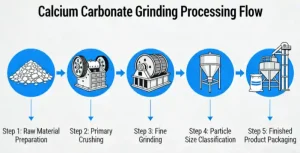
Step 1: RawOre Mining and Primary Selection
High-purity limestone or calcite ore (CaCO₃ content ≥95%) is mined.
Crushed to ≤100 mm and impurities (e.g., clay, dirt) are removed.
Step 2: Crushing (Primary+Secondary)
Jaw crusher: Reduces large rocks to ≤30–50 mm.
Hammercrusher / Impactcrusher: Further crushes material to ≤5–10 mm.
Purpose: Prepare feedstock with suitable particle size for grinding.
Step 3: Drying (if moisture >1%)
If the ore is damp (e.g., during rainy seasons), it is dried using a rotary dryer or pneumatic dryer to reduce moisture to ≤0.5%, preventing mill clogging and ensuring efficient classification.
Step 4: Main Grinding (Core Step)
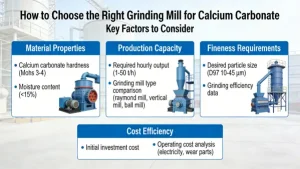
Equipment selection depends on the desired fineness:
| Target Fineness (D97) | Recommended Mill Type | Characteristics |
| 10–45 μm | Raymond mill, roller pendulum mill | Low cost, high capacity |
| 5–15 μm | Ultrafine ring roller mill (e.g., HCH series) | Moderate energy use, good particle shape |
| 1–10 μm | Jet mill (flat or fluidized bed type) | High purity, contamination-free, high energy consumption |
| <1 μm (nano-grade) | Wet grinding + surface modification + drying | Typically used for PCC or premium GCC |
Note: Over 80% of ultrafine GCC today is produced via dry one-pass grinding with integrated classification.
Step 5: Classification (Critical Control Point)
A turbine-type ultrafineclassifier (integrated or standalone) precisely controls particle size distribution (e.g., D97 = 5 μm or 10 μm).
Coarse particles are returned to the mill for regrinding, forming a closed-circuit system.
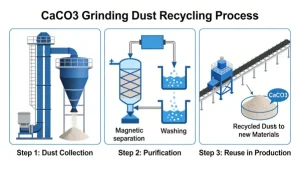
Step 6: Dust Collection and Emission Control
Qualified fine powder is collected by a pulse-jet bagfilter or a cyclone + bag filter system.
Exhaust gas is filtered to meet emission standards (dust concentration <10 mg/m³).
Step 7: Surface Modification (Optional, Application-Dependent)
Required for hydrophobic applications (e.g., plastics, rubber):
Modifiers: Stearic acid, titanates, silanes, etc.
Equipment: Continuous dry surface modifier (operating at 100–120°C for 5–15 minutes).
Benefits: Improved dispersion, compatibility, and filler loading.
Step 8: Packaging and Storage
Automated weighing and packaging in valve bags or bulk sacks (e.g., 25 kg or 1-ton bags).
Finished products are stored separately based on fineness, brightness, and activation level.
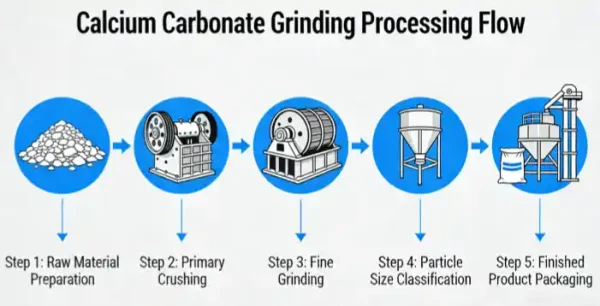
Brief Comparison: Precipitated Calcium Carbonate (PCC) Production
PCC is synthesized chemically and does not involve mechanical grinding (except for deagglomeration if needed). The main steps are:
Calcination: Limestone → CaO + CO₂
Slaking: CaO + H₂O → Ca(OH)₂
Carbonation: Ca(OH)₂ + CO₂ → CaCO₃↓ (precipitation)
Filtration → Drying → (Optional milling) → Surface treatment
PCC offers finer particle size (0.02–5 μm), controllable morphology (cubic, spindle, chain-like), but higher production cost than GCC.
Simplified Flow Diagram of a Typical Dry Ultrafine GCC Line (Text Format)
Raw ore → Jaw crusher → Hammer crusher → Bucket elevator → Silo ↓ Dryer (if needed) ↓ Ultrafine mill (e.g., ring roller mill or jet mill) ↓ Turbine classifier (closed-circuit loop) ↓ Cyclone collector + Pulse-jet bag filter ↓ Finished product silo → Surface modifier (optional) → Packaging
Key Process Control Parameters
| Parameter | Typical Range / Requirement |
| CaCO₃ content in ore | ≥95% (≥98% for high-end uses) |
| Brightness (whiteness) | ≥92% ISO (higher for paper/coatings) |
| Moisture content | ≤0.3% (for dry process) |
| Fe₂O₃ content | ≤0.1% (to avoid yellowing) |
| D97 | 2–45 μm (application-dependent) |
| Specific surface area | 1–20 m²/g |
Summary
Standard GCC (≤400 mesh / D97 ≈ 38 μm): Raymond mill suffices—simple and economical.
Ultrafine GCC (600–2500 mesh / D97 ≈ 5–20 μm): Ring roller mill +classifier is the mainstream choice, balancing efficiency and cost.
Premium ultrafine/high-purity GCC (≥3000 mesh / D97 ≤ 5 μm): Jet mill is preferred for contamination-free, well-shaped particles.
Surface modification is essential for polymer applications (e.g., PVC pipes, cables) but optional for paper or construction fillers.
If you have a specific application in mind—such as PVC pipe manufacturing, lithium battery separator coating, toothpaste, or food additives—I can provide a tailored recommendation for the optimal process route and equipment configuration.