1. Ball Mill
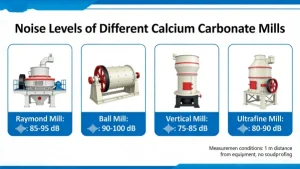
- Noise Level: 95-120 dB(A)
- This is one of the loudest industrial grinding equipment
- The noise is primarily generated from:
- Steel balls impacting the mill liner
- Motor and transmission system
- Material impact during grinding
- Requires significant noise control measures (sound enclosures, vibration isolation, etc.)
2. Vertical Roller Mill / Vertical Mill
- Noise Level: Below 85 dB
- Significantly quieter than ball mills
- Features:
- Fully enclosed system reduces dust leakage and noise
- 30-50% more energy efficient than ball mills
- Better environmental performance
- Considered a low-noise, environmentally friendly option
3. Raymond Mill
- Noise Level: Approximately 85-95 dB
- Moderate noise level between ball mills and vertical mills
- Features:
- More efficient than ball mills
- Lower power consumption
- Smaller footprint
- Cleaner operating environment with less dust
4. Ultrafine Grinding Mill
- Noise Level: Varies by design (typically 80-95 dB)
- Includes various types like:
- Ring roller mills
- Centrifugal ultrafine mills
- Generally designed with better noise control features
5. High-Pressure Suspension Mill
- Noise Level: Approximately 85-90 dB
- Improved design over traditional Raymond mills
- Better sealing reduces both dust and noise emissions
Noise Control Standards & Recommendations
| Mill Type | Typical Noise Level | Environmental Rating |
|---|---|---|
| Ball Mill | 95-120 dB | Poor (requires noise control) |
| Raymond Mill | 85-95 dB | Moderate |
| Vertical Mill | <85 dB | Good |
| Ultrafine Mill | 80-95 dB | Good to Moderate |
Important Notes:
-
Occupational Health Standard: Most countries require workplace noise levels to be below 85 dB for 8-hour exposure without hearing protection
-
Noise Control Measures for high-noise equipment:
- Sound enclosures
- Sound isolation rooms
- Vibration damping materials
- Regular maintenance to reduce mechanical noise
-
Selection Recommendation: For calcium carbonate processing where noise is a concern, vertical roller mills are generally preferred due to their lower noise levels (<85 dB), better energy efficiency, and superior environmental performance.