The hardness of raw materials—such as marble versus limestone—significantly influences mill selection in mineral processing and industrial grinding applications. Here’s a detailed comparison of how this difference impacts equipment choice:
1. Hardness Comparison
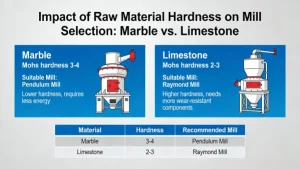
- Limestone: Typically has a Mohs hardness of 3–4. It is relatively soft and easy to grind.
- Marble: Also primarily composed of calcite (CaCO₃), but due to recrystallization during metamorphism, it can be slightly denser and sometimes exhibit a Mohs hardness up to 4–5, depending on impurities and crystalline structure.
Although both are carbonate rocks, marble is generally slightly harder and more abrasive than typical sedimentary limestone.
2. Impact on Mill Selection
A. Energy Consumption
- Harder materials like marble require more energy to achieve the same fineness compared to limestone.
- Mills must be selected with sufficient power capacity; underpowered mills will suffer from low throughput or inability to reach target particle size.
B. Wear and Maintenance
- Marble’s increased abrasiveness accelerates wear on grinding media, liners, and internal components.
- This favors mills with wear-resistant materials or designs that minimize direct impact wear (e.g., vertical roller mills over ball mills in some cases).
C. Grinding Efficiency & Fineness Requirements
- For ultrafine grinding (e.g., <10 µm for fillers or coatings), the slight hardness difference can affect grinding kinetics.
- Softer limestone may be efficiently processed in hammer mills or Raymond mills, while marble might require ball mills, stirred media mills, or high-pressure grinding rolls (HPGR) for consistent fineness.
D. Mill Type Suitability
| Mill Type | Limestone (Soft) | Marble (Slightly Harder) |
|---|---|---|
| Hammer Mill | Excellent | Acceptable for coarse grind |
| Raymond Mill | Very good | May require frequent part replacement |
| Ball Mill | Good (but less efficient) | Better suited for harder feed |
| Vertical Roller Mill (VRM) | Efficient & low wear | Preferred for harder/abrasive feeds |
| Stirred Media Mill | Suitable for fine grind | Better performance with harder materials if properly configured |
3. Economic Considerations
- Processing marble often incurs higher operational costs due to:
- Increased power consumption
- Faster wear part replacement
- Potential need for pre-crushing or staged grinding
- Therefore, mill selection must balance capital cost, operating cost, and product quality requirements.
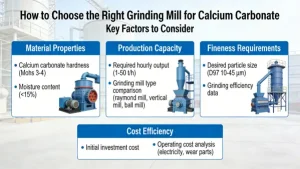
While both marble and limestone are relatively soft compared to siliceous rocks (e.g., quartz, granite), marble’s slightly higher hardness and density necessitate more robust or energy-intensive milling solutions. For high-volume or fine-grinding applications, mills with better wear resistance and higher energy efficiency (like VRMs or ball mills) are often preferred for marble, whereas simpler, lower-cost mills may suffice for limestone.
Selecting the right mill thus depends not only on hardness but also on throughput, desired particle size distribution, moisture content, and economic constraints. Pilot testing with actual feed material is highly recommended for optimal mill selection.