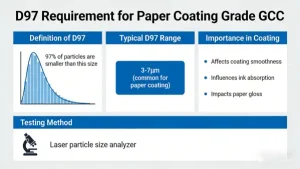
The required D97 (particle size at which 97% of the particles are finer) for paper coating grade Ground Calcium Carbonate (GCC) is determined by the coating layer type, paper grade, and target printability, with industry-standard specifications as follows:
Core Specification by Coating Application
-
Pre-coat / Base-coat GCC (standard coating grade)
-
Typical D97 requirement:≤ 5 μm(mainstream range: 2–4 μm)
- Corresponding particle size metric: 60–85% of particles < 2 μm
- Application: Base coating of paperboard, lightweight coated paper, balancing coverage, coating runnability and cost efficiency.
-
-
Standard Top-coatGCC
-
Typical D97 requirement:≤ 2 μm
- Corresponding particle size metric: 85–95% of particles < 2 μm
- Application: Surface coating of general coated paper and packaging paperboard, ensuring good smoothness and basic printability.
-
-
High-gloss / High-end Printing Top-coat GCC
-
Typical D97 requirement:≤ 1.6 μm, with ultra-fine grades as low as≤ 1.3 μmfor premium applications
- Corresponding particle size metric: ≥ 90% (up to 95%+) of particles < 2 μm
- Application: High-end coated woodfree paper, art paper, cast-coated paper, to deliver high gloss, ultra-smooth surface and high-precision printing adaptability.
-
Key Supplementary Notes
-
Industry Standards: There is no mandatory national standard for coating-grade ultra-fine GCC in China, with specifications mainly customized by paper mills; the international reference standard is ISO 3262-18. HG/T 3249.1-2008 specifies basic requirements for papermaking GCC, with the finest grade (1000 mesh) requiring D97 ≤ 11 μm for filler use, which is far coarser than coating grade.
-
Production Process: Coating-grade GCC with D97 ≤ 5 μm is almost exclusively produced via wet grinding process, to ensure narrow particle size distribution and minimal coarse particle residue, which prevents blade scratching and surface defects during coating.
-
Critical Distinction: Filler-grade GCC for papermaking has a much looser D97 requirement of 13–30 μm, which is not suitable for paper coating applications.