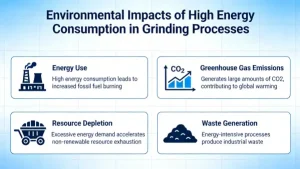
High energy consumption in calcium carbonate (GCC) grinding—especially for ultrafine (D97<2 μm) and near-nano (100–500 nm) powder production (200–300 kWh/t vs. 15–25 kWh/t for ordinary 45 μm GCC)—drives a cascade of direct and indirect environmental impacts. The core root is that industrial energy for grinding is overwhelmingly derived from fossil fuel-based thermal power (coal, natural gas) and auxiliary fossil fuel use (for drying, compressed air), with secondary impacts from energy-intensive equipment operation and resource utilization.
These impacts span atmospheric pollution, greenhouse gas emissions, water/land resource strain, solid waste generation, and noise/vibration pollution, and are amplified for ultrafine/near-nano CaCO₃ production (the most energy-intensive segment of the GCC industry). Below is a detailed breakdown of the key environmental impacts, tailored to the unique characteristics of CaCO₃ grinding (dry closed-circuit systems, jet mill/vertical mill dominance, and large-scale industrial production):
1. Increased Greenhouse Gas (GHG) Emissions & Climate Change Contribution
This is the most significant and far-reaching environmental impact of high grinding energy consumption. CaCO₃ production is a scope 1 (direct fuel combustion) and scope 2 (purchased electricity/steam) GHG emitter, with CO₂ as the primary gas—accounting for over 90% of total emissions.
Scope 2 emissions (dominant): 70–80% of industrial electricity globally comes from coal-fired thermal power, with a typical emission factor of ~0.8 kg CO₂/kWh (China’s industrial grid average) or ~0.45 kg CO₂/kWh (EU/US mixed grid). For a fluidized bed jet mill producing near-nano GCC (300 kWh/t), this equates to 240 kg CO₂/t (coal grid) or 135 kg CO₂/t (mixed grid)—16–18 times higher than ordinary 45 μm GCC (15 kWh/t = 12 kg CO₂/t).
Scope 1 emissions: Fossil fuel combustion for on-site drying (natural gas/coal) and compressed air production (diesel/gas-fired air compressors) adds an additional 20–50 kgCO₂/t for high-moisture ore (moisture >5%).
Cumulative impact: The global GCC industry produces ~1.5 billion tons of powder annually; high-energy ultrafine/near-nano production (10% of total) accounts for ~40% of the industry’s totalCO₂ emissions, contributing to global warming, extreme weather, and ocean acidification (relevant for CaCO₃’s end-use in marine coatings).
2. Elevated Atmospheric Pollutant Emissions &AirQuality Degradation
Fossil fuel combustion (for power generation and on-site processes) and energy-intensive grinding equipment operation release criteria air pollutants that harm human health and ecosystems, with the most severe impacts in industrial regions dependent on coal power.
Key pollutants from energy consumption:
Particulate matter (PM2.5/PM10): Coal-fired power plants emit fine fly ash and unburned carbon; for high-energy grinding, this translates to ~0.1–0.2 kg PM2.5/t of near-nano GCC (vs. 0.01 kg/t for ordinary GCC). PM2.5 penetrates lung tissue and causes respiratory/cardiovascular disease.
Sulfur dioxide (SO₂) & Nitrogen oxides (NOₓ): Coal combustion releases SO₂ (acid rain formation) and NOₓ (smog, ozone depletion); emission factors are ~8 g SO₂/kWh and ~4 g NOₓ/kWh for unregulated coal power. A 300 kWh/t near-nano line emits 2.4 kg SO₂/t and 1.2 kg NOₓ/t—20x higher than ordinary GCC.
Volatile Organic Compounds(VOCs): Minor emissions from fossil fuel evaporation and lubricant degradation in high-speed grinding equipment (jet mill/air classifier) at high energy loads.
Secondary air pollution from grinding:
High energy consumption often correlates with higher equipment load and poorer airtightness (e.g., worn seals in jet mills), leading to increased CaCO₃ dust leakage (PM10/PM2.5) from the grinding system—exacerbating local air pollution even with dust removal systems.
3. Excessive Water Resource Consumption & Strain on Aquatic Ecosystems
Grinding is a dry process for CaCO₃ (moisture <0.5% for finished powder), so direct water use is low—but high energy consumption drives indirect, large-scale water use for power generation and equipment cooling, a critical issue in water-scarce industrial regions (e.g., northern China, the American Southwest, parts of Europe).
Powerplant cooling water: Thermal power plants (coal/gas) require ~2–5 L of cooling water per kWh of electricity generated (once-through cooling) or 0.5–1 L/kWh (recirculating cooling). A 300 kWh/t near-nano GCC line consumes 150–300 L of indirect cooling water per ton (vs. 7.5–12.5 L/t for ordinary GCC). This depletes surface water (rivers, lakes) and groundwater, reducing water availability for ecosystems and human use.
On-site equipment cooling: High-energy jet mills/air compressors require recirculating cooling water (5–10 L/t for ultrafine GCC), with minor losses from evaporation and blowdown. Blowdown water contains trace scale inhibitors/corrosives, which can cause mild eutrophication if discharged without treatment.
Drying water loss: For high-moisture ore (10–15%), drying to 0.5% moisture evaporates ~95–145 kg of water per ton of ore—this water is lost to the atmosphere, reducing local water cycling in arid regions.
4. Increased Solid Waste Generation & Land Resource Pressure
High energy consumption in grinding links to greater solid waste production from both energy generation and the grinding process itself, with associated land use impacts from waste storage and mineral extraction.
Power plant solid waste: Coal-fired power plants produce ~0.1 kg of fly ash/slag per kWh of electricity. A 300 kWh/t near-nano GCC line generates 30 kg of fly ash/slag per ton (vs. 1.5 kg/t for ordinary GCC)—most is landfilled (occupying industrial land) or used in cement production (with limited recycling capacity).
Grinding process waste: High-energy ultrafine/near-nano grinding requires more rigorous impurity removal (magnetic separation, flotation) to maintain brightness/purity, producing 2–5 kg of tailings (iron oxide, clay, gangue) per ton of GCC (vs. 0.5–1 kg/t for ordinary GCC). These tailings are stored in lined piles, which risk soil contamination from trace heavy metals (Fe, Mn, Ti) if liners fail.
Equipment wear waste: High-energy grinding accelerates wear of ceramic/stainless steel contact parts (grinding rollers, classifier impellers) — 1–2 kg of worn ceramic/metal scrap per ton of near-nano GCC (vs. 0.1–0.2 kg/t for ordinary GCC). This scrap is mostly non-recyclable (ceramic) or requires energy-intensive metal recycling.
Increased ore extraction: High-energy grinding produces less finished powder per unit of energy input (exponential energy-fineness relationship), so more calcite ore must be mined to meet production demands—leading to greater land disturbance from mining (quarrying, soil erosion, habitat loss).
5. Elevated Noise & Vibration Pollution
High energy consumption in CaCO₃ grinding is directly tied to higher operating speeds and airflow rates in grinding/classification equipment, which generate intense noise and vibration pollution—a critical local environmental and occupational health impact.
Noise pollution: Jet mills/fluidized bed jet mills (the most energy-intensive) operate at 85–105 dB(A) (high-speed airflow collision), with auxiliary fans/air compressors adding 80–90 dB(A). This exceeds the industrial noise limit of 85 dB(A) for an 8-hour workday and causes community noise pollution (up to 1 km from the plant) with impacts like sleep disturbance and hearing loss.
Vibration pollution: High-speed grinding equipment (vertical mills, jet mills) generates structural vibration (0.1–0.5 mm/s) that propagates through the ground, damaging nearby buildings and disrupting soil ecosystems (e.g., root systems of plants, soil microorganism activity).
Amplification by high load: Running equipment at maximum energy load (to meet ultrafine production demands) exacerbates noise/vibration, as worn parts and unbalanced impellers create additional mechanical noise.
6. Depletion of Finite Fossil Fuel Resources
CaCO₃ grinding’s high energy demand relies on non-renewable fossil fuels (coal, natural gas, oil)—a finite resource with long-term environmental and geopolitical impacts.
Fossil fuel consumption: A single 100.000 t/year near-nano GCC plant (300 kWh/t) consumes 30 million kWh of electricity annually—equivalent to ~9.000 tons of standard coal (or ~5 million m³ of natural gas). This depletes regional fossil fuel reserves and increases reliance on imported fuels in resource-poor regions.
Energy cascading loss: Over 60–70% of fossil fuel energy is lost as waste heat during power generation (thermal power plants have an efficiency of only 30–40%), meaning the GCC industry uses far more primary fossil fuel energy than the electrical energy consumed for grinding—wasting finite resources.
7. Minor Impacts: Soil Contamination & Ecosystem Disruption
These are secondary, localized impacts amplified by high energy consumption, primarily linked to poor waste management and increased industrial activity:
Soil contamination: Leakage of cooling water chemicals (scale inhibitors, biocides) or tailing pile seepage (trace heavy metals) can contaminate agricultural/industrial soil, reducing soil fertility and harming soil organisms.
Ecosystem disruption: Increased power plant emissions (SO₂, acid rain) and ore mining (habitat loss) damage nearby terrestrial/aquatic ecosystems—e.g., acid rain acidifies lakes/streams, killing fish, and mining removes calcite ore habitats for soil invertebrates and plants.
Light pollution: High-energy grinding plants operate 24/7 (to maximize efficiency and reduce idle energy loss), with industrial lighting causing light pollution that disrupts animal migration and circadian rhythms.
Key Variation by GCC Fineness (Impact Severity)
The environmental impacts scale exponentially with grinding fineness (matching the exponential energy-fineness relationship for CaCO₃), with near-nano production causing the most severe harm. The table below summarizes the relative environmental impact intensity (1 = lowest, 5 = highest) for different GCC grades:
| GCC Fineness (D97) | Electric Consumption (kWh/t) | GHG Emissions | Air Pollution | Water Use | Solid Waste | Noise/Vibration |
| 45 μm (ordinary) | 15–25 | 1 | 1 | 1 | 1 | 1 |
| 20 μm (medium-fine) | 30–40 | 2 | 2 | 2 | 2 | 2 |
| 5 μm (ultrafine) | 50–70 | 3 | 3 | 3 | 3 | 3 |
| 2 μm (ultrafine) | 80–120 | 4 | 4 | 4 | 4 | 4 |
| 500 nm (near-nano) | 200–300 | 5 | 5 | 5 | 5 | 5 |
Mitigation Strategies: Reducing Environmental Impacts from High Grinding Energy Consumption
The environmental harms of high energy consumption in CaCO₃ grinding are mitigable through targeted, industry-proven measures that align with energy efficiency and circular economy principles—many also reduce production costs (a win-win for manufacturers and the environment). Key strategies include:
Switch to renewable energy: Power grinding plants with on-site solar/wind power or purchase green electricity (scope 2 emission reduction of 80–100%).
Optimize grinding efficiency: Maintain 80–95% equipment load, control closed-circuit circulating load at 250–350%, and use high-efficiency vertical mills/jet mills (20–30% energy savings).
Waste heat recovery: Recycle waste heat from grinding mills/air compressors for ore drying (reduces fossil fuel use for drying by 30–40%).
Improve equipment design: Use low-noise jet mills/air classifiers, install vibration dampeners, and upgrade to 100% airtight grinding systems (reduces dust leakage by 99%).
Recycle solid waste: Reuse power plant fly ash in cement production, recycle worn metal parts, and use calcite tailings as road base material (zero-waste target).
Water conservation: Use air-cooled instead of water-cooled equipment (eliminates cooling water use), and recycle drying condensate for on-site use.
Raw ore pretreatment: Dry ore to <0.5% moisture, remove impurities pre-grinding, and use high-purity calcite ore (reduces grinding energy and tailings production).
High energy consumption in CaCO₃ grinding—especially for ultrafine/near-nano powder—drives a range of interconnected environmental impacts, with greenhouse gas emissions and atmospheric pollution as the most severe and global. These impacts stem from the fossil fuel dependence of industrial energy systems and are amplified by the exponential increase in energy demand with finer grinding fineness (a fundamental physical limit of CaCO₃ physical grinding).
While grinding is an essential step in GCC production, the environmental harms are not inevitable: energy efficiency improvements, renewable energy adoption, and circular waste management can drastically reduce the industry’s environmental footprint—while also lowering production costs for manufacturers. For the near-nano GCC segment (the most energy-intensive), these mitigation strategies are not just environmentally responsible but economically necessary to align with global carbon neutrality and pollution control regulations.