When calcium carbonate (CaCO₃) is processed via ultrafine grinding—typically defined as D97 ≤ 10 μm (approximately ≥1250 mesh), with some grades reaching the nanoscale—it exhibits significantly increased specific surface area, improved dispersion, and enhanced surface reactivity. These properties enable its use across a wide range of high-value applications. Below are the major application areas:
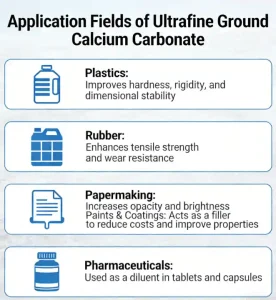
Plastics Industry (Largest Application Sector)
Function: Functional filler that simultaneously reinforces, toughens, and reduces costs.
Advantages:
Enhances rigidity, dimensional stability, and heat resistance of products;
Improves melt flow and processing efficiency, reducing energy consumption;
Ultrafine particle size minimizes negative impacts on mechanical properties;
Surface modification greatly improves compatibility with polymer matrices.
Typical Products: PVC pipes/profiles, PP/PE films, automotive plastic parts, wire & cable sheathing.
Rubber Industry
Function: Reinforcing and filling agent (especially effective with precipitated or nano CaCO₃).
Advantages:
Chain-like or spindle-shaped ultrafine CaCO₃ improves tensile strength and abrasion resistance;
Enhances compound processability and vulcanization characteristics;
Can partially replace silica, lowering formulation costs.
Typical Products: Tires, hoses, seals, shoe soles.
Coatings and Inks
Function: Extender pigment and functional additive.
Advantages:
High brightness, opacity, and excellent dispersibility;
Improves gloss, smoothness, and adhesion of paint films;
Modulates rheology and prevents pigment settling;
Nano-sized CaCO₃ enhances weatherability and anti-aging performance.
Typical Products: Architectural latex paints, industrial coatings, premium printing inks, UV-curable coatings.
Paper Industry
Function: Filler and coating pigment (especially compatible with neutral/alkaline papermaking processes).
Advantages:
Increases paper brightness, opacity, and printability;
Enhances bulk and softness;
Ultrafine particles fill inter-fiber voids, improving smoothness;
Reduces fiber consumption, lowering raw material costs.
Typical Applications: Coated paper, carbonless copy paper, high-grade printing/writing paper, specialty papers.
Adhesives and Sealants
Function: Extender filler and rheology modifier.
Advantages:
Controls viscosity and sag resistance;
Improves cohesive strength;
Enhances storage stability.
Typical Products: Construction structural adhesives, silicone sealants, pressure-sensitive tapes.
Personal Care and Pharmaceuticals
Toothpaste: Used as a mild abrasive (requires food/pharma-grade ultrafine CaCO₃)—effectively cleans without damaging enamel.
Cosmetics: Added to foundations and powders for silky texture and coverage.
Pharmaceuticals: Serves as a tablet filler or calcium supplement (requires high purity and low heavy metals).
Food and Animal Feed
Food Additive (E170): Functions as a calcium fortifier, anti-caking agent, and pH regulator.
Feed Additive: Provides bioavailable calcium for bone development in livestock.
Requirements: Must meet food-grade or feed-grade standards (e.g., GB 1886.214. FCC), with extremely low levels of heavy metals.
Emerging High-Value Applications (Frontier Fields)
| Field | Application Form | Function |
| Lithium-ion Batteries | Separator coating material | Enhances thermal stability and pore uniformity |
| Biomedical Materials | Bone repair composites | Biodegradable and biocompatible |
| Environmental Materials | Flue gas desulfurization, wastewater treatment | Neutralizes acidic pollutants via alkalinity |
| 3D Printing | Polymer composite filaments | Improves strength and reduces shrinkage |
| Electronics Packaging | Thermal/electrical insulating filler | High-purity ultrafine CaCO₃ improves dielectric properties |
Key Performance Requirements vs. Application Matching
| Application Area | Particle Size (D97) | Surface Modification Required? | Purity / Brightness Requirement |
| General Plastics | 5–15 μm | Yes | Moderate |
| High-end Films / Cables | ≤5 μm | Yes | High (Fe₂O₃ < 0.1%) |
| Coatings / Inks | 2–10 μm | Partially | High brightness (≥95%) |
| Paper Filler | 2–8 μm | No or mild | High brightness |
| Toothpaste / Food | 1–5 μm | No | Very high purity |
| Battery Separator Coating | ≤2 μm (nano) | Special treatment | Ultra-high purity, non-magnetic |
Summary
Ultrafine grinding transforms calcium carbonate from a conventional filler into a functional material, enabling deep integration into advanced manufacturing, green chemistry, and life sciences. With ongoing advances in surface modification, particle morphology control, and composite technologies, calcium carbonate is increasingly entering strategic emerging sectors such as new energy, electronics, and biomaterials, driving its high-value utilization.