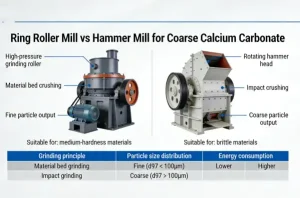
For coarse calcium carbonate processing (typically defined as 80–400 mesh / 38–180 μm for coarse powder, or 0–3 mm for aggregate-grade material), the core difference between the two mills lies in their crushing mechanism, optimal working range, total cost of ownership, and final powder quality. Below is a full technical and economic comparison tailored to calcium carbonate (calcite/limestone, Mohs hardness 3, brittle material) processing.
Core Specification Comparison Table
|
Parameter
|
Ring Roller Mill
|
Hammer Mill
|
|
Core Crushing Mechanism
|
Compression + rolling + shear grinding between rotating rollers and a fixed grinding ring; closed-loop air classification integrated
|
High-speed impact crushing by swinging hammers; size controlled by bottom grate bars/screens
|
|
Optimal Coarse Calcium Carbonate Size Range
|
80–400 mesh (38–180 μm); can achieve tight top-size control; not suitable for >3 mm aggregate production
|
0–3 mm aggregate to 80–400 mesh coarse powder; ideal for primary coarse crushing of bulk material
|
|
Feed Size Requirement
|
Strict: max feed size ≤10–15 mm; requires pre-crushing; sensitive to oversized/tramp material
|
Flexible: max feed size up to 330 mm; can handle raw crushed limestone directly without secondary pre-crushing
|
|
Energy Efficiency (Coarse Grinding)
|
30–50% lower specific energy consumption per ton for 80–400 mesh production; minimal energy waste from over-grinding
|
Higher specific energy for 80–400 mesh fine coarse powder; lower efficiency for narrow particle size distribution; better energy performance only for >1 mm bulk crushing
|
|
Particle Size Distribution (PSD)
|
Extremely narrow PSD (span <1.2); no oversized particles; minimal unwanted ultra-fines; consistent batch-to-batch quality
|
Wide PSD (span >1.8); high over-grinding rate (15–20% ultra-fines generated); risk of oversized particles if screens/grate bars wear
|
|
Calcium Carbonate Powder Quality
|
Near-spherical/short columnar particles with rounded edges; low iron contamination (<50 ppm); preserves high whiteness (>95%); better compatibility with polymer fillers
|
Irregular, flaky/needle-like particles from impact crushing; higher iron wear from hammers/liners; higher risk of whiteness loss; higher oil absorption value
|
|
Upfront Capital Cost
|
2–3x higher initial investment for the same throughput; complete system includes classifier, pulse dust collector, and air circulation system
|
Low upfront cost; simple structure; 50–70% lower investment for the same coarse crushing throughput; easy to install and commission
|
|
Maintenance & Wear Life
|
Longer wear part life (6–8 years for grinding rollers/rings when processing calcium carbonate); low daily maintenance; less frequent part replacement
|
Rapid wear of hammers, liners, and grate bars (replacement every 1–3 months for high-volume production); high downtime for part changes; higher long-term operating cost for 80–400 mesh production
|
|
Moisture & Feed Tolerance
|
Sensitive to moisture (max ≤5–6%); sticky/high-moisture material causes caking and blockages in the grinding chamber
|
Better moisture tolerance (max ≤8–10%); lower clogging risk for coarse crushing; can handle slightly wet limestone
|
Detailed Performance Analysis for Coarse Calcium Carbonate
1. Working Principle & Application Fit
-
Hammer Mill: Designed for primary crushing and bulk coarse reduction. High-speed rotating hammers strike and shatter incoming limestone/calcite, with final size controlled by replaceable grate bars at the bottom. It is the industry standard for raw ore pre-crushing and large-volume production of >1 mm calcium carbonate aggregate/coarse grits.
-
Ring Roller Mill: Optimized for progressive grinding and precision classification. Material is repeatedly rolled and sheared between centrifugally driven rollers and a grinding ring, with an integrated dynamic classifier that recirculates oversize particles for re-grinding. It excels at producing 80–400 mesh coarse powder with strict quality requirements, rather than primary crushing of large raw ore.
2. Critical Advantages for Coarse Calcium Carbonate Processing
Hammer Mill Key Advantages
-
Unmatched flexibility for primary coarse crushing: Handles large raw limestone lumps (up to 330 mm) directly, eliminating the need for a pre-crushing jaw crusher in small-scale production lines.
-
Low barrier to entry: Simple structure, low upfront cost, easy operation, and fast maintenance, making it ideal for small-batch production or low-budget projects.
-
High throughput for bulk material: Single-unit capacity up to 650 t/h for 0–3 mm aggregate production, far exceeding ring roller mills for ultra-coarse calcium carbonate.
Ring Roller Mill Key Advantages
-
Superior powder quality for downstream filling applications: Produces rounded, spherical calcium carbonate particles with narrow PSD, which improves dispersion and reduces viscosity in polymer, paint, and coating formulations—critical for high-value coarse calcium carbonate products.
-
Higher efficiency for 80–400 mesh production: Closed-loop classification eliminates over-grinding, cutting specific energy consumption by 30–50% compared to hammer mills for the same target mesh size, with significantly lower ultra-fine dust waste.
-
Lower long-term operating cost: Wear parts have 5–10x longer service life than hammer mill consumables when processing calcium carbonate, reducing downtime and replacement costs for continuous 24/7 production.
-
Better environmental performance: Fully enclosed negative-pressure operation with integrated pulse dust collection, achieving near-zero dust emissions, unlike open hammer mill systems that require additional dust control equipment.
3. Key Limitations
Hammer Mill Limitations
-
Poor performance for fine coarse powder (200–400 mesh): High over-grinding rate generates large amounts of unwanted ultra-fines, reducing yield of on-spec product and increasing dust management costs.
-
High long-term maintenance cost: Rapid wear of hammers and liners leads to frequent replacement, rising operating costs, and inconsistent product quality as parts wear.
-
Particle quality drawbacks: Irregular particle shape and higher iron contamination limit its use in high-end applications that require high whiteness and good flowability.
Ring Roller Mill Limitations
-
Strict feed requirements: Cannot handle oversized raw ore; requires pre-crushing to <15 mm, adding equipment and process complexity to the production line.
-
High upfront investment: Complete system costs 2–3x more than a hammer mill of the same throughput, requiring higher capital expenditure and longer payback period.
-
Not suitable for >3 mm aggregate production: Its grinding mechanism is not designed for ultra-coarse reduction, making it uneconomical for aggregate-grade calcium carbonate.
Final Selection Recommendation
Choose a Hammer Mill if:
-
You need primary crushing of raw limestone ore, or bulk production of >1 mm calcium carbonate aggregate/coarse grits;
-
You have a limited budget, need a simple, easy-to-operate system, or run small-batch, intermittent production;
-
Downstream applications have low requirements for particle shape, PSD, and whiteness (e.g., construction filler, cement raw material).
Choose a Ring Roller Mill if:
-
Your target product is 80–400 mesh coarse calcium carbonate powder for high-value applications (e.g., plastic filler, paint, paper coating);
-
You require tight particle size control, minimal over-grinding, high whiteness, and consistent batch quality;
-
You run continuous, large-volume production and prioritize long-term energy savings and low operating costs over upfront investment.