Ultrafine calcium carbonate (2500 mesh, D97≈5μm) is a high-value functional filler widely used in plastics, rubber, coatings, papermaking and other industries, with strict requirements for particle size distribution, whiteness, purity and particle morphology. Jet mill and ring roller mill are the two most commonly used ultrafine grinding equipment for calcium carbonate, and their grinding principles, structural characteristics and application performance are quite different. This guide comprehensively compares the two types of mills from grinding principle, technical performance, production cost, product quality, adaptability and other aspects, and provides selection suggestions for ultrafine calcium carbonate production enterprises.
Key Definition & Technical Index of 2500 Mesh Calcium Carbonate
Before the comparison, it is necessary to clarify the core technical index of 2500 mesh ultrafine calcium carbonate, which is the basis for evaluating the performance of the mill:
Particlesize: 2500 mesh (Tyler standard), the actual D97 particle size is about 4–6μm (the test is based on laser particle size analyzer), and the particle size distribution requires narrow distribution (no large particles >10μm).
Key indicators: Whiteness ≥95%, purity ≥98.5% (no iron, manganese and other impurity pollution), particle morphology is mostly cubic or spindle-shaped (no excessive crushing and amorphous particles), bulk density is moderate (0.25–0.4g/cm³).
Grinding requirements: The equipment can stably grind heavy calcium carbonate (calcite, marble, limestone) with Mohs hardness 2.7–3.0. whiteness ≥94% into 2500 mesh products, and meet the continuous production requirements of industrialization.
Core Grinding Principle & Structural Characteristics
1.1 Jet Mill (Airflow Jet Mill)
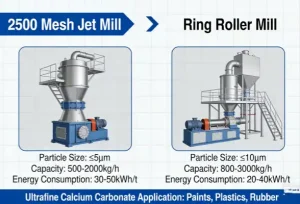
The jet mill is a fluidenergy grinding equipment that uses high-speed airflow (compressed air/steam) to drive material particles to collide, impact and rub against each other for ultrafine grinding, and realizes classification and collection through the built-in air classifier.
Core structure: Composed of air compressor, air dryer, jet nozzle, grinding chamber, classifier, cyclone collector, bag filter and fan.
Grinding process: Compressed air is accelerated to supersonic speed (300–500m/s) through the nozzle to form a high-speed airflow beam, which entrains calcium carbonate particles into the grinding chamber; particles collide and grind each other at the intersection of multiple airflow beams; the ground fine particles are sent to the built-in classifier by the airflow, and the qualified 2500 mesh particles are collected by the cyclone and bag filter, and the coarse particles return to the grinding chamber for regrinding.
Typical types: Fluidized bed opposed jet mill (the most commonly used for calcium carbonate), disc jet mill, target jet mill (rarely used for ultrafine calcium carbonate).
1.2 Ring Roller Mill (Ultrafine Ring Roller Mill, also known as Roller Pin Mill)
The ring roller mill is a mechanical pressure grinding equipment improved on the basis of the traditional Raymond mill, which realizes ultrafine grinding through the extrusion, rolling and shearing of the roller and the grinding ring, and matches the external high-precision classifier to control the product particle size.
Core structure: Composed of feeding device, host (grinding chamber, grinding roller, grinding ring, main shaft), classifier, blower, cyclone collector, bag filter and hydraulic system.
Grinding process: Calcium carbonate coarse powder (200–325 mesh) is fed into the grinding chamber, and the grinding roller is pressed against the grinding ring under the action of centrifugal force and hydraulic pressure; the main shaft drives the grinding roller to roll at high speed, and the material is extruded and rolled into fine powder between the roller and the ring; the fine powder is blown up by the airflow from the blower to the external classifier, the qualified 2500 mesh particles are collected, and the coarse particles fall back to the grinding chamber for regrinding.
Key improvement: The ultrafine ring roller mill for calcium carbonate adopts a multi-layer grinding ring, high-hardness wear-resistant roller sleeve and high-precision turbine classifier, which solves the problem that the traditional Raymond mill cannot grind below 1250 mesh.
Comprehensive Performance Comparison (Core Indexes)
The following is the core performance comparison of the two mills for grinding 2500 mesh calcium carbonate, covering product quality, production efficiency, energy consumption, wear resistance, operation and maintenance and other key dimensions, which is the core basis for selection:
td {white-space:nowrap;border:0.5pt solid #dee0e3;font-size:10pt;font-style:normal;font-weight:normal;vertical-align:middle;word-break:normal;word-wrap:normal;}
| Comparison Index | Jet Mill (Fluidized Bed Opposed Type) | Ring Roller Mill (Ultrafine Type) | Advantage Side |
| Product Particle Size Distribution | Narrow distribution (D90/D10≈2–3), no large particles, D97 stably controlled at 4–5μm | Relatively wide distribution (D90/D10≈4–6), individual large particles (≤8μm) need secondary screening, D97≈5–6μm | Jet Mill |
| Whiteness Retention | No mechanical contact grinding, no impurity pollution, whiteness increased by 0.5–1.0% (compared with raw material) | Slight wear of roller/ring (high-hardness alloy), trace metal impurity pollution, whiteness unchanged or slightly reduced (≤0.3%) | Jet Mill |
| Particle Morphology | Cubic/spindle shape is well preserved, no amorphous particles, good dispersibility | Partial particle edge is crushed, a small amount of amorphous particles, dispersibility is slightly poor (need modification to improve) | Jet Mill |
| Production Capacity (Single Machine) | 0.8–2.0 t/h (2500 mesh, calcium carbonate with bulk density 1.2g/cm³) | 2.5–5.0 t/h (same raw material and particle size) | Ring Roller Mill |
| Unit Energy Consumption (kWh/t) | 180–250 kWh/t (including air compression, classification, collection) | 60–90 kWh/t (including host, classifier, blower) | Ring Roller Mill |
| Wear Part Consumption | No direct contact grinding parts, only the nozzle is slightly worn (ceramic nozzle, service life ≥12 months), low consumption | Roller sleeve/grinding ring (high-chromium alloy) is worn, service life 3–6 months; classifier impeller is worn, need regular replacement, high consumption | Jet Mill |
| Raw Material Adaptability | Adapt to dry, non-sticky coarse powder (80–200 mesh), water content ≤0.5% | Adapt to dry coarse powder (200–325 mesh), water content ≤1.0%, strong adaptability to raw material particle size | Ring Roller Mill |
| Floor Area | Large (air compressor, dryer, grinding host, classification system are independent), about 80–120 m² | Small (integrated host and auxiliary equipment), about 30–50 m² | Ring Roller Mill |
| Operation Complexity | High (need to control air pressure, airflow, classifier speed, multiple parameters), professional operation required | Low (automatic feeding, hydraulic pressure control, simple parameter adjustment), ordinary workers can operate | Ring Roller Mill |
| Noise & Vibration | Low noise (≤85 dB), no mechanical vibration (no high-speed rotating pressure parts) | High noise (≤95 dB), certain mechanical vibration (need foundation reinforcement) | Jet Mill |
| Impurity Pollution Risk | Extremely low (ceramic/PTFE parts, no metal contact) | Low (high-hardness alloy parts, trace wear debris, need magnetic separation to remove) | Jet Mill |
Key Notes on the Table
The data is based on the mainstream industrial single machine model (jet mill: Φ600–Φ1000; ring roller mill: YFM160–YFM210) for calcium carbonate grinding, excluding laboratory small equipment.
Energy consumption of jet mill includes air compressorenergy consumption (accounting for 70–80% of total energy consumption), which is the main reason for high unit energy consumption.
Wear part consumption of ring roller mill is related to the purity of raw material (the higher the silica content, the faster the wear).
Product Quality Comparison for 2500 Mesh Calcium Carbonate
Product quality is the core factor determining the application grade of ultrafine calcium carbonate, and the two mills have obvious differences in particle size, morphology, purity and other aspects, which directly affect the downstream application effect:
3.1 Jet Mill: High-Grade, High-Purity Ultrafine Products
Particlesize: Narrow distribution is the biggest advantage, D97 can be stably controlled at 4–5μm, no large particles, which meets the strict requirements of high-end coatings (water-based industrial paint), high-precision plastics (PP/PE film) and papermaking (coated paper) for particle size uniformity.
Whiteness& purity: No mechanical contact grinding, the grinding chamber and nozzle are made of ceramic or polytetrafluoroethylene materials, which avoids iron, manganese and other metal impurity pollution; the high-speed airflow can also take away the fine powder on the surface of the raw material, making the product whiteness 0.5–1.0% higher than the raw material.
Particlemorphology: The grinding is based on inter-particle collision, without excessive extrusion and shearing, the original cubic/spindle morphology of calcium carbonate is well preserved, the particle surface is smooth, the dispersibility is excellent, and it can form a good filling effect with the polymer matrix without additional modification.
Bulk density: Moderate bulk density (0.3–0.4g/cm³), good fluidity, easy to mix and feed in the downstream production process.
3.2 Ring Roller Mill: Cost-Effective General Ultrafine Products
Particlesize: Relatively wide distribution, D97 is about 5–6μm, individual large particles (6–8μm) may appear, which needs secondary screening to remove; it can meet the requirements of general-grade products (rubber filler, ordinary plastic, putty powder), but it is difficult to meet the high-end application requirements for narrow particle size distribution.
Whiteness& purity: The roller sleeve and grinding ring are made of high-chromium alloy, with slight wear during grinding, and a small amount of iron debris is mixed in the product, which needs to be removed by magnetic separation; the whiteness is basically the same as the raw material, and individual models may have a slight decrease (≤0.3%).
Particlemorphology: The grinding is based on mechanical extrusion and rolling, part of the particle edges are crushed, a small amount of amorphous particles are produced, the particle surface is slightly rough, the dispersibility is slightly poor, and it needs to be surface modified (stearic acid coating) to improve the compatibility with the polymer.
Bulk density: Slightly higher bulk density (0.35–0.45g/cm³), good fluidity, suitable for bulk filling applications with low requirements for particle morphology.
Production Cost Comparison (Key for Industrialization)
For calcium carbonate production enterprises, the comprehensive production cost (including investment cost, operation cost, maintenance cost) directly determines the profit margin, and the two mills have huge differences in cost structure due to different working principles:
4.1 Initial Investment Cost
Jet Mill: High one-time investment, the price of a single industrial model (Φ800) is about 1.5–2.5 times that of the same capacity ultrafine ring roller mill; in addition, supporting equipment (air compressor, air dryer, high-pressure pipeline) needs to be invested, and the total initial investment is about 2–3 times that of the ring roller mill.
Ring Roller Mill: Low initial investment, integrated design of host and auxiliary equipment, no need for expensive air compression system, the total investment is only 1/3–1/2 of the jet mill, which is suitable for small and medium-sized enterprises with limited initial funds.
4.2 Daily Operation Cost (Core Cost for Long-Term Production)
Calculated based on the annual production of 300 days and 24 hours of continuous operation (2500 mesh calcium carbonate):
td {white-space:nowrap;border:0.5pt solid #dee0e3;font-size:10pt;font-style:normal;font-weight:normal;vertical-align:middle;word-break:normal;word-wrap:normal;}
| Cost Item | Jet Mill (1.5 t/h) | Ring Roller Mill (3.5 t/h) | Cost Ratio (Jet/Ring) |
| Electricity Cost (0.6 yuan/kWh) | 1.5×220×0.6×24=4752 yuan/day | 3.5×75×0.6×24=3780 yuan/day | 1.26:1 (per ton: 132 vs 45 yuan) |
| Wear Part Cost | 100 yuan/day (ceramic nozzle) | 800 yuan/day (roller sleeve/grinding ring) | 0.125:1 |
| Labor Cost (2 people) | 400 yuan/day | 200 yuan/day (1 person) | 2:01 |
| Auxiliary Material Cost (lubricating oil, etc.) | 50 yuan/day | 100 yuan/day | 0.5:1 |
| Daily Total Cost | 5302 yuan/day | 4880 yuan/day | 1.086:1 |
| Unit Cost (yuan/t) | 154.8 yuan/t | 57.9 yuan/t | 2.67:1 |
Core conclusion: The unit production cost of the ring roller mill is only about 1/3 of the jet mill, and the advantage is extremely obvious; the high electricity cost of the jet mill is the main reason for the high unit cost, and the low wear part cost can only partially offset it.
4.3 Maintenance & Upgrading Cost
Jet Mill: Simple maintenance, few wear parts, only need to check the nozzle and classifier regularly, the annual maintenance cost is about 1–2% of the equipment value; the upgrading space is small, and the particle size adjustment is realized by changing the airflow and classifier speed, without major structural modification.
Ring Roller Mill: Frequent maintenance, need to replace the roller sleeve, grinding ring and classifier impeller regularly, the annual maintenance cost is about 5–8% of the equipment value; the upgrading space is large, and the particle size can be reduced by replacing the high-precision classifier, and the production capacity can be improved by increasing the grinding layer.
4.4 Space & Infrastructure Cost
Jet Mill: Large floor area, need to build an independent air compression room and drying room, and the infrastructure cost (factory building, foundation) is high; no vibration, no need for special foundation reinforcement.
Ring Roller Mill: Small floor area, integrated equipment, low infrastructure cost; certain vibration, need to reinforce the foundation of the host, and the additional cost is low.
Process Adaptability & Industrial Application Scenarios
The two mills have different adaptabilities to production scale, product grade and raw material characteristics, and are suitable for different industrial application scenarios. The selection needs to be combined with the enterprise’s product positioning,market demandand production scale:
5.1 Jet Mill: Suitable for High-End, Small-Batch, High-Purity Production
Applicable scenarios:
Production of high-end 2500 mesh calcium carbonate for water-based industrial coatings, high-gloss powder coatings, BOPP/PE plastic films, coated paper, food grade calcium carbonate (pharmaceutical, food additive).
Small and medium production scale (annual output ≤5000 tons), high product added value (selling price ≥2000 yuan/t), strict requirements for whiteness, purity and particle morphology.
Raw materials with high silica content (≤5%) or high whiteness (≥95%), which need to avoid metal impurity pollution.
Advantages in application: The product has narrow particle size distribution, high whiteness and good dispersibility, which can significantly improve the performance of downstream products (e.g., improve the gloss and covering power of coatings, improve the toughness and transparency of plastics).
5.2 Ring Roller Mill: Suitable for General-Grade, Large-Batch, Cost-Sensitive Production
Applicable scenarios:
Production of general-grade 2500 mesh calcium carbonate for rubber filler (tires, sealing strips), ordinary plastics (PP/PE pipes, injection molding parts), putty powder, building coatings, ink fillers.
Large production scale (annual output ≥10.000 tons), medium product added value (selling price 800–1500 yuan/t), the main demand is to meet the particle size requirements with low cost.
Raw materials with low silica content (≤3%) and ordinary whiteness (94–95%), no strict requirements for particle morphology.
Advantages in application: High production capacity, low unit cost, stable continuous production, which can meet the bulk demand of downstream general industries for ultrafine calcium carbonate, and the product cost performance is high.
5.3 Mixed Production (Jet Mill + Ring Roller Mill)
For large enterprises with both high-end and general-grade product demand, the combined process of ring roller mill primary grinding + jet mill secondary classification/grinding can be adopted:
The ring roller mill grinds the raw material into 2500 mesh coarse ultrafine powder (wide distribution) with low cost.
The jet mill is used for secondary classification and fine grinding to remove large particles, narrow the particle size distribution, and obtain high-end products.
This process combines the low cost of the ring roller mill and the high quality of the jet mill, which can reduce the unit cost of high-end products by 30–40% compared with pure jet mill production.
Key Selection Criteria & Suggestions
Based on the above comprehensive comparison, the selection of jet mill and ring roller mill for 2500 mesh calcium carbonate grinding should follow the “product positioning first, cost second, production scale matching” principle, and the specific selection suggestions are as follows:
6.1 Select Jet Mill If
The product is positioned as high-end ultrafine calcium carbonate (selling price ≥2000 yuan/t), and the downstream application has strict requirements for particle size distribution, whiteness, purity and particle morphology (e.g., high-end coatings, food grade, pharmaceutical grade).
The production scale is small (annual output ≤5000 tons), and the enterprise pursues high product added value rather than large-scale output.
The raw material has high whiteness (≥95%) and needs to avoid any metal impurity pollution, or the silica content of the raw material is high (3–5%) and the wear resistance of mechanical equipment is poor.
The factory has sufficient space and initial investment funds, and the operation team has professional technical capabilities (can control the multiple parameters of the jet mill).
6.2 Select Ring Roller Mill If
The product is positioned as general-grade ultrafine calcium carbonate (selling price 800–1500 yuan/t), and the downstream application only has basic particle size requirements, and no strict requirements for morphology and distribution (e.g., rubber, ordinary plastics, building coatings).
The production scale is large (annual output ≥10.000 tons), and the enterprise pursues low production cost and large-scale continuous production.
The initial investment funds are limited, the factory space is small, and the operation team is ordinary (no professional grinding equipment operation experience).
The raw material has low silica content (≤3%) and ordinary whiteness (94–95%), and the wear part consumption can be controlled within an acceptable range.
6.3 Key Notes for Selection
Test first: No matter which mill is selected, it is necessary to send the raw material to the equipment manufacturer for small test and pilot test to verify the product quality (particle size, whiteness, morphology) and production capacity, and avoid blind purchase.
Wear resistance of parts: For the ring roller mill, it is necessary to select the high-hardness wear-resistant alloy roller sleeve/grinding ring (e.g., high chromium cast iron, ceramic composite) to extend the service life and reduce the wear part cost.
Classifier matching: The particle size control of 2500 mesh calcium carbonate mainly depends on the classifier. It is necessary to select the high-precision turbine classifier (rotor speed adjustable 1000–3000r/min) to ensure the stability of the product particle size.
Environmental protection requirements: Both mills need to configure a high-efficiency bag filter (filtration efficiency ≥99.9%) to meet the national environmental protection emission standards (dust emission ≤30mg/m³); the jet mill has low noise and no need for additional noise reduction measures, while the ring roller mill needs to configure a noise reduction cover (reduce noise to ≤85dB).
Development Trend of Ultrafine Calcium Carbonate Grinding Equipment
With the continuous upgrading of downstream industries (e.g., high-end new materials, electronic chemicals) for the performance of ultrafine calcium carbonate, the grinding equipment is also developing in the direction of high efficiency, low consumption, high precision and intelligence:
Jet mill: Develop towards air energy saving (adopt high-efficiency air compressor and heat recovery system) to reduce unit energy consumption; develop the integrated design of grinding and classification to reduce the floor area; adopt intelligent control system to realize automatic adjustment of air pressure, airflow and classifier speed.
Ring Roller Mill: Develop towards high precision and low wear (adopt ceramic composite roller sleeve/grinding ring to reduce impurity pollution and wear); develop the multi-layer grinding + multi-stage classification structure to narrow the particle size distribution; adopt hydraulic automatic pressure control and intelligent fault diagnosis system to improve the stability of operation.
New combined process: The “mechanical grinding + airflow classification” combined process will become the mainstream of high-end ultrafine calcium carbonate production, which can balance product quality and production cost, and is suitable for large-scale industrial production.
Conclusion
Jet mill and ring roller mill have their own irreplaceable advantages in the grinding of 2500 mesh ultrafine calcium carbonate:
The jet mill is the first choice for high-end product production, with the advantages of high product quality (narrow distribution, high whiteness, good morphology), low impurity pollution and stable operation, but the initial investment and unit production cost are high.
The ring roller mill is the first choice for general-grade product large-scale production, with the advantages of low investment, high production capacity, low unit cost and simple operation, but the product particle size distribution is wide and there is slight impurity pollution risk.
For calcium carbonate production enterprises, the most reasonable selection is not to pursue a single equipment advantage, but to match the equipment with the product positioning, production scale and market demand. For enterprises with both high-end and general-grade product demand, the mixed production process of ring roller mill + jet mill is the most cost-effective solution, which can realize the simultaneous production of different grade products and maximize the economic benefits.
Finally, no matter which equipment is selected, it is necessary to choose a professional calcium carbonate grinding equipment manufacturer with rich experience, perfect after-sales service and pilot test conditions, which can provide customized process solutions according to the raw material characteristics and product requirements of the enterprise, and ensure the stable and efficient operation of the production line.