Key Retrofit Modifications for Ultrafine Output
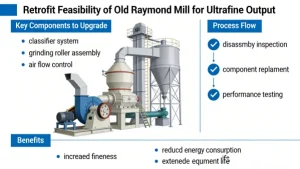
The retrofit requires systematic upgrades, not just a single component change, to overcome the original mill’s design limits for coarse powder (80–400 mesh):
-
High-Precision TurbineClassifierUpgrade (Most Critical)
Replace the original low-speed blade-type analyzer with a variable-frequency forced turbine classifier (single or multi-impeller design). This eliminates coarse particle leakage, enables precise ultrafine particle separation, and is the single most impactful upgrade to lift maximum stable fineness from 400 mesh to 800–1500 mesh.
-
Grinding SystemOptimization
Upgrade grinding rollers/rings to high-chromium alloy (HRC ≥ 60) for superior wear resistance during extended ultrafine grinding cycles. Optimize shovel blade design for consistent material feeding into the grinding zone, and replace spring loading with a hydraulic pressurization system to maintain stable, adjustable grinding force, reducing uneven particle size and over-grinding.
-
Air Circuit & Dust Collection Overhaul
Replace the fixed-speed fan with a variable-frequency drive (VFD) fan to precisely control air volume and pressure, which is critical for stable ultrafine powder conveying and classification. Upgrade to a high-efficiency pulse bag filter with ultra-fine filtration precision to capture fine particles, prevent product loss, and meet environmental compliance.
-
Drive & Automation Upgrade
Install VFD for the main mill, classifier, and fan to enable linked parameter adjustment for different fineness requirements. Add an online particle size monitoring system to real-time tune operation parameters, ensuring consistent product quality.
-
Optional Secondary Classification Circuit
For fineness above 1500 mesh, add an external secondary ultrafine air classifier to separate qualified powder and return oversize particles, avoiding excessive over-grinding in the main mill.
Hard Technical & Economic Limitations
The inherent pendulum grinding mechanism (compression/impact grinding between rollers and rings) creates non-negotiable boundaries for a retrofitted mill:
-
FinenessCeiling: Even with full upgrades, a retrofitted Raymond mill cannot match the stable 2500–6000 mesh mass production of purpose-built ultrafine mills (ring roller mills, vertical roller mills, jet mills). Production above 1250 mesh sees a sharp drop in throughput and a surge in costs.
-
Throughput& Energy Penalty: For a standard 4R Raymond mill, the original 325 mesh throughput of 4–5 t/h will drop to just 0.5–1 t/h when producing 1250 mesh powder. Energy consumption per ton is 30–50% higher than a dedicated ultrafine mill, and wear part replacement frequency increases by 2–3 times.
-
Material Restrictions: Retrofit is only economically viable for low-abrasion, soft materials with Mohs hardness ≤ 3 (e.g., calcium carbonate, talc, kaolin, barite). High-hardness materials (quartz, feldspar) cause extreme wear, making the retrofit uneconomical.
-
Equipment Condition Threshold: Retrofit is only feasible if the mill’s main frame, spindle, bearing housing, and transmission system are in good condition with minimal runout. Severely aged equipment with poor precision cannot support ultrafine production, and rebuilding costs will negate any savings.
When Retrofit Makes Sense (and When It Doesn’t)
| A retrofit is recommended when: | A retrofit is NOT recommended when: |
| Target fineness is 800–1250 mesh, with small/medium batch production | You require stable mass production of powder finer than 1500 mesh (d97 ≤ 10 μm) |
| Existing mill has intact structural integrity and core mechanical components | The mill is severely worn, with compromised spindle precision or structural fatigue |
| Limited capital budget for a new dedicated ultrafine mill | You process high-hardness, highly abrasive materials |
| You process low-hardness, non-abrasive non-metallic minerals | Total retrofit cost exceeds 50% of a new dedicated ultrafine mill |
Critical Risks & Best Practices
-
SystemCompatibility: A standalone classifier upgrade will not deliver expected results. All systems (grinding, air circuit, dust collection, control) must be matched and optimized together to avoid over-grinding, blockages, or inconsistent particle size.
-
SafetyVerification: When upgrading high-speed classifiers and hydraulic systems, verify the housing structural strength, spindle load capacity, and vibration control to avoid equipment failure or safety hazards.
-
Phased Implementation: For first-time ultrafine production, start with the core classifier and air circuit upgrade, then add secondary systems based on actual performance to avoid over-investment.
Better Alternatives for High-Volume Ultrafine Production