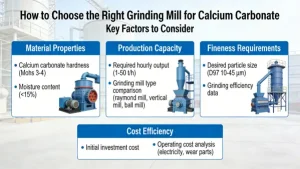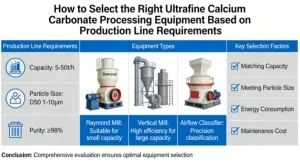
The core logic for selecting ultrafine calcium carbonate processing equipment is to center on production line requirements and match the technical performance, cost structure, production capacity scale and process adaptability of the equipment, rather than pursuing the superiority of a single equipment parameter. It is necessary to make precise matching with the characteristics of mainstream equipment such as jet mills, ring roller mills (ultrafine type) and ball mills (ultrafine modification all-in-one machine) around the five core demand dimensions of product positioning, production capacity planning, raw material characteristics, site/capital/operation capacity and downstream application requirements, while taking into account the continuity, expandability and comprehensive benefits of the production line. The following is a dimension-by-dimension, implementable selection process and decision-making points, covering the whole process from demand sorting to equipment finalization.
Step 1: Precisely Sort Out the Core Requirements of the Production Line (Prerequisite for Selection)
First, clarify the core objectives and constraint conditions of the production line to avoid equipment mismatch caused by vague demands, which is the foundation of selection. It is necessary to implement specific quantitative indicators instead of the vague demand of “ultrafine powder production”.
Product-side Requirements (Core Determinants of Equipment Technical Threshold)
Particlesize and distribution: Clarify the target particle size (e.g., 1250 mesh/2500 mesh/5000 mesh, corresponding to D97≈10μm/5μm/2μm), particle size distribution requirements (narrow distribution with D90/D10≤3 or ordinary wide distribution), and whether large particles are allowed (e.g., whether no particles >8μm are required);
Key quality indicators: Whiteness requirements (≥94%/≥95%/≥96%), purity requirements (whether food/pharmaceutical grade with no metal impurities; whether trace iron filings are allowed for industrial grade), particle morphology (whether cubic/spindle shape needs to be maintained, and whether dispersibility can be used directly without modification);
Product grade: High-end functional fillers (high added value, selling price ≥2000 CNY/ton), general fillers (medium and low added value, selling price 800-1500 CNY/ton), and whether synchronous modification is required (e.g., surface coating with stearic acid, coupling agent).
Production Capacity-side Requirements (Determine Equipment Model and Configuration Quantity)
Single machine capacity/total capacity: Clarify the designed hourly capacity (e.g., 1t/h/3t/h/10t/h) and annual capacity (5000 tons/year/20.000 tons/year/100.000 tons/year based on 300 days of 24-hour operation) of the production line;
Production mode: Continuous production (requiring uninterrupted operation capacity of equipment), batch production (small batch and multiple varieties), and whether multi-particle size switching is needed (e.g., one line for both 1250 mesh and 2500 mesh).
Resource-side Constraints (Determine the Feasibility Boundary of Equipment)
Rawmaterial characteristics: Raw materials are calcite/marble/limestone (Mohs hardness 2.7-3.0. easy to grind), silica content (≤3%/3-5%/>5%), moisture content (≤0.5%/0.5-1.0%/>1.0%), and raw material feed particle size (80 mesh/200 mesh/325 mesh);
Capital constraints: Initial investment budget (including equipment, infrastructure, supporting systems), affordability of daily operating costs (electricity fees, labor, wearing parts);
Site constraints: Plant floor area (length × width × height), whether strong vibration/high noise is allowed, foundation load-bearing capacity;
Operation capacity: Technical level of the operation team (professional technicians/ordinary workers), equipment maintenance capacity (whether wearing parts can be replaced independently/requiring on-site service from manufacturers).
Process-side Requirements (Determine the Supporting and Combination Mode of Equipment)
Integrated process or not: Whether crushing + classification + modification integration is needed (avoiding transfer between multiple equipment, reducing dust and loss);
Environmentalprotection requirements: Dust emission (≤30mg/m³), noise (≤85dB), energy consumption indicators (whether there are industrial energy-saving requirements);
Production line expandability: Whether it is planned to increase production capacity/reduce particle size in the future (e.g., upgrading from 2500 mesh to 5000 mesh), and whether it is necessary to match the subsequent packaging/storage system.
Step 2: Match the Core Characteristics of Mainstream Ultrafine Processing Equipment (Core of Selection)
The mainstream processing equipment for ultrafine calcium carbonate are jetmill(fluidized bedopposed type), ultrafine ring rollermill and ultrafine ballmill. Each of the three has its own applicable scenarios, with no absolute advantages or disadvantages, only differences in demand matching degree. Based on 2500 mesh (the core particle size of ultrafine powder), the core characteristics and adaptation boundaries of the three are sorted out, and it is clearly stated that the traditional Raymond mill (only suitable for ≤1250 mesh) is eliminated to avoid the selection of low-efficiency equipment.
Core Characteristics and Adaptation Table of Mainstream Equipment
| Equipment Type | Core Advantages | Core Disadvantages | Core Adaptable Requirements | Inadaptable Requirements |
| Fluidized Bed Opposed Jet Mill | Narrow particle size distribution, no metal impurities, intact morphology, improved whiteness, low vibration and noise | High unit energy consumption, high initial investment, low production capacity, sensitive to raw material moisture content (≤0.5%) | High-end ultrafine powder (2500-5000 mesh), narrow distribution, high whiteness and purity, food/pharmaceutical grade, small batch and high added value | Large-batch general powder, limited capital, small site, raw material moisture content >0.5% |
| Ultrafine Ring Roller Mill | Large production capacity, low unit cost, low initial investment, simple operation, small floor area, strong raw material adaptability | Relatively wide particle size distribution, slight metal impurities, partial morphology breakage, high noise and vibration | General ultrafine powder (1250-2500 mesh), large batch and low added value, limited capital/site, operation by ordinary workers | High-end narrow distribution powder, food/pharmaceutical grade, strict requirements for morphology/purity |
| Ultrafine Ball Mill (Modification All-in-one Machine) | Integratable crushing + modification, moderate investment, wide adjustable particle size range (800-5000 mesh) | Medium production capacity, medium particle size distribution, high consumption of wearing parts, long production cycle | Ultrafine powder requiring synchronous modification, medium production capacity, multi-particle size switching, balancing cost and quality | Ultra-narrow distribution high-end powder, large-batch continuous production, no modification demand |
Supplement: Adaptation of Combined Processes (Optimal Solution for Balancing Quality and Cost)
If the production line needs to produce both high-end powder and general powder, or pursue costoptimizationof high-end powder, there is no need for single equipment selection, and a “coarse grinding + fine grinding + classification” combined process can be adopted, with the core as follows:
Ultrafine ring roller mill (primary grinding) + jet mill (secondary classification/fine grinding): The ring roller mill grinds to 2500 mesh coarse powder at low cost, and the jet mill removes large particles and narrows the distribution to obtain high-end powder, with the unit cost 30-40% lower than that of pure jet mill;
Ball mill (crushing and modification) + air classifier: Solve the problem of wide distribution of ball mill, realize modification + narrow distribution integration, and adapt to the production of medium-scale high-end modified powder.
Step 3: Implement Selection Decisions by Scenarios (Directly Applicable)
Based on the core requirements of the production line, clear equipment selection schemes are given for 4 typical scenarios, covering more than 90% of the demand for ultrafine calcium carbonate production lines, and the matching requirements of supporting systems are clarified to ensure the continuity of the production line.
Scenario 1: High-end Ultrafine Powder Production Line (2500-5000 mesh, High Added Value)
Core requirements: 2500/5000 mesh, narrow distribution (D90/D10≤3), whiteness ≥95%, no metal impurities, intact morphology, small batch (annual capacity ≤5000 tons), downstream for high-end coatings/plastic films/food/pharmaceuticals;
Equipment selection: Fluidized bedopposed jet mill (main equipment) + high-precision built-in classifier + hot air drying system (equipped when raw material moisture content >0.5%) + ceramic/PTFE material parts (avoiding impurities);
Supporting requirements: Equip with high-efficiency air compressor + air dryer (ensuring air purity), bag filter (dust ≤30mg/m³), contact-free conveying system (avoiding secondary pollution);
Key points: Prioritize the jet mill with waste heat recovery to reduce unit energy consumption; if modification is needed, add an airflow modifier (no mechanical contact, avoiding morphology damage) after crushing.
Scenario 2: Large-scale General Ultrafine Powder Production Line (1250-2500 mesh, Low Added Value)
Core requirements: 2500 mesh, ordinary wide distribution, whiteness ≥94%, industrial grade (allowing trace impurities), large batch (annual capacity ≥10.000 tons, hourly capacity ≥3t/h), limited capital/site, downstream for rubber/ordinary plastics/building coatings;
Equipment selection: Ultrafine ring roller mill (main equipment, YFM160 and above models) + external high-precision turbine classifier + magnetic separation and iron removal system (removing worn iron filings) + simple modification system (optional, improving dispersibility);
Supporting requirements: Equip with noise reduction cover (noise ≤85dB), foundation reinforcement (solving vibration), bag filter, automatic feeding/discharging system (reducing labor);
Key points: The roller sleeve/grinding ring is made of ceramic composite or high-chromium cast iron material to extend the service life of wearing parts; the rotor speed of the classifier is adjustable (1000-3000r/min) to ensure the stability of particle size.
Scenario 3: Medium-scale Modified Ultrafine Powder Production Line (1250-2500 mesh, Balancing Quality and Cost)
Core requirements: 2500 mesh, medium distribution (D90/D10≤4), whiteness ≥94.5%, requiring surface modification (stearic acid/coupling agent), annual capacity 5000-10.000 tons, downstream for modified plastics/coatings;
Equipment selection: Ultrafine ball mill (modification all-in-one machine) + air classifier (supporting, narrowing distribution); or ultrafine ring roller mill + continuous modifier (modification after crushing, higher production capacity);
Supporting requirements: Equip with temperature control system (80-100℃ for modification), powder mixing system (uniform coating of modifier), classifier (removing large particles);
Key points: The ball mill uses alumina ceramic grinding media (avoiding metal impurities), and the modifier uses high-speed mixing type to ensure uniform coating.
Scenario 4: Multi-variety/Multi-particle Size Switching Production Line (800-5000 mesh, Flexible Production)
Core requirements: One line for 800/1250/2500/5000 mesh, small batch and multiple varieties, fast particle size switching, both general powder and high-end powder, annual capacity ≤8000 tons;
Equipment selection: Combination of small-sized jet mill + small-sized ultrafine ring roller mill + shared classification/collection/conveying system;
Supporting requirements: Equip with switchable feeding/classification system, particle size detection system (on-line laser particle size analyzer), and spare wearing parts of different specifications;
Key points: Prioritize the integrated control cabinet to realize independent parameter adjustment of the two sets of equipment, without major equipment modification when switching particle sizes.
Step 4: Key Verification and Risk Avoidance in Selection (Avoid Mismatch)
After completing the preliminary equipment matching, it is necessary to avoid selection risks through three steps of on-site verification, parameter review and cost accounting to ensure 100% matching between equipment and production line requirements and avoid blind procurement.
Raw Material Small Test + Pilot Test (The Most Core Verification Step)
Send the actualraw materials of the production line to the equipment manufacturer for small test (laboratory scale) + pilot test (industrial small batch) to verify the core indicators:
Small test: Verify whether the target particle size, whiteness and morphology can be achieved, and initially confirm the production capacity and energy consumption;
Pilot test: Run continuously for 4-8 hours to verify the stability of the equipment, the wear of wearing parts, and the consistency of product indicators, avoiding the disconnection between laboratory data and industrial production.
Whole-process Cost Accounting (Avoid Late Operation Pressure)
Based on the parameters provided by the manufacturer, calculate the wholelife cycle costof the production line instead of only looking at the initial investment:
Initial investment: Equipment + infrastructure + supporting systems (air compressor/dryer/dust collector) + installation and commissioning;
Operating cost: Unit electricity fee + wearing parts consumption + labor + maintenance + raw material loss (calculated by annual capacity);
Payback period: Calculate the equipment investment payback period based on product selling price and unit profit (generally, 1-3 years is a reasonable range for ultrafine powder equipment payback period).
Verification of Equipment Manufacturers and After-sales Service
Prioritize the selection of professional calcium carbonate processing equipment manufacturers (rather than general crushing equipment manufacturers), which need to meet the following requirements:
Having successful cases in the calcium carbonate industry (production lines with the same particle size/capacity), with on-site investigation available;
Having a complete after-sales service (supply of wearing parts, on-site maintenance, technical training);
Being able to provide customized whole-line solutions (one-stop supporting from raw material feeding to finished product packaging) to avoid poor connection of equipment from multiple manufacturers.
Site and Process Review
According to the equipment layout drawing provided by the equipment manufacturer, review whether the plant’s floor area, height, foundation load-bearing, power supply (voltage/power), and air supply (compressed air required for jet mill) meet the requirements; at the same time, review the connection between the equipment and the subsequent packaging and storage systems to ensure the continuity of the production line.
Step 5: Optimization and Expandability Design of Production Line Equipment (Long-term Benefits)
Selection is not a one-time decision, and it is necessary to take into account the late optimization and expansion of the production line to avoid the need to replace equipment for late upgrading, improve equipment utilization and long-term benefits:
Reserve production capacity space: When selecting equipment, select according to 1.2-1.5 times the designed production capacity (e.g., 4t/h equipment for 3t/h demand). The production capacity can be increased through parameter adjustment in the later stage without adding new equipment;
Reserve particle size upgrading space: The ultrafine ring roller mill needs to be equipped with a replaceable high-precision classifier, and the jet mill needs to be equipped with a high-speed classifier. It can be directly upgraded to 5000 mesh in the later stage without replacing the main engine;
Integrated process design: Prioritize the selection of equipment/schemes integrating crushing + classification + modification + conveying, reduce equipment transfer links, lower dust loss and labor costs, and improve production line efficiency;
Intelligent configuration: Equip with on-line particle size detection, automatic parameter adjustment and fault early warning systems to reduce the difficulty of manual operation, improve the stability of product indicators, and adapt to the future Industry 4.0 upgrading.
Core Summary of Selection
There is no fixed answer for the selection of ultrafine calcium carbonate processing equipment, and the core is “demand-driven, precise matching”:
If product quality is the core (high-end, high purity, narrow distribution) and unit cost is not a concern, select a jet mill;
If production capacity and cost are the core (general, large batch, low added value) and slight quality differences are acceptable, select an ultrafine ring roller mill;
If modification integration is the core (medium scale, requiring coating), select an ultrafine ball mill (modification all-in-one machine);
If balancing quality and cost (high-end + general powder), select the combined process of ring roller mill + jet mill.
Ultimately, all selection decisions must be based on the comprehensive benefits of the production line (product profit – equipment investment – operating cost), rather than the parameter superiority of a single equipment. Ensure that the equipment can create sustainable economic benefits for the production line, and at the same time adapt to the enterprise’s capital, site and operation capacity to achieve seamless connection between equipment and the production line.