Selecting the right liner plates for a calcium carbonate (CaCO3) ball mill requires careful consideration of purity requirements, material properties, and grinding efficiency, especially when targeting ultrafine particle sizes (0.02-0.1μm). Based on the knowledge base, here’s a comprehensive guide:
Key Considerations for CaCO3 Grinding
- Purity Requirements:
- CaCO3 is often used in high-purity applications like food, pharmaceuticals, cosmetics, and high-end plastics
- Metal contamination from traditional steel liners is unacceptable
- As noted in the knowledge base: “For fly ash ball mills, rubber liners or ceramic/silica stone liners are preferred to avoid iron particles mixing into the material”
- Material Properties:
- CaCO3 has a relatively low Mohs hardness (around 3), so extremely hard liners aren’t necessary
- However, for ultrafine grinding, liner design significantly impacts particle size distribution
Recommended Liner Materials for CaCO3 Ball Mills
1. Rubber Liners (Best for Most Applications)
- Advantages:
- Excellent corrosion resistance (pH 3-11 range)
- Reduces noise by 30dB (ideal for urban or sensitive environments)
- Prevents metal contamination
- Suitable for wet grinding processes
- Lower maintenance costs
- Best For: Most CaCO3 applications, especially where purity is important
2. Ceramic Liners (For Highest Purity Applications)
- Advantages:
- Zero metal contamination (critical for food, pharmaceuticals)
- Hardness comparable to diamond (HV1200-1500)
- Excellent wear resistance
- Disadvantages:
- Higher cost (4-6 times more expensive than manganese steel)
- Poor thermal shock resistance (temperature changes >200°C can cause cracking)
- Best For: Ultra-high purity requirements (e.g., pharmaceutical-grade CaCO3)
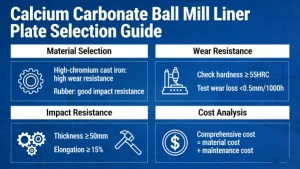
3. Avoid These Materials for CaCO3:
- High Manganese Steel:
- Prone to metal contamination (iron particles mixing with product)
- Requires impact to harden, which isn’t ideal for soft CaCO3
- As stated in the knowledge base: “Traditional high manganese steel is not suitable for ball mill liners, as it causes creep and extension, and surface phase transformation causes reverse deformation”
- High Chromium Cast Iron:
- While highly wear-resistant, it’s still a metal-based liner
- Not ideal for high-purity CaCO3 applications
- Better suited for coarse grinding applications
Liner Design Considerations
- Profile Type:
- For ultrafine grinding, wave or step profiles are recommended to promote fine grinding
- Avoid flat liners that promote coarse grinding
- Wear Distribution:
- For CaCO3 grinding, uniform wear is critical to maintain consistent particle size
- Consider liners with even wear characteristics to avoid “hot spots” of excessive wear
- Installation and Maintenance:
- Ensure proper installation to prevent gaps that could cause uneven grinding
- Rubber liners require less maintenance than metal liners
Selection Process
- Diagnose Your Specific Application:
- Determine the required purity level (food-grade, pharmaceutical-grade, etc.)
- Identify the target particle size (ultrafine vs. standard)
- Consider the moisture content of the feed (wet vs. dry grinding)
- Evaluate Wear Mechanisms:
- For CaCO3, wear is primarily abrasion rather than impact
- Choose liners optimized for abrasion resistance
- Conduct Cost-Benefit Analysis:
- Total cost = purchase cost + replacement frequency × (downtime + labor costs)
- For high-purity applications, the higher cost of ceramic liners may be justified
Practical Recommendations
- For Standard CaCO3 Grinding (80-600 mesh):
- Rubber liners are the optimal choice
- As noted in the knowledge base: “Wet grinding prefers rubber liners (corrosion reduction 70%)”
- For Ultrafine CaCO3 (600+ mesh):
- Ceramic liners or high-quality rubber liners with fine grinding profiles
- Consider “double metal composite” liners for high impact + high wear conditions
- For Environmental Compliance:
- Rubber liners reduce noise and vibration, which may be required for urban installations
Example Selection
If you’re producing CaCO3 for:
- Food Applications: Ceramic liners (highest purity)
- Pharmaceutical Applications: Ceramic liners
- Standard Industrial Applications: High-quality rubber liners
- Specialty Coatings: Rubber liners with fine grinding profile
As the knowledge base states: “For ultrafine powder processing (325 mesh and above), food/medical grade production lines, non-metallic materials are preferred.”
By selecting the appropriate liner material and design, you can significantly improve product quality, reduce contamination risks, and optimize grinding efficiency for your calcium carbonate ball mill.