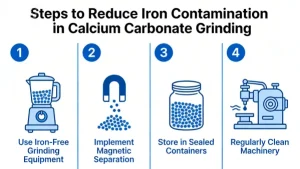
Reducing iron contamination during the grinding of calcium carbonate (CaCO₃) is crucial, especially for high-purity applications such as pharmaceuticals, food additives, paper coating, or specialty plastics. Iron contamination typically arises from wear of grinding media and equipment components (e.g., steel balls, liners, mills). Here are effective strategies to minimize iron contamination:
1. Use Non-Metallic Grinding Media and Liners
-
Replace steel grinding media with ceramic (e.g., zirconia, alumina) or high-density polyethylene (HDPE) media.
-
Line mills and classifiers with wear-resistant non-metallic materials such as:
-
Polyurethane
-
Ceramic tiles (alumina or zirconia)
-
Rubber linings
-
2. Select Appropriate Mill Type
-
Use non-ferrous mills such as:
-
Jet mills (air classifiers) – no moving parts, minimal contamination.
-
Vertical roller mills with ceramic components
-
Ball mills with ceramic lining and media
-
Jet mills are often preferred for ultra-fine, high-purity CaCO₃.
3. Pre-Treat Raw Material
-
Remove iron-bearing impurities before grinding using:
-
Magnetic separators (overband magnets, drum magnets)
-
Eddy current separators (for non-ferrous metals, though less relevant for Fe)
-
-
Ensure feedstock has low initial iron content.
4. Implement Post-Grinding Purification
-
Pass ground product through high-intensity magnetic separators (e.g., rare-earth drum magnets) to capture fine ferrous particles generated during grinding.
-
Use wet high-intensity magnetic separation (WHIMS) if processing in slurry form.
5. Optimize Process Parameters
-
Reduce grinding intensity/time to minimize media wear.
-
Avoid over-grinding—only grind to the required particle size.
6. Regular Maintenance and Cleaning
-
Inspect and replace worn metallic components promptly.
-
Clean equipment between batches to prevent cross-contamination.
7. Monitor Iron Content Routinely
-
Use analytical methods (e.g., ICP-OES, XRF) to track Fe levels and validate effectiveness of contamination control measures.
Summary Table
| Strategy | Effectiveness | Typical Fe Reduction |
| Ceramic grinding media | High | Down to 20–100 ppm |
| Jet milling | Very High | <50 ppm |
| Magnetic separation (pre/post) | Medium–High | 30–70% reduction |
| Non-metallic liners | High | Prevents ongoing contamination |