Coated calcium carbonate (CaCO₃) is produced via surface modification to convert hydrophilic CaCO₃ into hydrophobic/oleophilic particles, improving compatibility with organic matrices (plastics, rubber, coatings). Two primary coating methods are used for stearic acid and titanate coupling agents: dry process (most common for industrial scale) and wet process (for specialized applications).
Core Process Overview
The fundamental steps for producing coated CaCO₃ are:
- Pre-treatment: Grinding and drying of CaCO₃ (GCC/PCC)
- Coating application: Applying stearic acid, titanate, or both
- Reaction: Ensuring complete surface coverage and chemical bonding
- Post-treatment: Cooling, sieving, and quality control
1. Dry Coating Process (Most Industrial Applications)
Dry modification is preferred for its lower cost, simpler operation, and energy efficiency.
A. Equipment Required
| Equipment | Purpose |
|---|---|
| High-speed mixer (Henschel type) | Main reactor for coating; provides high shear and heating |
| Pin mill/ACM mill | Optional for in-process grinding and coating uniformity |
| Heating system | Controls temperature (90-120°C) for drying and reaction |
| Exhaust system | Removes moisture and volatile byproducts |
| Dosing system | Precise addition of modifiers (stearic acid, titanate) |
| Cooling unit | Prevents overheating post-reaction |
B. Step-by-Step Process for Stearic Acid Coating
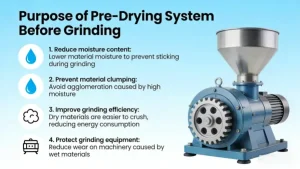
- Pre-drying: Add CaCO₃ (90-110 parts) to mixer, heat to 100-110°C, and dry for 5-10 minutes to remove surface moisture
- Stearic acid addition: Add 0.8-1.5% stearic acid (based on CaCO₃ weight) – can be molten or dissolved in solvent (ethanol) for better dispersion
- Reaction: Mix at high speed (1500-2000 rpm) for 10-20 minutes; temperature reaches ~100°C due to friction
- Cooling: Discharge at 110°C and cool to room temperature
- Sieving: Pass through 325-mesh screen to remove agglomerates
Reaction mechanism: Stearic acid reacts with CaCO₃ surface to form calcium stearate monolayer, creating hydrophobic surface:
2 C₁₇H₃₅COOH + CaCO₃ → (C₁₇H₃₅COO)₂Ca + CO₂↑ + H₂OC. Step-by-Step Process for Titanate Coating
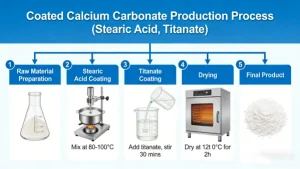
- Pre-drying: Dry CaCO₃ at 100-120°C for 5-10 minutes
- Titanate preparation: Dilute 0.5-3.0% titanate coupling agent (based on CaCO₃ weight) with solvent (liquid paraffin, ethanol, or isopropyl alcohol) at 1:1 ratio for better dispersion
- Titanate addition: Spray/dropwise add diluted titanate while mixing at high speed
- Reaction: Mix for 15-30 minutes at 80-100°C to ensure complete coupling reaction
- Cooling & finishing: Cool to <60°C before packaging
Reaction mechanism: Titanate’s inorganic end (RO⁻) bonds with CaCO₃ surface hydroxyl groups, while organic end (R’) provides compatibility with polymers:
Ti(OR)₄ + CaCO₃-OH → CaCO₃-O-Ti(OR)₃ + ROHD. Combined Stearic Acid + Titanate Coating (Dual Coating)
For enhanced performance (improved dispersion and mechanical properties):
- Dry CaCO₃ at 100°C for 5-10 minutes
- Add titanate coupling agent (1.5-2.5 parts) and react for 5-10 minutes
- Add stearic acid (2-3 parts) and continue mixing for 10-20 minutes
- Discharge at 110°C, cool, and sieve
Advantage: Titanate improves chemical bonding while stearic acid enhances lubricity and hydrophobicity.
2. Wet Coating Process (Specialized Applications)
Wet modification is used for nano-CaCO₃ or when uniform coating thickness is critical.
A. Equipment Required
| Equipment | Purpose |
|---|---|
| Reactor with stirrer | Main vessel for slurry processing |
| Heating/cooling jacket | Controls reaction temperature |
| Homogenizer | Ensures uniform modifier dispersion |
| Filter press/centrifuge | Solid-liquid separation |
| Spray dryer | Drying of coated CaCO₃ slurry |
B. Step-by-Step Process
- Slurry preparation: Disperse CaCO₃ in water to form 20-40% solids slurry
- Modifier preparation:
- Stearic acid: Dissolve in hot water (85°C) with NaOH (1:1.3 molar ratio) to form stearate emulsion
- Titanate: Dilute with isopropyl alcohol (1:1 ratio)
- Coating application: Add modifier emulsion to slurry under stirring at 60-80°C
- Reaction: Maintain temperature for 30-60 minutes to ensure complete surface coverage
- Separation: Filter and wash to remove unreacted modifiers
- Drying: Spray dry at 120-150°C inlet temperature
3. Key Process Parameters & Optimization
| Parameter | Stearic Acid Coating | Titanate Coating | Dual Coating |
|---|---|---|---|
| Modifier dosage | 0.8-1.5% (w/w) | 0.5-3.0% (w/w) | Titanate: 1.5-2.5%, Stearic acid: 2-3% |
| Temperature | 90-110°C | 80-100°C | 90-110°C |
| Reaction time | 10-20 min | 15-30 min | 20-35 min total |
| Mixing speed | 1500-2000 rpm | 1500-2000 rpm | 1500-2000 rpm |
| Solvent requirement | Optional (ethanol) | Required (white oil/IPA) | Required for titanate only |
4. Quality Control Parameters
| Property | Target Value | Testing Method |
|---|---|---|
| Activation degree | >95% | Toluene/water separation test |
| Oil absorption | 20-30 mL/100g | ASTM D281 |
| Moisture content | <0.5% | Karl Fischer titration |
| Particle size | D50: 0.5-5 μm | Laser diffraction |
| Hydrophobicity | Contact angle >100° | Contact angle measurement |
5. Industrial Production Considerations
-
Raw material selection:
- GCC (ground calcium carbonate): Cost-effective, used for general applications
- PCC (precipitated calcium carbonate): Higher purity, used for specialty applications
-
Cost optimization:
- Dry process is 30-50% cheaper than wet process
- Use of molten stearic acid avoids solvent costs
-
Safety:
- Titanate coupling agents are flammable; keep away from ignition sources
- Use proper ventilation to avoid exposure to volatile organic compounds
-
Environmental aspects:
- Recover and reuse solvents for titanate dilution
- Capture CO₂ from stearic acid reaction for potential reuse
6. Applications of Coated Calcium Carbonate
| Coating Type | Primary Applications | Key Benefits |
|---|---|---|
| Stearic acid | PVC pipes, films, masterbatches | Improved lubricity, processing efficiency |
| Titanate | Polyolefins, engineering plastics | Enhanced mechanical properties, impact resistance |
| Dual coating | Polyurethane foams, rubber products | Balanced lubricity and bonding strength |
Summary
The production of coated calcium carbonate with stearic acid and titanate involves dry or wet processes depending on application requirements. The dry process is dominant for industrial production due to cost-effectiveness, while the wet process is used for specialized needs. Key to success is precise control of temperature, modifier dosage, and mixing conditions to ensure uniform coating and complete surface modification.