Over-grinding is the main cause of high energy consumption, unwanted ultra-fine particles, and low productivity in ball mills—especially for soft materials like graphite and calcium carbonate. Below are the most practical, industrial-grade solutions:
1. Use Closed-Circuit Grinding (Most Effective Solution)
Open-circuit mills = severe over-grinding.
Closed-circuit with efficient classification is the single best way:
- Dry grinding: use high-efficiency air classifiers
- Wet grinding: use hydrocyclones
- Extract qualified fine particles immediately so they are not re-ground
- Lower circulating load to avoid over-grinding already-fine material
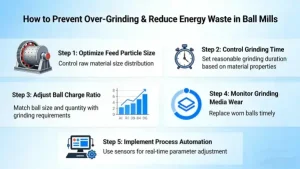
2. Optimize Ball Size & Ball Charge
Wrong balls = over-grinding + wasted energy.
- Use larger balls for coarse feed, smaller balls for fine grinding
- Avoid over-sized balls for soft materials (graphite, CaCO₃) → they cause excessive impact
- Keep ball filling rate at 30–40% of mill volume
- Regularly remove broken/worn-out balls and replenish properly
3. Control Mill Residence Time
Longer residence = more over-grinding.
- Maintain stable, uniform feeding (no starvation, no overloading)
- Run mill at 70–80% of critical speed
- Too fast: strong impact → over-grinding
- Too slow: low efficiency
- Use smooth liners for fine grinding (gentle action); wave liners only for coarse grinding
4. Use Two-Stage Grinding
For fine or ultrafine products:
- 1st stage: coarse grinding (large balls/rod mill)
- 2nd stage: fine grinding (small balls)
This eliminates over-grinding caused by mixing coarse and fine particles in one mill.
5. Optimize Slurry Concentration (Wet Grinding)
- Maintain stable concentration at 65–75%
- Too thin: fast flow, uneven grinding
- Too thick: poor fluidity, long residence → over-grinding
6. Stabilize All Operating Parameters
Fluctuations cause inefficient grinding and over-grinding:
- Constant feed rate
- Constant mill speed
- Stable air volume (dry grinding)
- Avoid idling or low-load operation (massive energy waste)
7. Online Particle Size Control (Automation)
Install a real-time particle size analyzer to:
- Automatically adjust classifier speed
- Automatically adjust feed rate
This prevents human delay from causing over-grinding.
8. Material-Specific Tips (Graphite, CaCO₃)
For soft, brittle minerals:
- Reduce impact force
- Shorten residence time
- Use a tighter classification cutoff
- Avoid strong cascading action
Key Summary
The core logic is simple:
Grind only as much as needed → remove qualified fines instantly → match grinding force to material and target size.
This will eliminate over-grinding and reduce specific energy consumption (kWh/t) significantly.
If you tell me your feed size, target fineness, and whether you use dry/wet grinding, I can give you a customized parameter set for your mill.