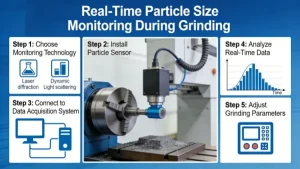
Real-time particle size monitoring in grinding processes (critical for industries like calcium carbonate, minerals, pharmaceuticals, and ceramics) is a core process analytical technology (PAT) that enables instant detection of particle size distribution (PSD), avoids off-line sampling delays, and supports closed-loop control of grinding parameters. The monitoring methods are classified by integration with the grinding process into in-line (direct in process stream), on-line (automatic sampling + rapid analysis), and at-line (semi-automatic sampling + lab-grade rapid testing)—with in-line being the gold standard for true real-time monitoring.
Below is a detailed breakdown of main monitoring technologies, system integration, process adaptation (for dry/wet grinding), and key considerations for calcium carbonate (CaCO₃) grinding (the most common application for this demand):
Core Real-Time Particle Size Monitoring Technologies
All technologies are optimized for grinding process conditions (high solid content, high flow rate, abrasive media, dust for dry grinding, slurry viscosity for wet grinding) and feature robust probes/sampling systems, fast analysis (1–10 seconds per measurement), and continuous data output.
1. Laser Diffraction (LD) – Most Widely Used for PSD Full Spectrum Monitoring
Principle: Laser light passes through a particle stream; particles scatter light at angles inversely proportional to their size (small particles = wide scattering angle, large particles = narrow angle). A detector array measures scattered light intensity, and PSD is calculated via the Mie scattering model (for submicron to millimeter particles, the standard for industrial grinding).
Grinding Application: Suitable for both dry and wet grinding (the dominant technology for CaCO₃ grinding, including heavy calcium carbonate (GCC) dry grinding and light calcium carbonate (PCC) wet grinding).
Real-Time Configuration:
-
In-line: A laser probe is directly inserted into the grinding loop (e.g., wet grinding slurry pipeline, dry grinding pneumatic conveying pipeline) with a flow cell/measurement cell designed for abrasive wear (hardened steel/ceramic linings).
-
On-line: An automatic sampler extracts a small stream of slurry/powder, conditions it (dilution, dispersion, deagglomeration), and feeds it into a compact laser diffraction analyzer.
Key Advantages: Measures full PSD (D10, D50, D90, D99) (the most critical parameters for grinding quality, e.g., D50 for CaCO₃ coating/paper applications) and has a wide measurement range (0.1 μm – 2000 μm, covering all grinding scales from coarse to nano-CaCO₃).
Industrial Equipment Examples: Malvern Panalytical Mastersizer 3000 In-Line, Horiba LA-960 On-Line, Bettersize 2600 In-Line (cost-effective for CaCO₃ industry).
2. Focused Beam Reflectance Measurement (FBRM) – Ideal for Wet Grinding & Agglomeration Monitoring
Principle: A rotating laser probe emits a focused beam into the slurry; as particles pass through the beam, they reflect light, and the detector measures the chord length distribution (CLD) of particles. CLD is correlated to PSD via calibration (for grinding processes, CLD directly reflects real-time particle size trends).
Grinding Application: Wet grinding only (the best choice for nano-CaCO₃ wet grinding, where slurry solid content is high (30–70 wt%) and viscosity is high—laser diffraction may require heavy dilution).
Real-Time Configuration: In-line probe direct insertion (no sampling/ dilution needed) into the grinding tank/circulation pipeline; the probe tip has a sapphire window (abrasion-resistant) and a purge gas port (prevents particle adhesion).
Key Advantages: No sample preparation, fast response (1 second per scan), detects particle agglomeration in real time (a critical issue for CaCO₃ wet grinding—agglomeration leads to false large particle readings), and works with high-solid slurries.
Industrial Equipment Examples: Mettler Toledo FBRM G400, Lasentec D600.
3. Dynamic Light Scattering (DLS) – For Nano-Scale Grinding (Submicron/ Nanometer Particles)
Principle: Brownian motion of nano-particles scatters laser light, causing fluctuations in scattered light intensity; the particle size is calculated from the intensity fluctuation rate (smaller particles = faster motion = higher fluctuation rate).
Grinding Application: Exclusively for nano-CaCO₃ wet grinding (D50 < 100 nm) or other nano-powder grinding; not suitable for micron-scale grinding (low resolution for large particles).
Real-Time Configuration: On-line/at-line (in-line is rare due to strict sample requirements—low solid content (0.1–1 wt%) and no agglomeration). An automatic sampler dilutes the high-solid slurry to the required concentration, disperses it, and feeds it into a compact DLS analyzer.
Key Advantages: High resolution for nano-particles; measures hydrodynamic diameter (reflects actual particle size in slurry, critical for nano-CaCO₃ application performance).
Industrial Equipment Examples: Malvern Panalytical Zetasizer Nano On-Line, Brookhaven BI-200SM On-Line.
4. Electrical Sensing Zone (ESZ) – For Monodisperse/ Micron-Scale Dry/Wet Grinding
Principle: Particles pass through a small orifice between two electrodes; the particle displaces the conductive fluid (wet) or ionized gas (dry), causing a change in electrical resistance/pulse amplitude—the pulse amplitude is proportional to particle volume (size).
Grinding Application: Suitable for micron-scale CaCO₃ grinding (1–100 μm) with narrow PSD; ideal for quality control of monodisperse powder.
Real-Time Configuration: On-line (automatic sampling + fluidization for dry grinding, direct flow for wet grinding).
Key Limitation: Narrow measurement range; not suitable for high-solid/high-viscosity slurries.
Industrial Equipment Examples: Beckman Coulter Multisizer 4e On-Line, Particle Measuring Systems AccuSizer 780 A7000.
5. Alternative Rapid Methods (At-Line, Low-Cost)
For small-scale grinding processes or low-budget scenarios, at-line rapid testing is a compromise for “near real-time” monitoring:
-
Laser Particle Sizer (Lab Compact Version): Manual sampling (1–2 minutes) + rapid analysis (30 seconds); suitable for batch grinding of CaCO₃ with low production capacity.
-
Image Analysis (IA): Automatic sampling + high-speed camera imaging + AI-based particle size calculation; measures morphology + PSD (useful for CaCO₃ grinding where particle shape affects application performance, e.g., paper coating).
System Integration: Real-Time Monitoring + Grinding Process Linkage
Real-time particle size monitoring is not just about a standalone analyzer—it requires seamless integration with the grinding equipment and process pipeline to ensure representative sampling and stable measurement. The integration design differs significantly for dry grinding (e.g., GCC grinding with Raymond mill, vertical mill, air classifier mill) and wet grinding (e.g., nano-CaCO₃ grinding with bead mill, ball mill).
1. Integration for Dry Grinding (GCC Mainstream Process)
Dry grinding challenges: powder dust, particle segregation, low flow uniformity—the core design is to ensure the measured powder stream is representative of the entire grinding system and to protect the analyzer from abrasive wear/dust contamination.
-
Sampling System: Install a dilution system in the pneumatic conveying pipeline (the main output of dry grinding mills) – use dry, clean compressed air to dilute the high-concentration powder stream (1–5 vol%) to a uniform aerosol for laser diffraction measurement.
-
Probe/Cell Protection: Use hardened ceramic (Al₂O₃/SiC) linings for in-line measurement cells; install a purge air system to prevent powder adhesion to laser windows/probes.
-
Typical Integration Point: After the air classifier (the key unit for controlling CaCO₃ PSD in dry grinding) – monitor PSD in real time and adjust classifier speed to correct over/under grinding.
2. Integration for Wet Grinding (Nano/PCC CaCO₃ Mainstream Process)
Wet grinding challenges: high slurry solid content, viscosity, particle agglomeration, abrasive grinding media (beads/balls)—the core design is to avoid probe fouling and ensure particle dispersion.
-
In-Line Probe Installation: Insert FBRM/laser diffraction probes into the circulation pipeline (not the grinding tank directly) to avoid collision with grinding media; install a scraper/purge system on the probe window to prevent slurry adhesion.
-
Sample Conditioning (for laser diffraction): If slurry solid content is too high (>60 wt%), add an automatic dilution unit (with deionized water and dispersant) to adjust the concentration to the optimal measurement range (5–20 wt%); add a static mixer/ultrasonic disperser to break up soft agglomerates (critical for CaCO₃, which is prone to agglomeration in wet grinding).
-
Typical Integration Point: After the grinding mill and before the product tank – monitor PSD in real time and adjust mill speed, bead load, or feed rate.
Data Processing & Closed-Loop Control (The Ultimate Goal of Real-Time Monitoring)
Real-time particle size data is only valuable if it is used to control the grinding process—this step transforms “passive monitoring” into “active process optimization” and is essential for consistent CaCO₃ product quality (a key requirement for CaCO₃ buyers in coating, paper, and plastic industries).
1. Real-Time Data Acquisition & Visualization
-
The analyzer outputs raw PSD data (D10, D50, D90, D99) via standard industrial communication protocols: 4–20 mA, Modbus RTU/TCP, OPC UA (the most common for smart factories).
-
The data is transmitted to a PLC (Programmable Logic Controller), SCADA (Supervisory Control and Data Acquisition) system, or industrial cloud platform for real-time visualization (trend charts, PSD curves, alarm thresholds).
-
Set automatic alarms for out-of-spec PSD (e.g., D50 of CaCO₃ for paper coating is 2 μm – alarm if D50 > 2.2 μm or < 1.8 μm).
2. Closed-Loop Process Control
Link the real-time PSD data to the grinding process parameters via PLC/SCADA to achieve automatic adjustment—the core control logic for CaCO₃ grinding is as follows (take the most common D50 as the control target):
|
Deviation
|
Dry Grinding (GCC, Vertical Mill/Air Classifier Mill)
|
Wet Grinding (Nano-CaCO₃, Bead Mill)
|
|
D50 > Target (over-coarse particles)
|
1. Increase air classifier speed<br>2. Reduce mill feed rate<br>3. Increase mill grinding pressure
|
1. Increase mill rotor speed<br>2. Reduce feed rate<br>3. Increase grinding media load (bead size)
|
|
D50 < Target (over-fine particles)
|
1. Decrease air classifier speed<br>2. Increase mill feed rate<br>3. Decrease mill grinding pressure
|
1. Decrease mill rotor speed<br>2. Increase feed rate<br>3. Reduce grinding time (circulation flow rate)
|
|
Severe Agglomeration (FBRM detects large chord lengths)
|
N/A (dry grinding agglomeration is rare)
|
1. Increase dispersant dosage<br>2. Activate ultrasonic disperser<br>3. Reduce slurry solid content
|
3. Data Logging & Process Optimization
-
Log all real-time PSD data and grinding parameters (temperature, pressure, speed, feed rate) for batch traceability (required for food/ pharmaceutical grade CaCO₃) and process optimization (use AI/machine learning to find the optimal parameter combination for target PSD and minimum energy consumption).
-
Use the data to calculate grinding efficiency (e.g., energy consumed per unit of fine particles produced) and reduce energy waste (grinding is an energy-intensive process—CaCO₃ grinding accounts for 60–80% of total plant energy consumption).
Key Considerations for CaCO₃ Grinding (Industry-Specific Requirements)
CaCO₃ has unique properties (mild abrasiveness, water slight solubility, easy agglomeration in wet grinding) that require targeted adjustments to the real-time monitoring system—these are the most critical points for practical application:
-
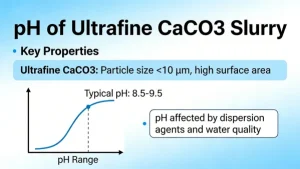
Prevent CaCO₃ Dissolution (Wet Grinding): CaCO₃ is slightly soluble in water (pH < 7); use neutral/alkaline dispersant (e.g., sodium polyacrylate) and adjust slurry pH to 8–10 to avoid dissolution and false particle size readings.
-
Abrasion Resistance Design: CaCO₃ powder/slurry is mildly abrasive; use sapphire windows (FBRM/laser probes), ceramic (SiC/Al₂O₃) measurement cells, and hardened steel sampling pipelines to extend equipment service life.
-
Agglomeration Elimination: CaCO₃ particles have high surface energy and are prone to soft agglomeration in wet grinding; add a low-dose, high-efficiency dispersant and an on-line ultrasonic disperser (20–40 kHz) to break up agglomerates—this is the single most important factor for accurate real-time PSD measurement of CaCO₃.
-
Calibration & Validation: Calibrate the real-time analyzer with standard reference materials (SRM) (e.g., NIST-traceable polystyrene latex particles) monthly; validate the real-time PSD data with off-line lab laser diffraction (gold standard) weekly to ensure accuracy.
-
Dust Explosion Prevention (Dry Grinding): GCC dry grinding produces fine powder with dust explosion risks; use explosion-proof (ATEX/IECEx) certified analyzers and inert gas (nitrogen) purging for the sampling system if needed.
Typical Industrial Application Cases for CaCO₃
-
GCC Dry Grinding (Paper Coating Grade, D50=2 μm): Malvern Panalytical Mastersizer 3000 In-Line + vertical mill + air classifier; real-time monitor D50/D90, adjust classifier speed and mill feed rate via PLC, achieve PSD stability with ±0.1 μm deviation, and reduce off-spec product by 80%.
-
Nano-CaCO₃ Wet Grinding (Plastic Filler Grade, D50=50 nm): Mettler Toledo FBRM G400 + bead mill + on-line DLS; FBRM monitors real-time chord length (agglomeration), DLS measures accurate nano-PSD, adjust mill speed and dispersant dosage, achieve agglomeration rate <5%, and product uniformity >95%.
-
PCC Wet Grinding (Paint Grade, D50=5 μm): Bettersize 2600 In-Line + ball mill; direct in-line measurement of slurry PSD (no dilution), adjust mill rotation speed and feed rate, reduce grinding cycle time by 30%, and save energy by 20%.
Summary of Technology Selection
For CaCO₃ grinding (the primary application), the technology selection principle is based on grinding type and particle size range:
-
Dry grinding (GCC, 1–100 μm): In-line laser diffraction (best choice) – measures full PSD, easy integration, high reliability.
-
Wet grinding (micron PCC, 1–50 μm): In-line laser diffraction (with dilution/dispersion) – balances accuracy and cost.
-
Wet grinding (nano-CaCO₃, <100 nm): FBRM (real-time agglomeration) + on-line DLS (accurate nano-PSD) – combined monitoring for optimal results.
-
Low budget/small scale: At-line compact laser particle sizer – compromise for near real-time monitoring.
Real-time particle size monitoring is a key technology for smart grinding of CaCO₃—it not only ensures consistent product quality but also reduces energy consumption, shortens grinding cycles, and eliminates the waste of off-line sampling. The future trend is the combination of multi-sensor monitoring (PSD + particle morphology + slurry viscosity) and AI-based self-optimizing control to achieve fully autonomous grinding processes.