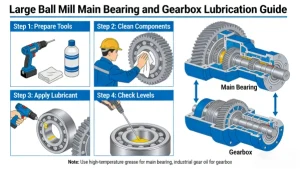
For large ball mills, use forced circulation oil lubrication for main bearings (with high-pressure jacking on startup) and enclosed oil bath/circulation for gearboxes + automatic spray lubrication for open girth gears. Key steps include: pre-start checks, correct oil selection, proper flow/temperature control, scheduled oil changes, and continuous monitoring. Always follow manufacturer specifications.
Main Bearing Lubrication
Large ball mills typically use trunnion bearings (spherical babbitt alloy) or hydrodynamic/hydrostatic bearings that support massive rotating loads. These require sophisticated lubrication systems to prevent catastrophic failure.
1. Lubrication Methods
| Method | Description | Application |
|---|---|---|
| Forced Circulation (Dynamic Pressure) | Low-pressure, high-flow oil pumped continuously to bearings, filtered and cooled | Standard for large mills with trunnion bearings |
| Hydrostatic (High-Pressure Jacking) | 100-300 bar oil lifts the mill shaft (0.1-0.2mm) before startup to eliminate metal-to-metal contact | Critical for heavy mills, prevents bearing damage during startup |
| Hydrodynamic/Hydrostatic Combo | High-pressure during startup, low-pressure during operation | Modern large mills for maximum protection |
2. Step-by-Step Lubrication Procedure
Pre-Startup Preparation
- Inspect the system: Check oil level in reservoir, filters, pumps, and pressure gauges for proper operation
- Cleanliness is critical: Ensure oil is filtered (NAS 8 class or better) and free of contaminants
- Temperature control: Preheat oil if ambient temperature <10°C to achieve proper viscosity
- Seal inspection: Verify bearing seals are intact to prevent oil leakage and contamination
Startup Lubrication Sequence
- Activate high-pressure jacking system: Start 5-10 minutes before mill rotation to lift trunnions
- Initiate low-pressure circulation: Start main oil pump to flood bearing with oil (3-5 GPM per bearing)
- Verify pressure and flow: Ensure high-pressure (150-250 bar) and low-pressure (2-4 bar) are within specified ranges
- Start mill rotation: Only after confirming oil film is established (pressure indicators stable)
- Deactivate high-pressure system: After 15-30 minutes of stable operation (varies by manufacturer)
Operational Monitoring
- Maintain oil temperature between 35-55°C (max 60°C)
- Monitor oil flow rates (typically 3-5 GPM per trunnion bearing)
- Check pressure gauges continuously for abnormalities
- Inspect for leaks and maintain proper oil level
Maintenance Schedule
| Task | Frequency | Notes |
|---|---|---|
| Oil analysis | Monthly | Check viscosity, contamination, and additive levels |
| Filter replacement | 250-500 hours | Use manufacturer-recommended filters |
| Complete oil change | 6 months-1 year | First change after 300-600 hours of initial operation |
| Bearing inspection | Annual | Check babbitt wear (max 5mm), surface condition, and clearances |
3. Lubricant Selection for Main Bearings
| Factor | Recommendation |
|---|---|
| Base Oil | Mineral oil (ISO VG 320-460) or synthetic oil for extreme conditions |
| Viscosity | Higher viscosity for heavy loads; adjust for temperature (lower in summer, higher in winter) |
| Additives | Anti-wear, rust inhibitors, and oxidation resistance |
| Oil Cleanliness | NAS 8 class or better (critical for bearing life) |
Gearbox Lubrication
Large ball mills have two main gear systems: the enclosed speed reducer (gearbox) and the open girth gear/pinion drive. Each requires distinct lubrication approaches.
1. Enclosed Gearbox Lubrication
Methods
- Oil Bath: Gears partially submerged in oil (splash lubrication) – simple but limited to low-to-medium speeds
- Forced Circulation: Oil pumped through heat exchangers and filters – preferred for high-power gearboxes
Step-by-Step Procedure
- Pre-operation checks:
- Verify oil level via sight glass (maintain at center line)
- Check for leaks and damaged seals
- Ensure cooling system is operational
- Oil selection:
- ISO VG 220-320 extreme pressure (EP) gear oil for standard conditions
- Synthetic EP oils (PAO or ester-based) for high temperatures (>50°C) or heavy loads
- Additives: EP, anti-wear, corrosion inhibitors, and foam suppressants
- Lubrication operation:
- Start oil circulation 5-10 minutes before gearbox engagement
- Maintain oil temperature at 40-55°C (max 60°C)
- Monitor oil pressure and flow rates continuously
- Maintenance:
- First oil change: After 300-600 hours
- Routine oil changes: Every 6-12 months (or 2000-4000 hours)
- Oil analysis: Monthly to check for wear particles, oxidation, and viscosity changes
- Filter replacement: Every 500-1000 hours
2. Open Girth Gear Lubrication
Large ball mills typically use a ** girth gear and pinion** drive system that requires specialized lubrication due to exposure to dust and harsh conditions.
Methods
- Automatic Spray Lubrication: Preferred method – precise oil delivery to gear teeth via nozzles timed with rotation
- Drip Lubrication: Gravity-fed oil to splash pans (less precise, for smaller mills)
- Grease Lubrication: Heavy-duty EP grease for low-speed applications
Step-by-Step Spray Lubrication Procedure
- System setup:
- Install nozzles at 15-30° angle to gear teeth (target the pitch line)
- Use air-assisted spray for better coverage and reduced consumption
- Set spray timing to coincide with tooth engagement
- Lubricant selection:
- High-viscosity (ISO 680-1000) open gear oil with solid lubricants (MoS₂)
- Synthetic blends for extreme temperatures or heavy shock loads
- Good adhesion properties to prevent wash-off from water or dust
- Application:
- Apply lubricant every 15-30 minutes during operation
- Ensure complete coverage of all gear teeth without excess build-up
- Clean gear surfaces regularly to remove old lubricant and contaminants
- Monitoring:
- Check for uneven wear or pitting on gear teeth
- Verify proper spray pattern and coverage
- Inspect for lubricant contamination by process materials
Critical Success Factors
- System Design: Use separate lubrication systems for main bearings and gearboxes for better control
- Filtration: Install multi-stage filtration (10-25 μm) to remove contaminants that cause wear
- Cooling: Use oil coolers to maintain optimal temperature (35-55°C) and viscosity
- Interlocks: Install safety interlocks to prevent mill startup without proper lubrication pressure/flow
- Training: Ensure operators understand the lubrication system and know how to respond to alarms
Troubleshooting Common Issues
| Problem | Cause | Solution |
|---|---|---|
| High bearing temperature (>60°C) | Insufficient flow, dirty oil, worn bearings | Increase flow, change oil/filter, inspect bearings |
| Low oil pressure | Leaks, clogged filters, pump failure | Repair leaks, clean/replace filters, service pump |
| Gear tooth wear | Inadequate lubrication, wrong oil type, misalignment | Adjust lubrication, use EP oil, realign gears |
| Oil contamination | Seal failure, dust ingress | Replace seals, improve dust protection, install breathers |
Final Recommendations
- Always follow the manufacturer’s specific lubrication guidelines for your ball mill model
- Implement a preventive maintenance program with scheduled oil changes, analysis, and inspections
- Maintain detailed records of lubrication activities, oil analysis results, and equipment performance
- Consider upgrading to automated lubrication systems for consistent, reliable performance and reduced labor costs
Remember: Proper lubrication is the single most important factor in extending the life of your ball mill’s main bearings and gearbox. Invest in quality lubricants, maintain your systems diligently, and monitor conditions continuously to avoid costly downtime.