The brightness (whiteness) of ground calcium carbonate is a core quality index for its application in coatings, plastics, papermaking, rubber and other industries. It is mainly determined by the raw material properties of calcite ore and affected by processing technology, impurity removal, and production environment control. The improvement of GCC brightness is a systematic process, starting from raw material selection and covering the whole production chain of crushing, grinding, purification, and post-treatment. Below is a detailed, industrial-feasible technical scheme, divided into core steps and auxiliary optimization measures:
Raw Material Selection & Pre-selection: The Fundamental Guarantee of Brightness
GCC is processed by physical grinding of natural calcite (calcium carbonate content ≥98%), and the inherent brightness of the ore is the primary factor determining the final product’s whiteness. No subsequent process can make up for the defect of low raw material whiteness.
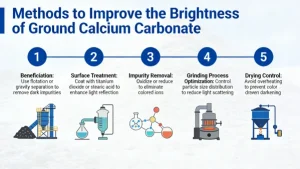
Select high-whiteness calcite ore: Prioritize ore with CIE L* value (CIE whiteness standard) ≥90 (blue light whiteness ≥85) and low content of chromogenic impurities (Fe₂O₃, MnO, TiO₂, organic matter, and clay minerals). Industrial-grade high-brightness GCC requires ore Fe₂O₃ < 0.05%, MnO < 0.01%.
Ore pre-selection: Remove heterochromatic ore blocks, gangue, and rock debris by hand sorting (for coarse ore) and washing (for ore with surface mud). For ore with obvious magnetic impurities, use dry low-intensity magnetic separation for pre-removal to reduce the impurity load of subsequent processes.
Avoid mixed mining of low-quality ore layers: Strictly separate high-whiteness ore layers from mud-bearing, carbon-bearing, or iron-manganese-rich ore layers during mining to prevent cross-contamination.
Ore Pretreatment: Eliminate Surface & Loose Impurities
Pretreat the selected ore to remove surface adherent impurities and control moisture, which avoids impurity introduction and grinding agglomeration in the subsequent process.
High-efficiency washing: Use countercurrent washing or ultrasonic washing for ore with high clay content (clay < 1% after washing). Clay minerals (kaolin, illite) will make GCC appear gray and reduce its brightness; ultrasonic washing can remove fine clay attached to ore cracks.
Controlled drying: Dry the washed ore to a moisture content of 0.5% or less at 105–120℃ (using flash dryers or disk dryers). Avoid overheating (>150℃) to prevent carbonization of trace organic matter in the ore (which forms black spots) and avoid incomplete drying (moisture causes particle agglomeration during grinding, affecting brightness and fineness).
Crushing impurity control: Use jaw crushers or cone crushers with wear-resistant liner (high manganese steel or ceramic) for coarse crushing; avoid ordinary carbon steel equipment to prevent iron chip mixing (iron chips will oxidize to Fe₂O₃ and form yellow/brown spots in the product).
Grinding & Classification Optimization: Minimize Mechanical Impurity Introduction
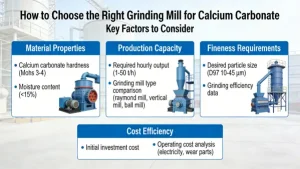
GCC grinding is a physical process (crushing → fine grinding → classification), and the key to brightness protection is to reduce mechanical impurity mixing and avoid over-grinding-induced defects. The choice of grinding equipment and process directly affects the final brightness and particle size distribution.
Key Equipment & Material Requirements
Use equipment with non-ferrous, high-whiteness wear-resistant contact parts to eliminate iron contamination (the main cause of GCC yellowing):
Fine grinding: Replace traditional Raymond mill carbon steel grinding rollers/ring with ceramic (alumina/zirconia) or nylon66 parts; use airflow mill for high-purity GCC (no contact grinding, almost no mechanical impurity introduction).
Classification: Adopt high-precision airclassifier (turbine type) with ceramic impellers; ensure the classification efficiency >95% to remove coarse impurity particles in time.
Conveying & mixing: Use 304/316 stainless steel or ultra-high molecular weight polyethylene (UHMWPE) pipelines and hoppers instead of carbon steel equipment; regularly clean equipment inner walls to remove scale and iron filings.
Process Control
Closed-circuit grinding process: Adopt “grinding + classification” closed circuit to avoid over-grinding. Over-grinding will cause lattice defects of CaCO₃ particles and make the product appear gray; it will also generate heat and cause local organic matter carbonization.
Control grindingfinenessmatching: The brightness of GCC has a certain correlation with fineness (the finer the particle size under the same raw material, the higher the apparent brightness). For general applications (coating/papermaking), control the D97 at 2–10 μm; for high-brightness requirements, grind to D97 < 2 μm (nano/micron grade) with airflow mill.
Deep Impurity Removal: The Core Step to Improve Brightness
Trace chromogenic impurities (Fe, Mn, Ti ions) and non-magnetic gangue (silicate, aluminate) in calcite ore are the main factors limiting the further improvement of GCC brightness. Physical purification is the main method (industrial feasibility, no damage to CaCO₃ crystal structure), and chemical purification is the auxiliary method (for high-brightness GCC with ultra-low impurity requirements).
Physical Purification (Mainstream Industrial Technology)
Physical methods have the advantages of no chemical residue, high yield, and simple operation, and are suitable for large-scale production.
High-gradient magnetic separation (HGMS): The most commonly used method for removing iron/manganese impurities. Adopt wet high-gradient magnetic separation (slurry concentration 20–30%) with a magnetic field strength of 10000–20000 GS; use multi-stage magnetic separation (2–3 stages) for ore with high iron content, which can reduce Fe₂O₃ content to <30 ppm. Wet magnetic separation is better than dry magnetic separation because the slurry disperses particles and magnetic impurities are easier to be adsorbed by the magnetic medium.
Optical color sorting: For coarse GCC particles (0.1–1 mm) with heterochromatic ore grains (e.g., carbon black spots), use CCD optical color sorter to accurately remove heterochromatic particles with a removal rate of >99%. Suitable for the production of high-purity GCC (calcium carbonate content ≥99.9%).
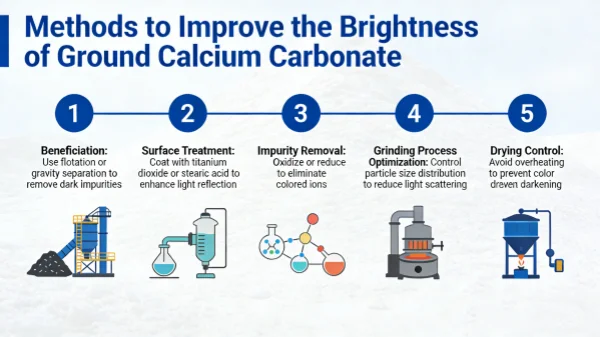
Flotation: For non-magnetic gangue impurities (e.g., quartz, feldspar, talc) in ore, use anionic flotation with fatty acid collectors (e.g., oleic acid, stearic acid) and adjust the slurry pH to 8–10 (with Na₂CO₃). Flotation can remove silicate impurities to <0.5%, avoiding the gray color of GCC caused by silicate scattering.
Chemical Purification (Auxiliary for Ultra-High Brightness GCC)
Aim at soluble trace iron/manganese ions in GCC; use weak acid mild treatment to avoid excessive dissolution of CaCO₃ (ensure yield >95%). Suitable for GCC with CIE L* ≥95 (e.g., papermaking coating, high-grade paint).
Weak acid leaching: Prepare 0.5–2% dilute acid solution (citric acid, oxalic acid, or dilute hydrochloric acid; citric acid is preferred for no chloride ion residue), mix with GCC slurry (solid-liquid ratio 1:3), stir at room temperature for 30–60 min. The acid reacts with Fe³+/Mn²+ to form soluble metal salts, then filter, wash with deionized water (to remove soluble salts), and dry.
Reduction-assisted leaching: For ore with high Fe³+ content (Fe³+ is less soluble in weak acid), add a small amount of reducing agent (0.1–0.3% sodium sulfite/metabisulfite) to the acid solution to reduce Fe³+ to Fe²+ (more soluble in weak acid), which can improve the iron removal rate by 20–30%.
Note: Avoid strong acid (e.g., concentrated hydrochloric acid/sulfuric acid) and high-temperature reaction, which will cause a large amount of CaCO₃ dissolution (CaCO₃ + 2H+ = Ca²+ + CO₂↑ + H₂O) and reduce the product yield and whiteness (the dissolved Ca²+ will form calcium sulfate/calcium chloride precipitation and contaminate the product).
Post-Treatment & Surface Modification: Optimize Apparent Brightness
Surface modification does not directly increase the intrinsic whiteness of GCC, but it can improve theparticle dispersion (agglomerated particles appear gray, and dispersed particles show higher apparent brightness) and avoid secondary contamination of the product. At the same time, reasonable post-treatment can lock the purification effect.
Washing & filtration: After purification (magnetic separation/acid leaching), wash the GCC slurry with deionized water (instead of tap water) to remove soluble salts (e.g., FeSO₄, MnCl₂) and residual acid; the washing end point is neutral (pH 6.5–7.5). Use plate and frame filter press for solid-liquid separation to reduce moisture content (≤20%) and facilitate subsequent drying.
Controlled drying & cooling: Use spray drying (for fine powder) or flash drying (for general powder) to dry the filter cake; the hot air temperature is controlled at 120–150℃, and the outlet material temperature is 60–80℃. Dry the product and cool it to room temperature in time to prevent moisture absorption (moisture absorption causes agglomeration) and oxidation (re-oxidation of Fe²+ to Fe³+).
High-whiteness modifier selection: For modified GCC (used in plastics/rubber), select high-whiteness surface modifiers (e.g., stearic acid, calcium stearate, titanate coupling agent, silane coupling agent) with whiteness ≥95. Avoid low-whiteness modifiers (e.g., oxidized paraffin wax) to prevent reducing the product brightness. Control the modification temperature (80–100℃) and time (15–30 min) to avoid modifier decomposition and carbonization.
Production Environment & Storage Control: Avoid Secondary Contamination
Even high-brightness GCC will lose brightness due to secondary contamination in production and storage; strict environmental and process control is the key to maintaining brightness stability.
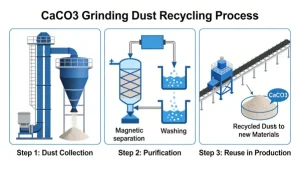
Closed production system: Realize full closed-circuit operation of crushing, grinding, purification, and packaging to avoid dust, smoke, and iron filings in the workshop from mixing into the product. Install dust removal equipment (bag filter, electrostatic precipitator) in the workshop to control the dust concentration <10 mg/m³.
Regular equipment maintenance: Clean the inner walls of grinding, classification, and conveying equipment every 24–48 hours; check the wear of ceramic/stainless steel parts regularly and replace them in time to avoid iron chip mixing caused by part wear.
Moisture-proof & clean storage: Store the finished GCC in stainless steel or plastic sealed silos; the warehouse humidity is controlled at <60% and the temperature at 15–30℃. Avoid contact with iron, copper, and other metal materials during storage (metal oxidation will contaminate the product).
Clean packaging: Use coated woven bags, kraft paper bags, or plastic sealed bags for packaging; the packaging materials must be clean and dry (moisture content <0.5%) to avoid contamination by dust and impurities in the packaging.
Quality Detection & Process Real-Time Adjustment
Set up multi-point detection in the production chain to monitor brightness and impurity content in real time, and adjust process parameters in time to ensure stable product quality:
On-linewhitenessdetection: Install CIE Lab whiteness meter* at the grinding, purification, and finished product outlets to detect the whiteness of intermediate and finished products in real time (detection frequency ≥1 time/hour).
Impurity content detection: Use atomic absorptionspectrophotometer(AAS) or inductively coupled plasmaemission spectrometer (ICP) to detect the content of Fe, Mn, Ti and other elements in the finished product (detection frequency ≥1 time/shift), and control Fe₂O₃ < 50 ppm, MnO < 10 ppm for high-brightness GCC.
Process parameter adjustment: If the whiteness is reduced, check the raw material quality first, then adjust the magnetic separation field strength, acid leaching concentration, or classification efficiency to eliminate the problem in time.
Typical Brightness Improvement Process for Different GCC Grades
According to the application requirements of GCC, the process can be optimized to balance brightness, yield, and production cost:
| GCC Grade | Application | Target Whiteness (CIE L*) | Recommended Process |
| General grade | Rubber, building materials | ≥90 | Raw material selection + dry magnetic separation + ceramic grinding |
| Medium grade | General coatings, papermaking filling | ≥93 | High-whiteness ore + wet HGMS (1 stage) + airflow mill + closed-circuit classification |
| High grade | High-grade coatings, papermaking coating | ≥95 | Ultra-high whiteness ore + wet HGMS (2–3 stages) + weak acid leaching + optical color sorting + spray drying |
| Ultra-high purity grade | Food, cosmetics, electronic materials | ≥97 | Purified calcite ore + airflow mill + multi-stage magnetic separation + citric acid leaching + deionized water washing |
Key Notes
Yield balance: Deep purification (e.g., acid leaching) will reduce the GCC yield by 3–5%; the process should be designed according to the market demand for brightness and cost.
No chemical residue: For food/medical grade GCC, chemical purification is prohibited; physical purification (magnetic separation + flotation + color sorting) is the only option to ensure compliance with food safety standards.
Crystal structure protection: All processes are physical/ mild chemical treatments to avoid destroying the calcite crystal structure (the crystal structure affects the oil absorption value, dispersibility, and other properties of GCC).
By implementing the above steps, the whiteness of GCC can be increased by 3–8 CIE L* units on the basis of raw material whiteness, and the high-brightness and stable-quality GCC products can be obtained to meet the application requirements of different high-end industries.