This is a practical, field-ready guide for ball mills, vertical roller mills, hammer mills, and roller mills.
1. Quick On-Site Diagnosis (No Special Tools)
1) When does vibration happen?
- Only at startup / low speed: Likely foundation looseness, resonance, or uneven media settling.
- Constant at full speed: Imbalance, bearing damage, or misalignment.
- Only under load / with material: Uneven feeding, material segregation, overloading.
- Vibration + high temperature + noise: Bearing or gear failure.
2) Visual & manual checks
- Loose foundation bolts, anchor bolts, bearing housing bolts
- Cracked concrete base, broken grout, deformed frame
- Worn, broken, or missing liners
- Uneven or damaged grinding rollers / balls
- Oil leaks, burnt grease, overheated bearings
- Uneven feeding, material buildup, blockage
3) Frequency-based quick judgment
- 1× running speed: Imbalance (liners, media, rotor)
- 2×–4× speed: Misalignment, loose coupling
- High-frequency peaks: Bearing defects
- Irregular fluctuation: Process / feed instability
2. Common Causes & Direct Solutions
A. Mechanical Imbalance
Causes
- Missing/worn/loose liners
- Uneven grinding media (balls/rollers)
- Material buildup on rotor/table
- Damaged impeller or flywheel
Fixes
- Replace broken liners, tighten evenly
- Recharge media uniformly, remove broken media
- Clean caked material from rotating parts
- Dynamic balance if vibration remains
B. Misalignment & Loose Parts
Causes
- Motor–gearbox–mill misalignment
- Loose bolts on base, housing, coupling
- Worn flexible coupling
Fixes
- Realign drive unit to factory tolerance
- Retorque all foundation and housing bolts
- Replace damaged couplings
C. Bearing Failure
Causes
- Lack of lubrication / contaminated oil/grease
- Overload, improper mounting, fatigue
Fixes
- Check temperature and noise; replace bad bearings
- Clean lubrication system, change oil/grease
- Correct bearing preload and installation
D. Gear & Drive Problems
Causes
- Worn/broken gear teeth, improper backlash
- Gearbox oil shortage or contamination
Fixes
- Repair or replace gear sets
- Adjust backlash
- Restore proper lubrication
E. Foundation & Structural Issues
Causes
- Foundation settlement, cracked concrete
- Resonance with natural frequency
- Loose sole plate grout
Fixes
- Re-grout base plates
- Repair or reinforce foundation
- Add dampers to avoid resonance
F. Process & Material Vibration
Causes
- Uneven feed, surging feeder
- Overload / underload
- Inconsistent material size, hardness, moisture
- Feed blockage
Fixes
- Stabilize feeder speed and uniformity
- Control feed rate within design range
- Screen oversize material before feeding
- Clear blockages, adjust moisture
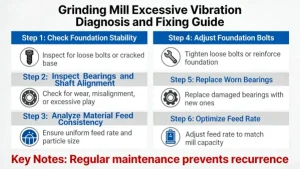
3. Step-by-Step Troubleshooting Order
- Stop mill safely, lock out power
- Check and tighten all bolts
- Inspect foundation and grout
- Check drive alignment and coupling
- Inspect bearings, temperature, lubrication
- Check liners, grinding media, material buildup
- Test run empty → check vibration
- Test with material → adjust feed and process
- Use vibration analyzer for final verification