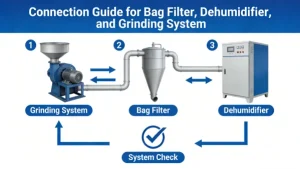
To connect a bag filter and dehumidifier to a grinding system, the core principle is: dehumidify before filtration (for process air) to prevent moisture-related issues like filter clogging and material sticking, while filter before dehumidification (for recirculated clean air) to protect the dehumidifier from dust damage.
1. Core System Components
| Component | Purpose | Key Specifications |
|---|---|---|
| Grinding Mill | Primary material reduction | Properly sealed to prevent air leakage |
| Bag Filter (Baghouse) | Dust collection (≥99.9% efficiency) | Pulse-jet cleaning, suitable filter media for material type |
| Dehumidifier | Moisture removal (to ≤40% RH or specific dew point) | Desiccant or refrigeration type; sized for process airflow |
| Centrifugal Fan | Creates required airflow (5000–20,000 m³/h typical) | Matched to system pressure drop; explosion-proof if needed |
| Ductwork | Air conveyance | Proper diameter for carrying velocity (≥20 m/s); abrasion-resistant material |
| Air Lock Valve | Prevents air loss while discharging collected dust | Rotary airlock or double flap valve |
| Control System | Monitors and regulates RH, airflow, and cleaning cycles | PLC with sensors for RH, temperature, pressure drop |
| Pre-Filter | Protects dehumidifier from dust (when placed post-filter) | Coarse particulate removal (≥10 μm) |
2. Open-Loop Configuration (Simplest Setup)
Airflow Path:Fresh Air → Dehumidifier → Grinding Mill → Cyclone Separator (optional) → Bag Filter → Exhaust Fan → Atmosphere
Step-by-Step Connection
- Dehumidifier to Mill Connection
- Connect dehumidifier discharge to mill air inlet using properly sized ductwork (calculate based on CFM and carrying velocity)
- Install butterfly valve for airflow adjustment and isolation during maintenance
- Insulate ductwork to prevent condensation in cold zones
- Mill to Bag Filter Connection
- Connect mill air outlet to bag filter inlet (use short-radius elbows only when necessary)
- Install pressure gauge and temperature sensor at filter inlet for monitoring
- Include optional cyclone separator before bag filter to reduce fine dust load (pre-collects 95–98% of material)
- Bag Filter to Fan & Exhaust
- Connect clean air outlet of bag filter to suction side of exhaust fan
- Fan discharge connects to exhaust stack (with rain cap to prevent water entry)
- Install airlock valve at bag filter hopper to maintain system pressure while discharging dust
- Control Integration
- Wire dehumidifier, fan, and pulse-jet cleaning system to PLC
- Set RH setpoint (≤40% RH) and monitor baghouse pressure drop (1000–1500 Pa typical)
3. Closed-Loop Configuration (Superior for Moisture-Sensitive Materials)
Airflow Path:Grinding Mill → Cyclone Separator → Bag Filter → Dehumidifier → Fan → Mill (recirculated)With optional fresh air makeup (10–15% of total airflow)
Step-by-Step Connection (Key Differences from Open-Loop)
- Post-Filter Dehumidification
- Locate dehumidifier after bag filter to protect it from dust damage
- Install pre-filter (≥10 μm) before dehumidifier inlet for added protection
- Air Recirculation Loop
- Connect dehumidifier discharge to fan suction, then return to mill air inlet
- Install fresh air intake valve with flowmeter for makeup air (to maintain oxygen levels and pressure balance)
- Condensate Management
- Connect dehumidifier drain to dedicated collection system (with P-trap to prevent air leakage)
- Insulate all cold surfaces to avoid condensation-related issues
4. Critical Connection Principles
A. Sequence Logic: Dehumidifier Placement Rules
| Scenario | Dehumidifier Position | Rationale |
|---|---|---|
| Dry Grinding (Hygroscopic Materials) | Before mill (process air) | Prevents moisture-induced agglomeration and sticking |
| Closed-Loop Systems | After bag filter | Dust-free air protects dehumidifier components; reduces maintenance |
| High-Humidity Environments | Both pre-mill and post-filter | Comprehensive moisture control; maintains dew point margin (≥10°C) above exhaust temperature |
| Condensation Risk Zones | Add secondary dehumidification near filter outlets | Prevents moisture condensation on clean bags during shutdown |
B. Ductwork Best Practices
- Sizing: Calculate diameter based on required airflow and minimum carrying velocity (≥20 m/s for fine powders)
- Layout: Minimize bends; use long-radius elbows when turns are necessary
- Sealing: Flange connections with high-temperature silicone gaskets; no air leakage tolerated
- Slope: Install with 1–2° downward slope toward collection points to prevent dust accumulation
- Insulation: Use 50 mm thick insulation on all ductwork crossing temperature-differential zones
C. Fan Placement Guidelines
| Fan Position | Pros | Cons | Best For |
|---|---|---|---|
| Suction Side (Negative Pressure) | Cleaner fan operation; prevents dust leakage | Higher fan wear; requires airtight system | Most industrial grinding applications |
| Pressure Side (Positive Pressure) | Lower fan maintenance; simpler ductwork | Risk of dust leakage at joints; filter must handle pressure | Smaller systems with well-sealed components |
5. Installation & Commissioning Checklist
Pre-Installation
- Verify all components are correctly sized for process requirements (airflow, pressure, RH)
- Inspect filter bags for damage; ensure proper matching with material type
- Confirm dehumidifier is suitable for target RH/dew point (desiccant for ≤30% RH; refrigeration for 40–60% RH)
Installation Steps
- Mount all equipment on vibration-isolated foundations
- Connect ductwork with proper alignment; avoid forced fitting
- Install airtight connections with gasketed flanges and secure clamps
- Wire control system and calibrate sensors (RH, temperature, pressure)
- Set up condensate drainage with P-traps and proper slope
- Install safety devices: pressure relief valve, fire suppression, explosion vents (if combustible dust risk)
Commissioning Procedure
- Leak Test: Pressurize system to 500 Pa; check for leaks with smoke or pressure decay method
- Airflow Calibration: Adjust dampers to achieve design airflow (measure with anemometer)
- Dehumidifier Test: Verify RH control within ±3% of setpoint
- Filter Performance: Confirm pressure drop stabilizes within design range (1000–1500 Pa)
- Full System Test: Run for 4 hours; monitor all parameters and adjust as needed
- Emergency Shutdown Check: Test safety interlocks and shutdown procedures
6. Operational Maintenance & Troubleshooting
Preventive Maintenance Schedule
| Component | Interval | Tasks |
|---|---|---|
| Bag Filter | Daily | Check pressure drop; inspect for leaks |
| Weekly | Pulse-jet cleaning system test | |
| Monthly | Inspect filter bags; replace damaged ones | |
| Dehumidifier | Daily | Drain condensate; check RH performance |
| Quarterly | Clean coils/desiccant; check refrigerant charge | |
| Ductwork | Monthly | Inspect for wear; clean accumulated dust |
| Fan | Monthly | Check bearings; lubricate as needed |
Common Issues & Solutions
| Problem | Cause | Solution |
|---|---|---|
| High Filter Pressure Drop | Moisture-induced cake formation | Improve dehumidification; adjust cleaning frequency |
| Filter Bag Damage | Excessive moisture/condensation | Maintain ≥25°C above dew point; add insulation/heating |
| Dehumidifier Frosting | Airflow below minimum rating | Increase airflow; add pre-heater |
| Material Agglomeration | Insufficient dehumidification | Upgrade dehumidifier capacity; check air leakage points |
7. Typical System Layout Diagrams
Open-Loop System
[Fresh Air Intake] → [Dehumidifier] → [Butterfly Valve] → [Grinding Mill] → [Cyclone Separator] → [Bag Filter] → [Exhaust Fan] → [Atmosphere]
Closed-Loop System

Final Recommendations
- Prioritize Dehumidification: For moisture-sensitive materials (e.g., cement, limestone, lithium battery materials), ensure RH ≤40% in the grinding chamber to prevent agglomeration and product quality issues
- Filter Protection: Always place dehumidifiers after bag filters in closed-loop systems to avoid dust damage to dehumidifier components
- Pressure Monitoring: Install differential pressure gauges across the bag filter to detect filter degradation or moisture-related problems early
- Insulation: Insulate all cold surfaces to maintain ≥10°C above dew point throughout the system