Calcium carbonate grinding mills refer to specialized mechanical equipment used to crush and grind natural calcium carbonate ores (such as calcite, marble, or chalk) or industrial-grade lumps into fine or ultrafine powders. Depending on the required particle size and production scale, different types of grinding mills can be selected. The following is a comprehensive overview of calcium carbonate grinding equipment.
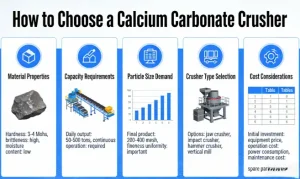
1. Common Types of Calcium Carbonate Grinding Mills and Their Applications
| Equipment Name | Typical Output Particle Size | Capacity Range | Key Features | Suitable Product Grade |
|---|---|---|---|---|
| 颚式破碎机 | 10–150 mm | High | Primary coarse crushing; simple structure, durable | Raw ore pre-processing |
| Hammer Mill | 1–10 mm | Medium–High | Impact-based crushing; high efficiency but prone to wear | Medium/coarse filler grade |
| Raymond Mill | 80–325 mesh (≈45–180 μm) | Medium | Mature technology, moderate energy consumption; widely used in China | Standard ground calcium carbonate (GCC) |
| Ring Roller Mill | 325–2500 mesh (≈5–45 μm) | Medium–High | Multi-layer grinding; higher fineness and efficiency than Raymond mill | Mid-to-high-end GCC (for coatings, plastics) |
| Ball Mill + Air Classifier | 2–45 μm | High | Continuous operation, versatile, but high energy use | Industrial fillers, some surface-modified CaCO₃ |
| Jet Mill (Air Classifier Mill) | 1–20 μm (some down to sub-micron) | Low–Medium | No mechanical contact → zero contamination; high purity and brightness | Premium/food/pharmaceutical-grade CaCO₃ |
| Stirred Media Mill (Bead Mill) | 0.5–10 μm | Medium | Wet or dry process; ideal for ultrafine grinding | Nano-CaCO₃ precursors, ink-grade powders |
✅ Ground Calcium Carbonate (GCC): Produced by direct mechanical grinding of natural ores—these mills are primarily used for GCC.
❌ Precipitated Calcium Carbonate (PCC): Synthesized via chemical precipitation; no grinding required—particle size is controlled by reaction conditions.
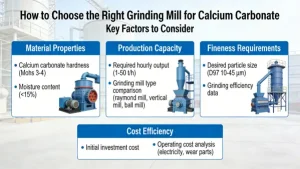
2. Key Factors in Selecting a Grinding Mill
Target Particle Size and Distribution
General filler (D₉₇ ≤ 45 μm) → Raymond mill or ring roller mill
Premium coatings/plastics (D₉₇ ≤ 10 μm) → Ultrafine ring roller mill or jet mill
Nano-scale (<100 nm) → Chemical synthesis (PCC); physical grinding cannot reliably achieve this
Production Capacity
Lab/pilot scale: Small jet mill or vibratory ball mill (<100 kg/h)
Industrial scale: Ring roller mill (1–10 t/h), large ball mill system (10–50 t/h)
Purity Requirements
Food/pharma grade: Must use iron-free equipment (e.g., ceramic-lined jet mill)
Industrial grade: Tolerates minor metal wear
Energy Consumption & Operating Cost
Jet mill: High purity but very high energy use (~200–400 kWh/ton)
Ring roller mill: Best cost-performance balance (~50–100 kWh/ton)
Integrated Classification System
Modern grinding lines typically integrate a turbine air classifier for “grind-and-classify” in one step, enabling precise control of D₉₇.
3. Typical Calcium Carbonate Grinding Production Line
Raw Ore → Jaw Crusher (Primary Crushing)
↓
Hammer Mill (Secondary Crushing)
↓
Elevator → Storage Bin
↓
Main Mill (Raymond / Ring Roller / Jet Mill)
↓
Turbine Classifier (Adjust Fineness)
↓
Pulse Dust Collector (Product Collection)
↓
Automatic Packaging System
🔧 Optional Add-ons:
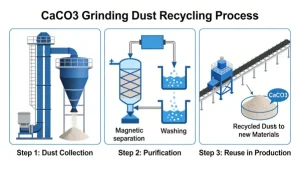
Magnetic separator: Removes iron impurities
Surface modifier: In-line coating with stearic acid to improve dispersion in polymers
5. Operational Best Practices
Regularly inspect wear on grinding rollers, rings, and classifier blades
Control feed moisture (<1%) to prevent clogging (“paste-up”)
Maintain system airtightness to avoid dust emissions (comply with environmental regulations)
For high-purity products, avoid carbon steel contact throughout—use 304/316L stainless steel or ceramic components
Conclusion
The selection of a calcium carbonate grinding mill should be driven by the target product application:
For cost-effectiveness → Ring roller mill or upgraded Raymond mill
For high purity and brightness → Jet mill + multi-stage magnetic separation
For nano-scale particles → Prefer chemical precipitation (PCC) over mechanical grinding
By aligning equipment choice with product requirements and process goals, manufacturers can efficiently and consistently produce calcium carbonate powders tailored to diverse industrial needs.