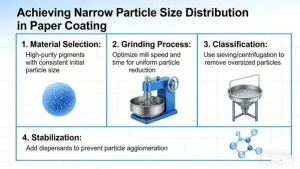
To achieve a narrow particle size distribution (PSD) for paper coating pigments (kaolin, GCC, PCC, etc.), follow this systematic approach combining pigment selection, wet grinding optimization, dispersion control, classification, and quality assurance. A narrow PSD (typically d90/d10 < 5) ensures better coating smoothness, printability, opacity, and runnability on high-speed coaters.
1. Start with Strategic Pigment Selection
- Choose engineered pigments: Prefer pigments designed for narrow PSD, such as pre-classified kaolin or specialty PCC grades
- Avoid broad native pigments: GCC from natural sources often has wider PSD than processed alternatives
- Target median size: For coating applications, aim for d50 = 0.5–2 μm with >90% <2 μm for optimal performance
- Particle shape matters: Platy kaolin and rhombohedral GCC affect packing efficiency differently, even with similar PSD
2. Optimize Wet Grinding Process (Most Critical Step)
Wet grinding is the primary method to refine PSD in paper coating. Use bead mills/agitator mills for superior control.
Equipment Selection
| Equipment | Best For | Key Advantages |
|---|---|---|
| Horizontal bead mills | High-volume production | Better temperature control, higher energy efficiency, narrow PSD |
| Basket mills | Small batches/lab trials | Smaller media capability, narrow PSD, easy cleaning |
| Recirculation mode | All applications | Multiple passes ensure uniform grinding, reduces overgrinding |
Critical Grinding Parameters
| Parameter | Optimal Setting | Impact on PSD |
|---|---|---|
| Grinding media size | 0.1–1.0 mm (zirconia/silica) | Smaller media = narrower PSD (media:particle ratio 10²–10³) |
| Media filling degree | 70–85% | Balances energy transfer and flow dynamics |
| Tip speed | 10–14 m/s | Higher speed = finer grind, but excessive speed causes media wear |
| Slurry solids content | 60–75% | Higher solids improve efficiency; avoid >75% to prevent viscosity issues |
| Specific energy input | 50–150 kWh/t | Target energy based on pigment type (kaolin: lower, GCC: higher) |
| Residence time | 10–30 minutes (multiple passes) | Prevents overgrinding and maintains narrow distribution |
Pro Tip: Use multi-stage grinding: coarse grind (1–2 mm media) → fine grind (0.3–0.5 mm media) for optimal PSD control.
3. Master Dispersion Chemistry
Dispersants prevent agglomeration and maintain the narrow PSD achieved during grinding.
Dispersant Selection & Dosage
- Primary dispersants: Sodium polyacrylate (most common), ammonium polyacrylate, or polycarboxylates
- Dosage: 0.1–0.5% based on pigment weight (adjust via titration for minimum viscosity)
- Addition timing: Add before grinding to improve efficiency and prevent re-agglomeration
- pH control: Maintain pH 7–9 for optimal dispersant performance and pigment stability
Dispersion Process Steps
- Add water and dispersant first, mix thoroughly
- Add pigment slowly while maintaining high shear to ensure complete wetting
- Premix at moderate speed (500–1000 rpm) to break large agglomerates
- Transfer to bead mill for fine grinding
- Post-grinding: Add secondary stabilizers if needed (e.g., CMC for rheology control)
4. Implement Precision Classification
Classification removes oversize particles and narrows PSD further.
| Classification Method | Particle Size Range | Paper Coating Application |
|---|---|---|
| Hydrocyclones | 0.5–10 μm | Primary classification for GCC/kaolin, removes coarse tails |
| Centrifugal classification | 0.1–5 μm | For high-purity, ultra-narrow PSD (e.g., calcined kaolin) |
| Sedimentation | 0.1–3 μm | Lab-scale or specialty pigments, highest precision |
| Membrane filtration | <1 μm | For nanoscale pigments in specialty coatings |
Best Practice: Use two-stage classification:
- Coarse removal with hydrocyclones (cut size ~5 μm)
- Fine tuning with centrifugal classification (cut size ~1 μm)
5. Quality Control & Process Monitoring
Maintain consistency with real-time PSD measurement and process control.
PSD Measurement Techniques
- Laser diffraction: Industry standard for paper coating pigments (0.1–1000 μm range)
- Sedimentation analysis: For ultra-fine particles and high-resolution PSD curves
- Coulter counter: For counting individual particles and narrow distributions
- Grind gauge: Quick on-site check for coarse particles
Key Quality Metrics
- d10, d50, d90: Target values based on coating type (e.g., d90 < 3 μm for high-gloss coatings)
- Span: (d90 – d10)/d50 < 2.0 indicates narrow PSD
- Coarse particle count: <0.1% >5 μm to prevent coating defects
Process Control Strategies
- Inline PSD analyzers: Monitor and adjust grinding parameters in real time
- Energy monitoring: Track kWh/t to prevent under/overgrinding
- Viscosity profiling: Changes indicate PSD shifts or agglomeration
- Regular calibration: Verify grinding media size distribution and classifier performance
6. Post-Grinding Stability & Formulation
- Aging: Allow 12–24 hours post-grinding for dispersion stabilization (reduces re-agglomeration)
- Rheology modifiers: Use small amounts of CMC or HEC to control viscosity without broadening PSD
- Binder compatibility: Match latex particle size to pigment PSD for optimal film formation
- Temperature control: Maintain 25–35°C during processing to prevent viscosity fluctuations
Step-by-Step Implementation Workflow
- Select appropriate pigment grade with baseline narrow PSD
- Prepare pre-dispersion with optimized dispersant dosage (0.2–0.4%) at 65% solids
- Grind in horizontal bead mill with 0.3 mm zirconia media (80% fill) at 12 m/s tip speed
- Classify with hydrocyclone (cut size 2 μm) followed by centrifugal classification (cut size 1 μm)
- Test PSD: Ensure span <2.0, d50=1.0 μm, d90<2.5 μm
- Adjust formulation with binders and rheology modifiers
- Quality check before coating application
Troubleshooting Common Issues
- Broad PSD after grinding: Reduce media size, increase specific energy, or add classification step
- Coarse particles present: Check media integrity, increase classifier efficiency, or adjust feed rate
- Agglomeration post-grinding: Increase dispersant dosage, optimize pH, or add anti-flocculants
- Viscosity instability: Improve dispersion quality, check for overgrinding, or adjust solids content
By following this comprehensive approach, you can consistently achieve the narrow PSD required for high-performance paper coatings, resulting in smoother surfaces, better print quality, and improved coater runnability. The most critical factors are proper grinding media selection, energy input control, and precision classification, supported by robust dispersion chemistry and quality monitoring.