GCC (Ground Calcium Carbonate) is a high-value inorganic non-metallic mineral widely used in plastics, papermaking, coatings, rubber, food, and pharmaceutical industries. A 2026 turnkey GCC processing plant solution integrates site planning, equipment selection, process design, installation commissioning, operation training, and after-sales service into a one-stop package, optimized for the latest industry trends (energy efficiency, environmental compliance, ultra-fine grinding technology, and intelligent control). This guide details the full process of GCC plant setup, core technical parameters, equipment configuration, and key considerations for 2026, to help investors and enterprises achieve efficient, low-cost, and compliant project implementation.
1. Pre-Setup Preparation: Market & Feasibility Analysis
The foundation of a successful GCC plant setup is accurate market positioning and comprehensive feasibility research, especially for 2026’s market demand for high-purity, ultra-fine, and customized GCC products.
1.1 Market Demand Research
-
Product grade positioning: Distinguish between general grade GCC (200-800 mesh, for rubber, building materials) and high-end grade GCC (1250-5000 mesh, for food, pharmaceutical, high-end coatings/plastics); 2026 market demand for nano GCC (D50<1μm) is growing at a CAGR of 15%+, focus on high-end segment layout if conditions permit.
-
Downstream customer locking: Cooperate with local/regional downstream enterprises (e.g., plastic film manufacturers, paper mills, coating factories) to confirm product specifications, order volume, and pricing to avoid overcapacity.
-
Raw material supply: GCC production relies on high-quality calcite, limestone, or marble ore (CaCO₃ content ≥95%, Fe₂O₃ ≤0.1%, MgO ≤0.5% for high-end products). Sign long-term supply contracts with ore mines to ensure stable raw material supply and cost control (ore transportation cost accounts for 10-20% of total production cost).
1.2 Feasibility Study Report (FSR) Core Content
A professional FSR is a prerequisite for project approval and financing, including:
-
Ore resource detection report (grade, reserve, mining capacity);
-
Market demand forecast (3-5 years) and product profit analysis;
-
Technical feasibility (process selection, equipment matching, land/energy conditions);
-
Economic feasibility (total investment, payback period, break-even point);
-
Environmental & safety feasibility (compliance with national/regional emission standards, safety production norms).
1.3 Project Approval & Certification
Complete the necessary administrative procedures according to local industrial policies (2026 global focus on low-carbon industrial certification):
-
Land use certificate, industrial project approval document, environmental impact assessment (EIA) report;
-
Safety production license, fire protection inspection certificate;
-
For food/pharmaceutical grade GCC: GMP, FDA, HALAL, or other international certification (if export-oriented).
2. Core Factors for Site Selection & Plant Layout
Site selection directly affects the long-term operation cost and efficiency of the GCC plant; plant layout follows the principles of process continuity, energy saving, and safe operation, optimized for 2026’s intelligent and green production requirements.
2.1 Key Site Selection Criteria
-
Close to raw material mines: Reduce ore transportation cost (the best distance is within 50km);
-
Convenient transportation: Adjacent to highways, railways, or ports (for finished product delivery);
-
Sufficient energy supply: Stable electricity (380V/10kV), water supply (low water consumption for GCC processing, mainly for dust removal and equipment cooling), and natural gas (for drying, if needed);
-
Compliant with environmental zoning: Avoid residential areas, ecological protection zones, and water source protection zones (distance ≥1km from residential areas);
-
Adequate land area: Reserve space for future capacity expansion (the land area for a 50,000 t/a plant is about 10,000-15,000 ㎡, 200,000 t/a is about 30,000-50,000 ㎡);
-
Low geological risk: Avoid flood zones, landslide zones, and seismic high-risk zones.
2.2 2026 Optimized Plant Layout
Divide the plant into 6 functional zones with clear boundaries and short material conveying paths, integrating dust removal, noise reduction, and intelligent control facilities:
-
Raw Material Storage Zone: Closed ore yard (with rainproof, dustproof covers) + ore crushing feeding area (equipped with bag dust collectors);
-
Crushing & Grinding Zone: Core processing area (arrange crushing, grinding, classification equipment in a line according to process flow);
-
Drying & Milling Zone: For high-moisture ore (moisture >5%), equipped with rotary dryer or flash dryer (adjacent to grinding zone to reduce material loss);
-
Finished Product Classification & Packaging Zone: Classifier, silo, automatic packaging machine, and finished product warehouse (closed silo with temperature/humidity monitoring);
-
Auxiliary Zone: Power distribution room, water treatment room, maintenance workshop, office building;
-
Environmental Protection Zone: Central dust removal system, sewage treatment tank, noise reduction wall (for high-power equipment such as grinding mills).
Key Layout Principle: Shorten the material conveying distance (use belt conveyors, bucket elevators instead of manual transportation) to reduce energy consumption and material loss; all processing zones are closed to realize zero dust leakage (2026 mandatory environmental requirement).
3. 2026 Optimized GCC Processing Technology & Process Flow
GCC processing technology has evolved from traditional rough grinding to ultra-fine grinding, classification precision, and low-carbon production in 2026. The core process is divided into dry process (mainstream, 90% of plants) and wet process (for high-end nano GCC), with the dry process optimized for energy saving and intelligent control this year.
3.1 Dry Process Flow (2026 Mainstream, for 200-5000 Mesh GCC)
The dry process is suitable for ore with moisture ≤5%, featuring simple process, low investment, low operation cost, and easy intelligent control—the 2026 optimized version reduces energy consumption by 18-25% compared with the traditional process.
Core Flow:
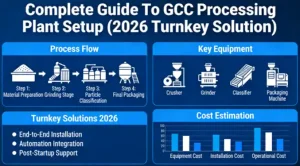
Raw Ore → Primary Crushing (Jaw Crusher) → Secondary Crushing (Cone Crusher/Impact Crusher) → Fine Crushing (Hammer Crusher) → Powder Grinding (Raymond Mill/Vertical Roller Mill/Ultrafine Mill) → Precision Classification (Air Classifier) → Drying (Optional, Flash Dryer) → Dust Removal & Collection (Bag Dust Collector/Cyclone Dust Collector) → Finished Product Silo → Automatic Packaging & Storage
2026 Key Optimizations:
-
Add ore pre-screening before crushing to remove impurities (soil, stone) and improve grinding efficiency;
-
Adopt closed-loop air circulation in the grinding zone to reduce heat loss and improve drying efficiency (no need for additional heat source for low-moisture ore);
-
Equip online particle size detection after classification to realize real-time adjustment of classifier parameters and ensure product precision (D50 error ≤±2μm).
3.2 Wet Process Flow (for Nano GCC, D50<1μm, High-End Segment)
The wet process is suitable for producing food, pharmaceutical, or high-end coating grade nano GCC, with higher product purity and finer particle size—2026 optimized wet process reduces water consumption by 30% and shortens the production cycle by 20%.
Core Flow:
Raw Ore → Crushing → Wet Grinding (Ball Mill/Sand Mill) → Slurry Classification (Centrifugal Classifier) → Slurry Purification (Magnetic Separation/Flotation) → Drying (Spray Dryer) → Powder Modification (Optional) → Finished Product Collection & Packaging
3.3 Optional Process: GCC Surface Modification
80% of industrial GCC requires surface modification (to improve compatibility with polymers such as plastics and rubber); 2026 uses environmentally friendly modifiers (replace traditional toxic modifiers) and continuous modification technology (improve modification efficiency).
Modification Process:
GCC Powder → Heating & Drying → Mixing with Modifier (Titanate, Silane, Stearic Acid) → High-Speed Shear Modification → Cooling → Modified GCC Finished Product
-
2026 Highlight: Adopt automatic modifier metering system to realize precise control of modifier dosage (dosage 0.5-3% of GCC weight) and reduce raw material waste.
4. Turnkey Equipment Configuration (Matching Capacity & Product Grade)
The turnkey equipment configuration is the core of the GCC plant project, and the equipment model and specification are strictly matched with the designed annual capacity and product grade (2026 equipment upgrades focus on energy saving, intelligence, and long service life). Below is the standard turnkey equipment list for different capacity plants (the most common in 2026), including main equipment, auxiliary equipment, and environmental protection equipment, with one-stop supply, installation, and commissioning.
4.1 Capacity Classification & Matching Equipment (2026 Mainstream)
GCC plants are divided into small-scale (10,000-50,000 t/a), medium-scale (50,000-200,000 t/a), and large-scale (200,000+ t/a) according to annual capacity; small/medium plants are the mainstream for new investors (low investment, fast payback).
|
Annual Capacity
|
Product Grade (Mesh)
|
Core Main Equipment
|
Key Auxiliary Equipment
|
Environmental Protection Equipment
|
|
10,000-50,000 t/a
|
200-1250 mesh (general grade)
|
Jaw Crusher, Raymond Mill, Small Air Classifier
|
Belt Conveyor, Bucket Elevator, Silo (50-100 m³), Automatic Packaging Machine (5-25kg/bag)
|
Bag Dust Collector, Cyclone Dust Collector, Noise Reduction Wall
|
|
50,000-200,000 t/a
|
800-5000 mesh (mid-high grade)
|
Jaw Crusher, Impact Crusher, Vertical Roller Mill, High-Precision Air Classifier
|
Heavy-duty Belt Conveyor, Large Silo (200-500 m³), Palletizing Robot, Online Particle Size Detector
|
Central Bag Dust Removal System (200,000 m³/h), Flue Gas Desulfurization (FGD) Device, Sewage Treatment Tank
|
|
200,000+ t/a
|
1250-5000 mesh + nano GCC (high-end)
|
Large Jaw Crusher, Cone Crusher, Ultrafine Mill, Wet Sand Mill, Spray Dryer
|
Automatic Ore Feeding System, Continuous Modification Machine, Intelligent Control System, Forklift & Crane
|
Integrated Environmental Protection System (Dust + Noise + Wastewater), Carbon Capture Device (optional, low-carbon certification)
|
4.2 2026 Key Equipment Upgrades (Turnkey Highlight)
All equipment in the turnkey solution is the 2026 latest model with core upgrades in energy saving, intelligence, and reliability:
-
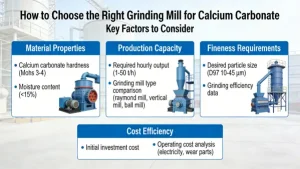
Vertical Roller Mill: Replace traditional Raymond Mill as the mainstream grinding equipment (energy saving 30%, grinding efficiency 40% higher, suitable for large-scale production);
-
Ultrafine Mill: For 5000 mesh ultra-fine GCC (D50=2-5μm), with automatic gap adjustment and online fault alarm;
-
High-Precision Air Classifier: Adopt frequency conversion speed regulation and CCD online particle size detection to realize product precision control (qualified rate ≥99%);
-
Automatic Packaging & Palletizing Line: 2026 upgraded to robot palletizing (replace manual labor, efficiency 3x higher, error rate 0);
-
Closed Conveying Equipment: All belt conveyors are closed with dustproof covers, and pneumatic conveying is used for fine powder to realize zero dust leakage.
4.3 Equipment Material Selection (Match Product Purity)
-
General grade GCC: Equipment made of carbon steel (low cost);
-
Food/pharmaceutical grade GCC: All equipment in contact with materials is made of 304/316 stainless steel (no heavy metal precipitation, meet GMP standards);
-
High-purity GCC (CaCO₃≥99.9%): Equipment inner wall with ceramic lining to avoid material contamination.
5. Key Technical Norms: Environmental Compliance & Energy Efficiency (2026 Updated)
2026 global industrial policies focus on carbon neutrality, environmental protection, and energy saving; GCC plants must meet the latest national/regional emission and energy consumption standards, which are the core of the turnkey solution’s compliance guarantee.
5.1 2026 Updated Environmental Emission Standards (Global Mainstream)
GCC processing is a dust-intensive industry (the main pollutant is particulate matter PM2.5/PM10), with secondary pollutants of noise and a small amount of wastewater; the turnkey solution is equipped with a one-stop environmental protection system to meet the strictest 2026 standards:
-
Dust Emission: ≤10 mg/Nm³ (China GB 26451-2021, EU EN 13779-2026, US EPA 40 CFR); the core measure is central bag dust removal system (filter bag material: PTFE, filtration efficiency ≥99.99%) + closed production zone;
-
Noise Emission: ≤65 dB (daytime) / ≤55 dB (night) at plant boundary; the core measure is equipment shock absorption pad + noise reduction wall + closed grinding zone;
-
Wastewater Emission: Zero discharge (2026 mandatory for GCC plants); wastewater is generated from dust removal and equipment cooling, treated by sewage treatment tank (sedimentation + filtration) and recycled for production;
-
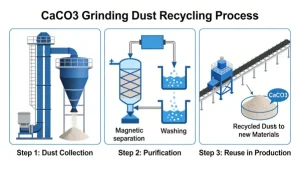
Solid Waste Disposal: Waste ore, filter residue, and dust collection ash are recycled for low-grade GCC production or building materials, realizing 100% solid waste utilization.
5.2 2026 Energy Efficiency Norms (Low-Carbon Production)
The turnkey solution optimizes the process and equipment to achieve energy saving and carbon reduction, meeting 2026 industrial low-carbon certification requirements:
-
Unit energy consumption: For 1250 mesh GCC, electricity consumption ≤80 kWh/t (traditional process is 100-120 kWh/t);
-
Heat energy utilization: Adopt waste heat recovery from grinding equipment (the heat generated by grinding is used for ore drying, reducing natural gas consumption by 40%);
-
Power saving: All high-power equipment (grinder, classifier) are equipped with frequency conversion speed regulation to realize load matching and reduce idle power consumption.
5.3 Safety Production Norms (2026 Updated)
-
Dust explosion prevention: The grinding and powder collection zones are equipped with explosion-proof valves, fire extinguishers, and dust concentration detectors (GCC powder is a combustible dust, dust concentration ≤50 g/m³);
-
Electrical safety: All equipment is grounded, and the power distribution room is equipped with lightning protection and surge protection devices;
-
Operation safety: The production line is equipped with emergency stop buttons and safety isolation barriers to avoid manual contact with moving parts;
-
Fire protection: The plant is equipped with automatic sprinkler system, fire hydrant, and fire alarm system (compliant with NFPA 101-2026 or local fire protection standards).
6. Intelligent Control & Digital Management System (2026 Smart Plant Standard)
2026 is the era of intelligent mineral processing, and the turnkey GCC plant solution is equipped with a full-process intelligent control system (ICS) as the standard configuration, replacing traditional manual operation to realize unmanned production, real-time monitoring, and remote management—the core of improving production efficiency and reducing labor cost.
6.1 Core Functions of 2026 Intelligent Control System
-
Centralized Operation Control: All equipment is controlled by a PLC touch screen control room (one-click start/stop, parameter adjustment, and interlock protection—if one equipment fails, the whole line stops automatically to avoid secondary damage);
-
Real-Time Data Monitoring: Collect key production data in real time (grinding speed, classifier frequency, product particle size, dust concentration, energy consumption) and display it on the SCADA big data screen (data storage for 1-3 years for traceability);
-
Online Quality Inspection: Equip laser particle size analyzer and X-ray fluorescence (XRF) analyzer to detect product particle size and purity in real time—if unqualified, the system automatically adjusts parameters to ensure product quality;
-
Remote Monitoring & Fault Alarm: Support mobile APP/PC remote monitoring; if equipment fails (e.g., high temperature, abnormal vibration), the system sends an alarm (SMS/APP) to the manager in real time and displays the fault location and solution;
-
Automatic Production Scheduling: According to the order volume and product grade, the system automatically schedules the production plan, optimizes the process flow, and improves production efficiency;
-
Energy Consumption & Cost Statistics: The system automatically counts the daily/weekly/monthly energy consumption (electricity, gas, water) and production cost, and generates a cost analysis report to help managers optimize cost control.
6.2 Digital Management System (DMS)
Integrate production, inventory, sales, and after-sales into a single platform to realize full-chain digital management:
-
Inventory Management: Real-time monitoring of raw material and finished product inventory (automatic alarm when inventory is low/high);
-
Sales Management: Link with downstream customers to realize order tracking, delivery scheduling, and invoice management;
-
Equipment Management: Automatic reminder of equipment maintenance (based on running time) and record of maintenance history to extend equipment service life;
-
Data Analysis & Decision-Making: The system generates a production analysis report (output, yield, product qualification rate) and provides data support for managers’ decision-making (e.g., capacity expansion, product adjustment).
7. Turnkey Project Implementation Timeline & Milestones
The turnkey GCC plant solution realizes fast project implementation with a clear timeline and milestone management (the construction period is 3-8 months according to capacity, 20% shorter than the traditional project). Below is the standard implementation timeline for a 50,000-200,000 t/a medium-scale GCC plant (2026 optimized schedule):
|
Phase
|
Core Work
|
Duration
|
Key Milestones
|
|
Phase 1: Project Initiation
|
Feasibility study, site selection, EIA report, project approval
|
1-2 months
|
Obtain all project approval documents, sign turnkey contract
|
|
Phase 2: Plant Design & Equipment Manufacturing
|
Plant layout design, process design, equipment customization & manufacturing
|
1.5-3 months
|
Complete design drawings, finish main equipment manufacturing, deliver auxiliary equipment
|
|
Phase 3: Civil Construction & Equipment Installation
|
Plant construction, foundation pouring, equipment installation, pipeline laying
|
1-2 months
|
Complete plant construction, realize 100% equipment installation
|
|
Phase 4: Commissioning & Trial Production
|
Equipment debugging, process optimization, trial production (5-10 days)
|
0.5-1 month
|
Trial production success, product qualification rate ≥99%, meet environmental/energy standards
|
|
Phase 5: Operation Training & Handover
|
On-site operation training, maintenance training, system handover
|
1-2 weeks
|
Train 2-3 batches of operators/maintainers, complete project handover, issue operation manual
|
|
Phase 6: After-Sales Service
|
Free on-site maintenance (3 months), remote technical support
|
Long-term
|
Realize formal mass production, stable output, and meet design capacity
|
2026 Turnkey Highlight: Parallel construction (e.g., equipment manufacturing and civil construction are carried out at the same time) to shorten the total construction period; the turnkey supplier is responsible for all work from design to production, and the investor only needs to carry out overall supervision.
8. Operation Training & After-Sales Support (Turnkey Core Service)
A perfect operation training and after-sales support system is the guarantee for the long-term stable operation of the GCC plant—this is the core difference between the turnkey solution and the traditional equipment supply mode (2026 turnkey service is upgraded to customized training and global 24/7 after-sales).
8.1 On-Site Operation & Maintenance Training (Customized)
The turnkey supplier sends a professional technical team to carry out on-site training for the investor’s operators and maintainers (training content is customized according to equipment model and product grade), including:
-
Equipment Operation Training: Hands-on training of grinding, classification, packaging, and intelligent control system operation (ensure operators can operate independently);
-
Maintenance Training: Daily maintenance (lubrication, cleaning), regular maintenance (part replacement), and common fault troubleshooting (ensure maintainers can solve basic faults independently);
-
Safety & Environmental Protection Training: Safety production operation norms, environmental protection system operation, and emergency handling (fire, dust explosion, equipment failure);
-
Quality Control Training: Product particle size and purity detection, process parameter adjustment, and unqualified product treatment.
Training Outcome: Train a professional operation and maintenance team (10-20 people for medium-scale plants) that can independently operate the plant, solve common faults, and ensure stable production.
8.2 2026 Upgraded After-Sales Support (Global Coverage)
The turnkey supplier provides long-term after-sales support (no additional cost within the warranty period) with the following core services:
-
Warranty Period: 1 year for main equipment (grinder, classifier), 6 months for auxiliary equipment (conveyor, packaging machine); free replacement of damaged parts (non-human factors) during the warranty period;
-
On-Site Maintenance: Free on-site maintenance within 3 months after project handover; for after-warranty faults, the technical team arrives at the site within 24-72 hours (according to regional distance);
-
24/7 Remote Technical Support: A dedicated after-sales hotline and online technical support (WeChat/WhatsApp/Zoom) to solve problems in real time;
-
Spare Parts Supply: Long-term supply of original spare parts (at factory price) with fast delivery (spare parts warehouse in major industrial regions);
-
Plant Upgrading Service: Free technical guidance for future capacity expansion, product grade upgrade, or process optimization (e.g., upgrading from general grade to nano GCC).
9. Cost Budget & Investment Return Analysis (2026 Market Data)
The total investment of the GCC plant is determined by annual capacity, product grade, and equipment configuration; the turnkey solution provides a transparent cost budget (no hidden costs) and accurate investment return analysis (based on 2026 global GCC market prices and production costs).
9.1 Total Investment Budget (2026 USD, FOB)
The total investment includes fixed asset investment (land, plant, equipment) and working capital (raw materials, labor, energy, maintenance)—the following is the budget for mainstream capacity plants (excluding land cost and tax):
|
Annual Capacity
|
Product Grade
|
Total Fixed Asset Investment
|
Working Capital (Annual)
|
Total Initial Investment
|
|
10,000-50,000 t/a
|
200-1250 mesh
|
$$300,000 -$$800,000
|
$$50,000 -$$150,000
|
$$350,000 -$$950,000
|
|
50,000-200,000 t/a
|
800-5000 mesh
|
$$800,000 -$$3,000,000
|
$$150,000 -$$500,000
|
$$950,000 -$$3,500,000
|
|
200,000+ t/a
|
1250-5000 mesh + nano GCC
|
$$3,000,000 -$$10,000,000
|
$$500,000 -$$2,000,000
|
$$3,500,000 -$$12,000,000
|
Key Cost Composition: Equipment investment accounts for 60-70% of the total fixed asset investment (the core cost of the turnkey solution); plant construction accounts for 20-30%; auxiliary facilities (environmental protection, intelligent control) account for 10-15%.
9.2 Annual Operation Cost (2026 Average)
The annual operation cost is the main cost of the GCC plant, with the following core components (taking a 100,000 t/a medium-scale plant as an example):
-
Raw Material Cost: $$30$$50/t (ore cost, accounts for 40-50% of total operation cost);
-
Energy Cost: $$20$$30/t (electricity + natural gas, accounts for 20-30%);
-
Labor Cost: $$5$$10/t (intelligent production, only 5-10 operators, accounts for 5-10%);
-
Maintenance Cost: $$3$$5/t (spare parts + equipment maintenance, accounts for 3-5%);
-
Environmental Protection Cost: $$2$$3/t (dust removal + wastewater treatment, accounts for 2-3%);
-
Other Cost: $$5$$10/t (transportation + management + tax, accounts for 10-15%).
Total Unit Operation Cost: $$65$$108/t (2026 optimized turnkey solution reduces operation cost by 15-20% compared with traditional plants).
9.3 Investment Return Analysis (2026 Market Price)
Based on the 2026 global GCC market price ($$100$$300/t for general grade, $$300$$800/t for high-end grade, $$800$$2000/t for nano GCC), the investment return of the GCC plant is high and fast payback (the payback period is 2-5 years for medium-scale plants, the mainstream for new investors).
Example: 100,000 t/a medium-scale plant (800-1250 mesh GCC)
-
Annual Output: 100,000 t (qualified rate ≥99%);
-
Market Price: $150/t (FOB, 2026 average);
-
Annual Revenue: $15,000,000;
-
Annual Total Operation Cost: $$8,000,000 (unit cost$$80/t);
-
Annual Gross Profit: $7,000,000;
-
Payback Period: 2.5-3 years (excluding tax, after deducting depreciation).
2026 Investment Highlight: The high-end GCC segment (nano, food/pharmaceutical grade) has a higher profit margin (gross profit margin 50-80%)—suitable for investors with mature downstream channels and higher capital strength.
10. 2026 Industry Trends & Plant Upgrading Direction
The GCC industry is developing towards high-end, green, intelligent, and customized in 2026; the turnkey plant solution is designed with future upgradability (reserve equipment and process space) to help investors adapt to industry trends and maintain market competitiveness.
10.1 2026 Key GCC Industry Trends
-
High-end product upgrading: The market demand for ultra-fine (5000 mesh+) and nano GCC is growing rapidly, replacing imported products (the core trend for the next 3-5 years);
-
Green low-carbon production: Global carbon neutrality policies promote GCC plants to adopt energy-saving equipment, waste heat recovery, and carbon capture technology (low-carbon certification becomes a market access threshold);
-
Intelligent unmanned production: The popularization of PLC, SCADA, and industrial robots makes unmanned GCC plants the mainstream (reduce labor cost and improve production efficiency);
-
Customized production: Downstream enterprises require GCC products with specific particle size, shape, and surface modification (the plant needs to have flexible production capacity);
-
Circular economy: Realize 100% utilization of raw materials and solid waste (waste ore, dust collection ash are recycled for production, reducing cost and environmental impact);
-
Integration of upstream and downstream: GCC producers cooperate with downstream enterprises (plastics, coatings) to develop customized products and extend the industrial chain (improve profit margin).
10.2 Future Plant Upgrading Direction (Turnkey Reserve Design)
The 2026 turnkey GCC plant solution reserves equipment, process, and land space for future upgrading, with the following core directions:
-
Capacity expansion: Add grinding and classification equipment to expand annual capacity (e.g., from 100,000 t/a to 200,000 t/a);
-
Product grade upgrade: Add ultra-fine grinding (HLMX) and surface modification equipment to produce high-end nano GCC;
-
Intelligent upgrading: Upgrade the intelligent control system to industrial 4.0 (add AI production scheduling and big data analysis);
-
Low-carbon upgrading: Add waste heat recovery, carbon capture, and solar power generation equipment to realize zero carbon production;
-
Wet process addition: Add wet grinding and spray drying equipment to produce high-purity nano GCC for food/pharmaceutical industries.
Conclusion
The 2026 turnkey GCC processing plant solution is a one-stop, optimized, and future-oriented project implementation mode, which solves the pain points of traditional plant setup (e.g., complex process, long construction period, non-compliant environmental protection, and low intelligent level). By following this guide, investors and enterprises can realize fast, efficient, and compliant GCC plant setup, with core advantages of energy saving 18-30%, operation cost reduction 15-20%, and payback period 2-5 years.
In the 2026 GCC industry trend of high-end, green, and intelligent, the turnkey solution not only meets the current production requirements but also reserves space for future upgrading, helping enterprises grasp the market opportunity of high-end GCC products and achieve long-term stable development. The key to the success of the project is to choose a professional and experienced turnkey supplier with core capabilities of process design, equipment manufacturing, installation commissioning, and after-sales support—to ensure the plant’s stable operation and high investment return.
Appendix: Key Abbreviations & Glossary
-
GCC: Ground Calcium Carbonate
-
EIA: Environmental Impact Assessment
-
PLC: Programmable Logic Controller
-
SCADA: Supervisory Control and Data Acquisition
-
GMP: Good Manufacturing Practice
-
CAGR: Compound Annual Growth Rate
-
D50: Median Particle Size
-
FGD: Flue Gas Desulfurization
-
PM2.5/PM10: Particulate Matter with diameter ≤2.5μm/10μm