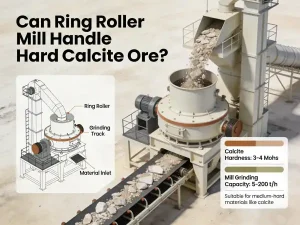
A ring roller mill can handle hard calcite ore efficiently, and it is actually one of the most widely used and cost-effective pieces of equipment for industrial calcite grinding.
Detailed Explanation
-
Hardness Compatibility
Calcite ore has a Mohs hardness of only 2.7–3.0, which is classified as a soft-to-medium-hard brittle mineral. Standard ring roller mills are designed to process non-metallic minerals with a Mohs hardness below 5–7 (depending on the model), making them perfectly suited for even the hardest natural calcite ores. Calcite is, in fact, the core feedstock for ring roller mills in the heavy calcium carbonate (GCC) production industry.
-
Performance Advantages for Calcite Processing
-
Wide fineness range: Ring roller mills can produce calcite powder with adjustable fineness from 325 mesh to 2500 mesh (5–45μm), and some ultra-fine models can achieve a one-time finished product fineness of D97 ≤ 5μm.
-
High efficiency & low energy consumption: Its production efficiency is more than twice that of traditional Raymond mills and jet mills, while energy consumption is only about 1/3 of a jet mill for the same output and fineness.
-
Stable product quality: The multi-stage grinding structure ensures uniform particle size distribution and consistent whiteness of calcite powder, which meets the strict requirements of coatings, plastics, papermaking and other downstream industries.
-
-
Key Operational Considerations
-
Feed pre-treatment: The feed particle size should generally be controlled below 10mm, and the moisture content should be less than 5–6% to avoid blockage in the grinding chamber and ensure stable operation.
-
Impurity control: If the calcite ore contains a large amount of high-hardness impurities (such as quartz, Mohs hardness 7), it will accelerate the wear of the grinding roller and grinding ring. Pre-screening and impurity removal are recommended to reduce maintenance costs.
-
Wear parts selection: For long-term continuous processing of calcite, it is recommended to use grinding rollers and rings made of high-chromium alloy or other wear-resistant materials to extend service life.
-
-
Limitations
Ring roller mills are not suitable for calcite ore mixed with a high proportion of Mohs hardness 7+ minerals, or for ultra-coarse grinding (below 80 mesh) scenarios. For these cases, cone crushers or ball mills are more appropriate options.