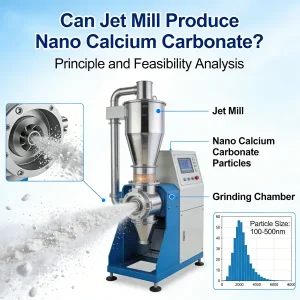
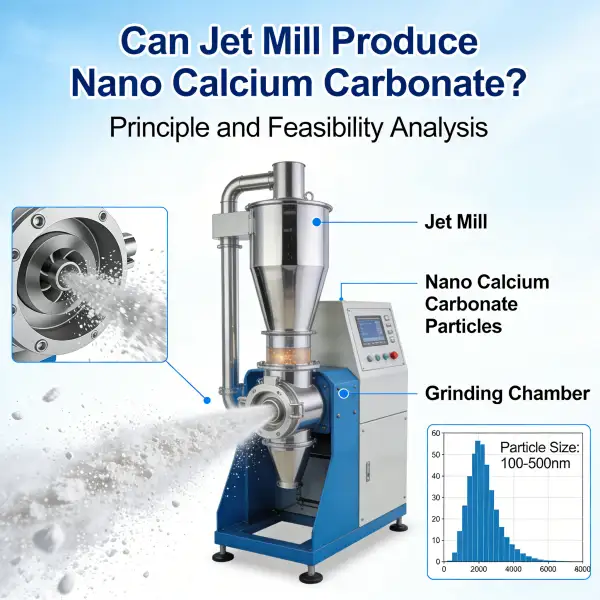
A jet mill (airflow mill) can produce sub-nano/near-nano grade ground calcium carbonate (GCC) (particle size ~100–500 nm), but it cannot independently manufacture true nano-calcium carbonate (nano-CaCO₃, particle size <100nm, typically 10–80 nm) for industrial applications.
Jet mills rely on physical grinding (brittle crushing via high-speed gas impact/collision) and are limited by the intrinsic physical properties ofcalcitecrystals and nanoparticleagglomeration effects—this makes it impossible to stably produce monodisperse, narrow-distribution nano-CaCO₃ (<100 nm) at scale. True industrial nano-CaCO₃ is exclusively produced via chemical synthesis, while jet mills only play an auxiliary role in the nano-CaCO₃ production chain (e.g., deagglomeration).
Why Jet Mills Cannot Produce True Nano-CaCO₃ (<100 nm)
Jet mills are the most advanced equipment for dry physical fine grinding of brittle materials (e.g., calcite), and their grinding principle is to drive particles to collide, impact, and shear with each other (or against ceramic liners) via high-speed airflow (300–500 m/s, compressed air/nitrogen). However, they hit an insurmountable grinding limit when approaching the true nano scale, for three key reasons:
Crystalfragmentationthreshold: Calcite (CaCO₃) has a stable rhombohedral crystal structure; physical crushing can only break intergranular bonds, not intragranular chemical bonds. The minimum particle size of calcite crystals after complete intergranular crushing is ~100 nm—this is the physical grinding limit of jet mills for GCC.
Severe agglomeration of fine particles: As particles are ground to <500 nm, their surface energy increases exponentially. Van der Waals forces between particles far exceed the grinding force of the jet mill, causing particles to form hard/soft agglomerates that cannot be broken by physical means. The final product is a mixture of agglomerates, not monodisperse nano-particles.
Energy inefficiency & heat generation: Grinding to <100 nm requires extremely high energy input (the energy required for grinding increases with the square of the fineness), and most energy is converted into heat instead of crushing work. Heat further exacerbates particle agglomeration and even causes slight decomposition of CaCO₃ at high temperatures, reducing product purity.
In industrial practice, the stable grinding limit of jet mills for GCC is D97 = 100–500nm (near-nano/sub-nano grade), which is the fine particle size ceiling for physical grinding of calcium carbonate.
True Nano-CaCO₃: Industrial Production via Chemical Synthesis
All commercial nano-CaCO₃ (10–80 nm, with controllable crystal forms: cubic, spindle, chain, needle) is produced via the carbonization method—a wet chemical synthesis process, not physical grinding. This is the only technology that can stably prepare monodisperse, narrow-distribution nano-CaCO₃ at industrial scale.
Core Industrial Carbonization Process (Lime Milk Method)
The most mature and widely used process for nano-CaCO₃, with precise control of particle size and crystal form:
Digestion: Calcined limestone (CaO) reacts with water to prepare a purified lime milk slurry (Ca(OH)₂, concentration 5–15%, remove impurities via filtration/sedimentation).
Crystal form control: Add crystal form regulators (e.g., sucrose, sodium polyacrylate, magnesium chloride) to the lime milk—this is the key to controlling the nano-particle size (10–80 nm) and crystal form (spindle/chain for rubber/plastics, cubic for coatings/papermaking).
Carbonization: Introduce purified CO₂ (or mixed gas of CO₂ and N₂) into the lime milk slurry, and control the reaction conditions (temperature 10–40℃, gas flow rate, stirring speed) for the carbonization reaction:Ca(OH)2+CO2=CaCO3↓+H2O
Post-treatment: The synthesized nano-CaCO₃ slurry is subjected to surface modification (stearic acid, titanate coupling agent), filtration, drying, and jet mill deagglomeration (critical auxiliary step) to obtain the final nano-CaCO₃ powder.
The Auxiliary Role of Jet Mills in Nano-CaCO₃ Production
Although jet mills cannot synthesize nano-CaCO₃, they are an indispensable post-treatment equipment in the industrial production of nano-CaCO₃—their core function is dry deagglomeration, not grinding:
The nano-CaCO₃ obtained after chemical synthesis and drying exists in the form of soft agglomerates (formed by weak van der Waals forces between primary nano-particles).
A jet mill uses high-speed airflow shear to break these soft agglomerates, releasing the monodisperse primary nano-particles (10–80 nm) and ensuring the product’s dispersibility in downstream applications (plastics, rubber, coatings).
For ground calcium carbonate (GCC), jet mills are used to produce near-nano GCC (100–500 nm) for mid-to-high-end applications (e.g., high-grade coatings, papermaking coatings) where the performance requirements are lower than those of true nano-CaCO₃.
Key Differences: Jet Mill-Grinded Near-Nano GCC vs. Chemically Synthesized Nano-CaCO₃
The two products are often confused, but their properties, production methods, and applications are fundamentally different—see the comparison table below:
| Index | Jet mill-grinded near-nano GCC | Chemically synthesized nano-CaCO₃ |
| Production method | Dry physical grinding | Wet chemical synthesis (carbonization) |
| Particle size range | D97 = 100–500 nm (sub-nano/near-nano) | D50 = 10–80 nm (true nano) |
| Particle size distribution | Wide (polydisperse) | Narrow (monodisperse, controllable) |
| Crystal form control | No (only natural calcite rhombohedron) | Precise control (cubic, spindle, chain, needle) |
| Surface properties | Hydrophilic (unmodified) / weakly modified | Hydrophobic/hydrophilic (customized surface modification) |
| Key performance | High brightness, low oil absorption | High specific surface area, strong reinforcement (rubber/plastics) |
| Industrial cost | Low (only grinding cost) | High (synthesis + post-treatment) |
| Typical applications | High-grade coatings, papermaking filling | Rubber reinforcement, plastic toughening, nano-coatings, adhesives |
A jet mill cannot produce true nano-CaCO₃ (<100nm)—this requires chemical synthesis (carbonization method), the only industrial technology for nano-CaCO₃ production.
Jet mills can grind GCC to 100–500 nm (near-nano grade) for mid-to-high-end applications, which is the physical grinding limit of calcium carbonate.
In the nano-CaCO₃ production chain, jet mills act as a critical auxiliary device for dry deagglomeration to break soft agglomerates of synthesized nano-particles and improve product dispersibility.
If you need to produce nano-CaCO₃ for industrial applications, the focus is on optimizing the chemical carbonization process (crystal form regulator, reaction conditions), while the jet mill is only a post-treatment step for deagglomeration. For near-nano calcium carbonate with lower cost requirements, a jet mill is the optimal physical grinding equipment.