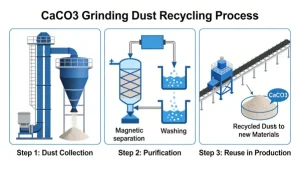
Calcium carbonate (CaCO₃) grinding dust is highly recyclable and widely reused in industrial processes, offering both economic and environmental advantages. This fine particulate matter, generated during limestone/marble grinding operations, typically represents 3-8% of material loss if not captured, making its recovery financially attractive.
🔄 Collection and Capture Systems
Effective dust recycling begins with proper collection:
| Collection Method | How It Works | Efficiency | 应用 |
|---|---|---|---|
| Baghouse Filters | Fabric bags capture dust while allowing air passage; automated cleaning (reverse air/pulse jet) keeps bags clear | 99.9%+ for PM2.5 | Standard in most CaCO₃ grinding plants |
| Cyclone Separators | Centrifugal force separates heavier particles from air stream | 90-95% for coarse dust | Pre-collection before baghouse; cost-effective |
| Electrostatic Precipitators | Electrically charged plates attract and collect dust particles | 99.9%+ | Large-scale operations; high-temperature environments |
| Wet Scrubbers | Water sprays capture dust in liquid suspension; sludge dewatered for reuse | 95-99% | Used when dust is highly adhesive or explosive |
Modern grinding mills (like CRGM series) often integrate onboard dust collection systems with oscillating filters to prevent clogging and ensure continuous operation.
🧪 Purification and Processing for Reuse
Collected dust may require purification depending on its end-use:
-
Particle Size Classification:
- Vibratory sieves or air classifiers separate dust into different fineness fractions (e.g., 200 mesh, 400 mesh, 1250 mesh)
- Critical for matching recycled dust to specific application requirements
-
Impurity Removal:
- Magnetic separation: Extracts iron-bearing contaminants (common in limestone)
- Dry/wet washing: Removes surface-adhered dirt or processing oils
- Air elutriation: Separates lighter organic impurities from CaCO₃ particles
-
Reconditioning:
- For contaminated dust: Calcination (800-900°C) to produce lime (CaO), followed by slaking and recarbonation for high-purity precipitated calcium carbonate (PCC)
- Surface modification (with stearic acid, titanates) improves compatibility with polymers/plastics
📦 Key Applications for Recycled CaCO₃ Dust
Recycled grinding dust finds use across multiple industries:
| Industry | 应用 | Value Proposition |
|---|---|---|
| CaCO₃ Production | Direct reintroduction into grinding process; filler in standard-grade products | Reduces raw material costs by 3-8% |
| Construction | Concrete aggregate, asphalt filler, cement production (up to 20% replacement) | Enhances workability; reduces cement demand |
| Plastics/Rubber | Filler in polyolefins, PVC, and rubber compounds (up to 20% by weight) | Improves stiffness and impact resistance; lowers material costs |
| Paints/Coatings | Extender pigment; improves opacity and durability | Reduces TiO₂ consumption; enhances scrub resistance |
| Paper Industry | Coating pigment and filler; improves printability | Increases paper brightness; reduces fiber usage |
| Environmental | Flue gas desulfurization (FGD); soil amendment; water treatment | Captures SO₂ emissions; neutralizes acidic soils |
✅ Benefits of Recycling CaCO₃ Grinding Dust
-
Economic Advantages:
- Reduces raw material purchasing costs (avoids buying new limestone for lost material)
- Lowers waste disposal fees (avoids landfill costs for dust)
- Creates additional revenue streams from high-value recycled products
-
Environmental Benefits:
- Reduces CO₂ footprint: Each ton of recycled CaCO₃ saves ~0.78 tons of CO₂ emissions compared to mining and processing new limestone
- Minimizes air pollution: Proper collection prevents dust from entering atmosphere (PM10/PM2.5 reduction)
- Conserves natural resources: Reduces demand for virgin limestone extraction
-
Operational Improvements:
- Cleaner facilities with less equipment wear from dust accumulation
- Improved worker safety and health (reduced respiratory hazards)
⚠️ Challenges and Considerations
-
Contamination Risks:
- Dust mixed with oils, metals, or other process contaminants may require specialized treatment
- Food/medical grade applications demand higher purity (99.9%+) requiring additional purification steps
-
Technical Limitations:
- Ultra-fine dust (<1μm) may need different collection technologies
- High humidity can cause dust agglomeration, affecting flow properties
-
Economic Viability:
- Small-scale operations may find initial investment in collection systems prohibitive
- Transportation costs can outweigh benefits if recycling facility is distant
🛠️ Best Practices for Effective Dust Recycling
-
Integrated System Design:
- Install dust collection at the source (grinding mill outlets)
- Use closed-loop systems to minimize losses and ensure dust quality
-
Quality Control:
- Regular particle size analysis and chemical testing
- Implement dust classification to match recycled material to appropriate applications
-
Process Integration:
- Reintroduce collected dust back into the grinding circuit at appropriate points
- For contaminated dust: Consider upgrading to higher-value products through calcination/PCC production
CaCO₃ grinding dust is not waste but a valuable resource that can be efficiently recycled through proper collection, purification, and processing. The technology is well-established and economically viable for most industrial operations, providing significant environmental benefits while improving profitability.
For CaCO₃ producers, implementing a comprehensive dust recycling program typically achieves ROI within 1-2 years through material savings and reduced disposal costs, making it a win-win for both business and sustainability.