In glass manufacturing, calcium carbonate (CaCO₃) is added as a traditional and essential raw material. The primary purpose is not to supply carbonate or carbon dioxide, but rather to introduce calcium oxide (CaO)—a critical network-modifying oxide that significantly enhances glass performance. Below are the detailed reasons:
I. Core Function: Source of Calcium Oxide (CaO)
During the glass melting process (at approximately 1500°C), calcium carbonate thermally decomposes:
CaCO₃→ΔCaO+CO₂↑CaCO₃ΔCaO+CO₂↑
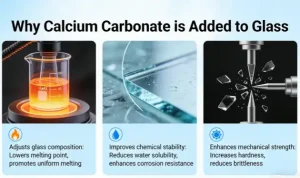
The resulting CaO becomes an integral component of the glass composition (typically 10–15% in soda-lime-silica glass) and provides several key benefits:
1. Enhances Chemical Durability
-
CaO dramatically improves the glass’s resistance to water, acids, and atmospheric corrosion.
-
Without CaO, pure sodium silicate glass (Na₂O·SiO₂)—commonly known as “water glass”—is highly water-soluble and unsuitable for containers, windows, or everyday use.
2. Improves Mechanical Strength and Hardness
-
Ca²⁺ ions occupy interstitial sites in the silicate network, increasing structural compactness and enhancing hardness, compressive strength, and abrasion resistance.
3. Optimizes Melting and Forming Behavior
-
Although CaO slightly raises the melting temperature, it reduces excessive fluidity at high temperatures, improving the viscosity–temperature profile and making the glass easier to shape during forming processes (e.g., blowing, pressing, or rolling).
4. Suppresses Crystallization (Promotes Glass Formation)
-
CaO helps inhibit the precipitation of silicate crystals during cooling, favoring the formation of a stable amorphous (glassy) structure and preventing devitrification (cloudiness or opacity).
II. Why Use Calcium Carbonate Instead of Directly Adding CaO?
Although the end goal is to incorporate CaO, the industry universally uses CaCO₃ (limestone or calcite) as the calcium source for practical reasons:
| Reason | Explanation |
| Low cost and abundant supply | Limestone (primarily CaCO₃) is a naturally occurring mineral with vast global reserves, far cheaper than industrial-grade CaO. |
| Ease of storage and handling | CaCO₃ is chemically stable; in contrast, CaO (quicklime) readily absorbs moisture from air to form Ca(OH)₂, making it difficult to handle and store. |
| Controlled reaction | The gradual decomposition of CaCO₃ releases CO₂ gas, which aids in stirring the melt and promotes homogenization of the batch materials. |
💡 Note: The released CO₂ is a major source of carbon emissions in the glass industry, driving current efforts toward low-carbon alternatives (e.g., electric melting, carbon capture).
III. Application in Common Glass Types
-
Soda-Lime Glass: Accounts for over 90% of global glass production, used in windows, bottles, jars, and tableware. A typical composition includes:
-
70–75% SiO₂ (from silica sand)
-
12–15% Na₂O (from soda ash, Na₂CO₃)
-
10–15% CaO (from CaCO₃)
-
-
Specialty glasses (e.g., borosilicate/heat-resistant glass) may use alternative calcium sources or reduced CaO content, but conventional glass cannot be made without calcium carbonate.
IV. What Happens If CaCO₃ Is Omitted?
Without CaCO₃ (and thus CaO):
-
The glass becomes highly water-sensitive, rapidly weathering or turning hazy upon exposure to moisture or rain;
-
Mechanical strength drops significantly, making it prone to scratching and breakage;
-
High-temperature viscosity becomes too low, complicating shaping and causing deformation;
-
Crystallization during cooling leads to loss of transparency.
Summary
✅ Calcium carbonate is added to glass primarily as a precursor to calcium oxide (CaO), which: • Enhances chemical durability • Boosts mechanical properties • Optimizes melting and forming characteristics🔬 Although CaCO₃ itself “disappears” during melting (converting to CaO and releasing CO₂), it remains an indispensable raw material in modern glassmaking.🌍 Consequently, limestone (CaCO₃), along with silica sand and soda ash, forms the “big three” foundational ingredients of the global glass industry.