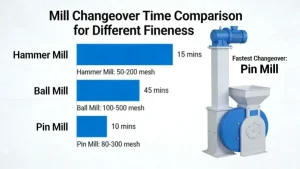
Thefluidized bedjet mill delivers the fastestfinenesschangeover time by a significant margin, followed by vertical roller mills (VRMs) with integrated variable-frequency (VFD) dynamic classifiers. Mills relying on fixed mechanical components or grinding media reconfiguration (ball mills, rod mills, hammer mills for large fineness shifts) have drastically longer changeover times.
For this comparison,finenesschangeover timeis defined as the total duration to switch from steady production of one target particle size to a second on-spec target, including parameter adjustments, system stabilization, particle size validation, and required cleaning for cross-contamination prevention in multi-product runs.
Ranking of Mill Types (Fastest to Slowest Changeover)
1. Fluidized Bed Jet Mill
-
Typical Changeover Time: 5–30 minutes total
- 5–15 minutes for parameter-only adjustments (no strict cross-contamination requirements)
- 20–30 minutes for full changeover with sanitary cleaning (food/pharmaceutical/color applications)
-
Core Drivers of Unmatched Speed:
-
Fineness is controlled almost exclusively by aVFD dynamicclassifierwheel: RPM is adjusted in real time via electronic control, with no shutdown, disassembly, or mechanical modifications required. Higher RPM delivers finer particle sizes with instant system response.
- No grinding media (steel balls, rods, rollers) to reconfigure: size reduction relies on high-velocity particle-on-particle impact, so no media grading, fill level, or gap adjustments are needed for fineness shifts.
- Auxiliary fine-tuning (inlet air pressure, feed rate) is fully online-adjustable, with zero downtime.
- Minimal material hold-up in the compact grinding chamber means the system stabilizes in seconds after adjustments, with rapid validation of particle size.
-
-
Key Note: Mills paired with in-line laser particle size analyzers can cut changeover time to under 5 minutes, eliminating manual sampling and lab testing delays.
2. Vertical Roller Mill (VRM) with Integrated VFD Dynamic Classifier
-
Typical Changeover Time: 15 minutes – 1 hour
- 15–30 minutes for moderate fineness shifts (e.g., 100 mesh to 325 mesh)
- 30–60 minutes for large cross-range shifts (e.g., 80 mesh to 600+ mesh)
-
Core Speed Advantages:
- Primary fineness control comes from an integrated, VFD-controlled high-efficiency classifier wheel, with fully online RPM adjustments for nearly all standard fineness changes.
- Secondary tuning (hydraulic grinding pressure, feed rate, air ring velocity) is adjustable during operation, with no disassembly required.
- Compact vertical design has far lower material hold-up than horizontal ball mills, reducing system lag and stabilization time.
- Fineness is decoupled from the grinding roller/table assembly, so no reconfiguration of grinding components is needed for most shifts.
-
Key Note: Extreme ultrafine shifts (to 1250+ mesh) may require minor air circuit adjustments, extending changeover time slightly, but still far faster than horizontal mills.
3. Raymond Mill (Suspension Roller Mill) with VFD Classifier
-
Typical Changeover Time: 30 minutes – 2 hours
-
Core Performance:
- Fineness is primarily adjusted via VFD-controlled top-mounted classifier speed and fan air volume, with online adjustments for moderate fineness shifts (100–325 mesh) achievable in ~30 minutes.
- Larger fineness jumps (e.g., 60 mesh coarse powder to 400+ mesh fine powder) require shutdown adjustments to roller spring pressure, scraper blade angle, or classifier wheel replacement, extending changeover to 1–2 hours.
-
Limitation: Higher material hold-up in the grinding chamber creates longer system lag, requiring more time to stabilize and validate on-spec production vs. jet mills/VRMs.
4. Hammer Mill
-
Typical Changeover Time: 1 – 4+ hours
-
Critical Caveat: Only minor fineness tweaks (±50 mesh) via VFD rotor speed adjustments can be done online in ~30 minutes. For any meaningful fineness change, the process is slow and labor-intensive:
- Fineness is primarily controlled by screen aperture size, which requires a full shutdown, disassembly of the mill housing, screen replacement, and reassembly.
- Large fineness shifts also require changes to hammer tip clearance, hammer type, or liner configuration, adding hours of downtime.
- Post-replacement test runs and validation are required to confirm consistent particle size, extending total changeover time.
5. Ball Mill
-
Typical Changeover Time: 4 hours – 24+ hours (multi-day for extreme fineness shifts)
-
Core Limitations for Slow Changeover:
- Fineness is heavily dependent on steel ball media grading, fill level, drum rotation speed, and circuit circulating load. Minor tweaks to closed-circuit classifier settings can be done online, but require 2–4 hours to stabilize due to massive material hold-up in the large horizontal grinding chamber.
- Any meaningful fineness shift (e.g., coarse 20 mesh grinding to 400+ mesh fine grinding) requires a full shutdown, complete evacuation of existing media and material, and full re-grading of steel ball sizes and fill levels. This process alone takes 8+ hours, plus test runs and tuning to reach steady on-spec production.
- Open-circuit ball mills have no external classifier, so fineness changes require full media reconfiguration, with changeover times exceeding 24 hours.
6. Rod Mill / SAG (Semi-Autogenous) / AG (Autogenous) Mill
-
Typical Changeover Time: 12 hours – multiple days
-
Slowest Changeover: These large-scale mills are designed for steady, single-grade production. Fineness is controlled by rod/ball media grading, liner design, feed size, and drum speed. Any fineness adjustment requires full shutdown, media evacuation and reconfiguration, and extended test runs to stabilize the massive grinding circuit. Extreme system lag from enormous material hold-up makes frequent fineness changes economically unviable.
Critical Factors That Alter Changeover Time
-
Closed vs. Open Circuit Design: Closed-circuit mills with integrated dynamic classifiers have 50–90% faster changeover times than open-circuit mills, as they decouple fineness control from the grinding chamber itself.
-
In-LineParticleSize Monitoring: Real-time laser particle analyzers eliminate manual sampling and lab testing delays, cutting changeover time by 50% or more for all mill types.
-
Sanitary/Cross-Contamination Requirements: For food, pharma, and cosmetic applications, jet mills and VRMs have far faster cleaning cycles (minimal dead space, smooth interiors) vs. ball mills/hammer mills with hard-to-clean crevices and media chambers.
-
FinenessShift Magnitude: Minor incremental adjustments can be done quickly on most modern mills, but large cross-range fineness changes only remain fast on jet mills and VRMs, which do not require mechanical disassembly.
Key Takeaways & Use Case Recommendations
-
Fastest possible changeover for frequent multi-fineness runs: Choose afluidized bedjet mill, the only mill with minute-scale fineness shifts, ideal for small-batch, high-value ultrafine powder production (pharmaceuticals, cosmetics, advanced materials).
-
Balanced throughput and fast changeover for mid-to-large scale operations: Choose a VRM with integrated VFD dynamic classifier, delivering 15–60 minute changeover for most industrial fineness ranges, with far higher throughput than jet mills.
-
Budget-friendly, moderate changeover for small-to-mid scale production: Choose aVFD-equipped Raymond mill, with 30 minute–2 hour changeover for standard fine powder applications.
-
Not suitable for frequentfinenesschanges: Ball mills, rod mills, and SAG/AG mills, designed for long, steady production runs of a single particle size, with changeover times measured in hours or days.
Critical Trade-off (aligned with your priorstartupcost question): The mills with the fastestfinenesschangeover (jet mills, VRMs) have the highest upfront capital costs, while the lowest-upfront-cost mills (hammer mills, ball mills) have the slowest changeover and poorest flexibility for multi-fineness production.