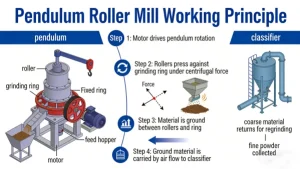
The pendulum roller mill (also known as Raymond mill) is a vertical, air-swept grinding machine that uses centrifugal force and pendulum motion to grind materials between rotating rollers and a stationary ring. It is widely used for processing non-metallic minerals like calcium carbonate, limestone, talc, and graphite (including for lithium battery applications).
Core Components
- Pendulum assemblies: 3-6 roller holders suspended from a rotating central “plum blossom” or star wheel
- Grinding rollers: Cylindrical rollers mounted on pendulum arms that rotate on their own axes
- Grinding ring: Stationary, circular ring fixed to the mill housing
- Rotating shovels/plows: Located at the bottom to feed material into the grinding zone
- Classifier/separator: Rotating impeller above the grinding chamber for particle size control
- Airflow system: Blower, cyclone collector, and ductwork for material transport and collection
Step-by-Step Working Process
1. Material Preparation & Feeding
- Raw material is crushed to 15-40mm particle size (depending on mill model)
- Elevator conveys material to a hopper, then an electromagnetic vibrating feeder delivers it evenly, quantitatively, and continuously into the mill house
2. Grinding Mechanism (Key Principle)
- Central shaft rotation: Motor drives the main shaft, rotating the plum blossom frame and pendulum assemblies around the vertical axis
- Centrifugal force generation: As the frame rotates (typically 100-300 RPM), centrifugal force causes pendulum arms to swing horizontally outward, pressing rollers firmly against the grinding ring
- Dual roller motion: Rollers perform two simultaneous movements:
- Revolution: Circling around the central shaft
- Rotation: Spinning on their own axes due to friction with the grinding ring and material
- Material introduction: Rotating shovels lift material from the mill bottom and throw it between the roller and ring
- Grinding action: Material is reduced by compression, shearing, and attrition between the high-pressure roller and ring
3. Classification & Airflow Transport
- Airflow carry-over: Blower creates a negative pressure airflow that lifts ground particles upward
- Particle separation: The classifier (rotating impeller) separates particles by size:
- Qualified fines: Pass through classifier vanes and proceed to collection
- Over-sized particles: Rejected and returned to the grinding chamber for reprocessing
- Fineness control: Classifier speed adjusts cut size (typically 80-400 mesh / 0.18-0.038mm)
4. Collection & Recirculation
- Cyclone collection: Qualified powder is captured in a cyclone collector and discharged via a rotary valve
- Air recirculation: Cleaned air returns to the blower, creating a closed-loop system (reduces dust emissions)
- Optional baghouse: Used for final dust collection, ensuring compliance with emission standards
Key Principles Summary
| Principle | Description |
|---|---|
| Centrifugal Force | Primary force creating grinding pressure (up to several tons per roller) |
| Pendulum Motion | Unique swing action that maintains consistent pressure regardless of material feed variations |
| Dual Roller Movement | Combined revolution and rotation for efficient, multi-directional grinding |
| Air Classification | Ensures precise particle size distribution and eliminates over-grinding |
| Closed-Circuit Operation | Maximizes efficiency by recycling under-sized material and optimizing energy use |
Typical Applications
- Mineral processing (calcium carbonate, limestone, talc, barite)
- Industrial minerals for paints, plastics, rubber, paper
- Advanced materials (graphite for lithium-ion battery anodes)
- Chemical industry (solid fuels, fertilizers)