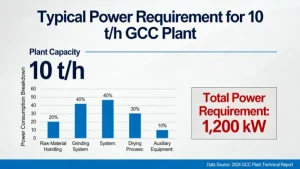
For a 10 t/h (tonnes per hour) Ground Calcium Carbonate (GCC) production line, the power requirement varies significantly based on grinding technology, product fineness, and process configuration (dry vs wet grinding). Below is a comprehensive breakdown of typical values:
1. Total Installed Power (Full Production Line)
| Grinding Technology | Fineness Range | Total Installed Power (kW) | Specific Power Consumption (kWh/t) |
|---|---|---|---|
| Vertical Roller Mill (VRM) | 325-1250 mesh (45-10 μm) | 350-525 | 35-50 |
| Ultra-fine Ring Roller Mill | 5-40 μm | 395-450 | 40-45 |
| Ball Mill + Classifier | 325-2500 mesh (45-5 μm) | 450-650 | 80-120 |
| Wet Stirred Media Mill | 1-10 μm (ultra-fine) | 400-550 | 40-55 (excluding drying) |
Note: Total power includes main mill motor, classifier, feeder, conveyor, dust collector, and auxiliary systems.
2. Key Equipment Power Breakdown (10 t/h VRM-based Dry Plant)
| Equipment | Мощность (кВт) | Function |
|---|---|---|
| Main Mill Motor | 250-355 | Core grinding process |
| Classifier/Turbo Separator | 30-55 | Particle size classification |
| Raw Material Feeder | 5-11 | Controlled material input |
| Bucket Elevator/Conveyor | 15-22 | Material transport |
| Pulse Dust Collector | 18.5-30 | Air purification & dust removal |
| Air Compressor (for dust collector) | 15-22 | Provide compressed air for cleaning filters |
| Subtotal | 350-525 | Total installed power |
3. Critical Factors Affecting Power Requirement
(1) Product Fineness (Most Significant Factor)
- Coarse GCC (325 mesh / 45 μm): 30-40 kWh/t
- Medium GCC (600 mesh / 20 μm): 40-60 kWh/t
- Fine GCC (1250 mesh / 10 μm): 50-80 kWh/t
- Ultra-fine GCC (2500 mesh / 5 μm): 80-120 kWh/t
Power consumption increases exponentially with decreasing particle size
(2) Grinding Method
- Dry Grinding: Higher power (40-50 kWh/t for 1250 mesh) but no drying needed
- Wet Grinding: 20-30% lower grinding power (30-40 kWh/t for same fineness) but requires additional 15-25 kWh/t for slurry drying
(3) Raw Material Properties
- Mohs hardness (calcite = 3, easy to grind)
- Ore purity (higher impurities increase wear and power)
- Feed size (smaller feed size reduces power by 10-15%)
4. Energy Efficiency Comparison
| Technology | Energy Saving vs Ball Mill | Best Application |
|---|---|---|
| Vertical Roller Mill | 40-60% | Large-scale, medium-fine GCC (325-1250 mesh) |
| Ring Roller Mill | 30-50% | Medium-scale, fine GCC (10-40 μm) |
| Ball Mill | Baseline (100%) | Ultra-fine GCC production (≤5 μm) |
5. Typical Power Requirement Summary
For a standard 10 t/h GCC plant producing 600-1250 mesh (20-10 μm) product using a vertical roller mill:
- Total Installed Power: 400-450 kW
- Operating Power Consumption: 40-45 kWh/t
- Daily Energy Use (20-hour shift): 8,000-9,000 kWh
For a ball mill-based plant producing the same fineness:
- Total Installed Power: 500-600 kW
- Operating Power Consumption: 80-100 kWh/t
- Daily Energy Use: 16,000-20,000 kWh
6. Optimization Tips to Reduce Power Consumption
- Use high-efficiency vertical roller mills instead of traditional ball mills
- Optimize feed size (reduce to ≤10 mm for VRM)
- Implement closed-circuit grinding with high-efficiency classifiers
- Maintain proper mill operation parameters (speed, pressure, air flow)
- Use grinding aids (for wet grinding) to reduce friction and energy use