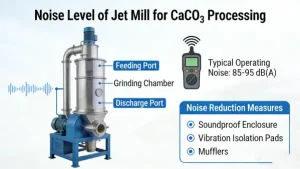
The noise level of a jet mill used for calcium carbonate (CaCO₃) ultra-fine grinding is primarily determined by its design type, production capacity, operating pressure, and whether noise reduction measures are applied. For industrial-grade jet mills (the mainstream for GCC/PCC ultra-fine grinding, targeting D97 < 10 μm), the raw (unattenuated) noise level ranges from 85 to 110 dB(A), with small lab-scale units at the lower end and large production-scale units at the upper end.
Notably, CaCO₃ is a soft, low-abrasiveness mineral (Mohs hardness 2.75), so jet mills grinding CaCO₃ produce 3–5 dB(A) lower noise than those grinding hard minerals (e.g., quartz, corundum) under the same operating conditions—this is a key CaCO₃-specific characteristic that reduces impact/abrasion noise in the mill.
Below is a detailed breakdown of jet mill noise levels for CaCO₃ grinding, including model-specific noise ranges, primary noise sources, key influencing factors, and industrial noise reduction solutions (to meet occupational health and environmental standards):
Core Noise Level Ranges (CaCO₃ Grinding Jet Mills)
Jet mills for CaCO₃ are mainly flat-bed jet mills, circulating tube jet mills, and target jet mills (the first two are the most common for ultra-fine CaCO₃ grinding). Noise levels are categorized by production capacity (the most critical factor) and exclude auxiliary high-pressure air systems (air compressors/ blowers—their noise is a separate major contributor and is addressed later).
All values are on-site measured values at 1 meter from the mill body (unattenuated, no noise reduction) and reflect typical operating conditions for CaCO₃: grinding pressure 0.6–1.0 MPa, feed particle size ≤1 mm, product fineness D97 2–10 μm (the most common ultra-fine CaCO₃ specs for coatings/plastics).
|
Jet Mill Type
|
Production Capacity (CaCO₃, dry grinding)
|
Typical Noise Level (1m, unattenuated)
|
Main Application for CaCO₃
|
|
Lab-Scale Jet Mill
|
<50 kg/h
|
85–95 dB(A)
|
R&D, small-batch ultra-fine CaCO₃ sampling
|
|
Medium Industrial Jet Mill
|
50–500 kg/h
|
95–105 dB(A)
|
Mid-scale production of ultra-fine GCC/PCC (D97 5–10 μm)
|
|
Large Production Jet Mill
|
>500 kg/h (up to 5,000 kg/h for large flat-bed models)
|
105–110 dB(A)
|
Mass production of ultra-fine CaCO₃ (core grinding line for large plants)
|
|
Low-Noise Optimized Jet Mill (new design)
|
100–1,000 kg/h
|
80–90 dB(A) (unattenuated)
|
Green CaCO₃ plants with strict noise requirements
|
Critical Note: Auxiliary Air System Noise (the “hidden noise source”)
Jet mills rely on high-pressure air (0.6–1.2 MPa) for particle acceleration and comminution—the air compressor/roots blower (the air source) produces nearly the same or higher noise than the mill body itself (85–105 dB(A) for industrial air compressors). When the mill and air system are operated together (the actual production condition), the combined noise level at the work station is 3–8 dB(A) higher than the mill’s standalone noise (due to sound superposition).
This is the single most important consideration for CaCO₃ jet mill noise control—ignoring the air system makes mill-only noise reduction ineffective.
Primary Noise Sources of Jet Mills for CaCO₃ Grinding
Jet mill noise is aerodynamic noise-dominant (accounting for 70–80% of total noise), with mechanical/vibration noise as a secondary factor. For CaCO₃ grinding, the soft mineral nature eliminates high-impact noise from hard particle collisions, so the noise sources are highly focused on airflow and system vibration:
-
Supersonic airflow turbulence noise (core source)<br>High-pressure air is ejected through narrow nozzles in the mill at supersonic speeds (Mach 1.5–3.0), creating intense gas turbulence, vortex shedding, and shock waves in the grinding chamber. This broadband aerodynamic noise is the loudest component (60–70% of total mill noise) and is centered at 1,000–4,000 Hz (the frequency range most harmful to human hearing).
-
Airflow exhaust noise<br>High-velocity air carrying fine CaCO₃ powder is exhausted from the mill to cyclone separators/bag filters—this high-speed exhaust produces jet noise at the exhaust port (15–20% of total mill noise).
-
Low-intensity particle impact noise<br>CaCO₃ particles accelerated by airflow collide with each other and the mill’s ceramic lining (Al₂O₃/SiC, used for wear resistance). Since CaCO₃ is soft, this impact noise is mild (5–10% of total noise) and far lower than when grinding hard minerals.
-
Mechanical/vibration noise<br>Minor noise from mill body vibration (caused by airflow turbulence), bearing rotation (for classifier-equipped models), and powder flow in conveying pipelines (5–10% of total noise). For CaCO₃, the ultra-fine powder flow produces little additional noise compared to coarse powders.
Key Factors Affecting Jet Mill Noise for CaCO₃ Grinding
Beyond production capacity, these parameters directly alter the noise level—all are adjustable in CaCO₃ grinding operations and can be optimized for mild noise reduction (while maintaining grinding efficiency):
-
Operating air pressure: Higher pressure (≥0.8 MPa) for finer CaCO₃ (D97 < 3 μm) increases airflow speed and turbulence, raising noise by 5–8 dB(A); reducing pressure (to 0.6–0.7 MPa) for coarser ultra-fine CaCO₃ (D97 5–10 μm) lowers noise significantly.
-
Airflow rate: Higher airflow (for higher CaCO₃ throughput) increases gas turbulence in the grinding chamber, raising noise by 3–5 dB(A).
-
Mill design: Flat-bed jet mills (with multiple nozzles and a central classifier) produce ~5 dB(A) more noise than circulating tube jet mills (more streamlined airflow, less turbulence) for the same CaCO₃ capacity.
-
Nozzle design: Conventional conical nozzles produce more noise than optimized supersonic Laval nozzles (designed for smooth airflow acceleration), which reduce noise by 4–6 dB(A) for the same pressure/flow.
-
CaCO₃ product fineness: Grinding to nano-CaCO₃ (D97 < 1 μm) requires higher pressure/airflow, increasing noise by 8–10 dB(A) compared to grinding D97 5–10 μm ultra-fine CaCO₃.
Industrial Noise Reduction Solutions for CaCO₃ Jet Mill Systems
The occupational health limit for industrial noise (China GBZ2.2, EU OSHA, US OSHA) is 85 dB(A) for an 8-hour work shift; environmental noise limits for plant boundaries are 55–65 dB(A) (day/night). For CaCO₃ jet mills (even medium-scale units at 95–105 dB(A)), comprehensive noise reduction is mandatory to protect workers and meet environmental regulations.
Solutions target the mill body + auxiliary air system (air compressor/blower) + exhaust/conveying system (the three noise sources) and are cost-effective for CaCO₃ grinding plants (no impact on CaCO₃ product quality/grinding efficiency):
1. Mill Body Noise Reduction (Aerodynamic + Vibration Noise)
-
Install a dedicated sound insulation enclosure: A steel/foam enclosure (50–100 mm thick sound-absorbing material, e.g., rock wool/glass wool) with a viewing window and maintenance door—reduces mill body noise by 20–30 dB(A) (the most effective single measure). For CaCO₃ mills, the enclosure is designed with a dust-tight seal to prevent fine CaCO₃ powder from entering and clogging sound-absorbing materials.
-
Optimize nozzles and exhaust ports: Replace conventional nozzles with low-noise Laval nozzles; install venturi silencers at mill exhaust ports—reduces airflow/exhaust noise by 8–12 dB(A).
-
Add vibration damping: Mount the mill on rubber/air spring dampers; use flexible connectors for all powder/air pipelines—reduces vibration/mechanical noise by 3–5 dB(A) and prevents noise transmission to the factory floor.
2. Auxiliary Air System Noise Reduction (the “biggest win”)
-
Air compressor/blower sound insulation room: Enclose the high-pressure air compressor/roots blower in a dedicated concrete/sound-absorbing room—reduces air system noise by 25–35 dB(A). Add a ventilation system to the room to prevent overheating of the compressor.
-
Install in-line silencers: Add absorptive silencers to the air inlet/outlet of the compressor/blower and the high-pressure air pipeline to the mill—reduces airflow noise by 10–15 dB(A).
-
Use oil-injected screw compressors: These produce 5–8 dB(A) less noise than oil-free compressors (the standard for CaCO₃ grinding) for the same air output.
3. Post-Mill Conveying/Collection System Noise Reduction
-
Silencers for cyclone/bag filter exhaust: Install silencers at the exhaust ports of cyclone separators and bag filters (the final exhaust of the CaCO₃ grinding system)—reduces exhaust noise by 8–10 dB(A).
-
Flexible pipeline connections: Use rubber/PTFE flexible connectors for all powder conveying pipelines (cyclone → bag filter → finished product silo) to prevent vibration noise transmission.
4. Factory/Workstation Local Noise Reduction
-
Workstation sound barriers: Install portable sound barriers (1.5–2 m tall) around operator workstations (e.g., mill control panels)—reduces local noise by 10–15 dB(A).
-
Factory wall/ceiling sound absorption: Line factory walls/ceilings with sound-absorbing panels (e.g., perforated metal + foam)—reduces overall factory reverberation noise by 5–8 dB(A) (critical for large plants with multiple jet mills).
-
Personal protective equipment (PPE): Provide workers with earmuffs/earplugs (NRR 20–30 dB(A)) as a final safety measure—mandatory even with full system noise reduction.
Typical Noise Levels After Reduction (CaCO₃ Jet Mill Systems)
With the above comprehensive noise reduction measures (mill enclosure + air compressor room + silencers + damping), the noise level of a CaCO₃ jet mill system is reduced to 70–80 dB(A) at the operator workstation (1–2 meters from the mill) and 50–60 dB(A) at the plant boundary—fully compliant with international occupational health and environmental noise standards.
For low-noise optimized jet mills (new design with integrated noise reduction), the post-reduction noise level is even lower (65–75 dB(A) at the workstation).
Summary for CaCO₃ Jet Mill Noise
-
Raw noise range: 85–110 dB(A) (1m, unattenuated) for CaCO₃ grinding, with small lab units at 85–95 dB(A) and large production units at 105–110 dB(A); CaCO₃’s soft nature reduces noise by 3–5 dB(A) vs. hard mineral grinding.
-
Hidden noise source: The high-pressure air compressor/blower (85–105 dB(A)) is a major contributor—combined mill+air system noise is 3–8 dB(A) higher than mill-only noise.
-
Core noise type: Aerodynamic noise (70–80% of total) from supersonic airflow turbulence; particle impact noise is minimal for CaCO₃.
-
Effective reduction: Comprehensive measures (mill enclosure, air compressor room, silencers, damping) cut noise by 20–35 dB(A), bringing workstation noise to 70–80 dB(A) (compliant with standards).
-
CaCO₃-specific design: All noise reduction equipment is dust-tight to prevent fine CaCO₃ powder from clogging sound-absorbing materials and affecting grinding performance.
For CaCO₃ plants selecting jet mills, noise reduction should be included in the initial equipment design and budget (not an afterthought)—integrated low-noise jet mill systems cost 10–15% more but avoid costly retrofits and ensure compliance with noise regulations.