The Fe₂O₃ (iron(III) oxide) limit for calcium carbonate (CaCO₃) used in white masterbatch varies by product grade, application requirements, and industry specifications, with the core driver being to maintain whiteness, prevent yellowing during high-temperature processing, and ensure long-term UV/thermal stability of the final plastic products.
Standard Limits by Grade
| Grade of White Masterbatch | Typical Fe₂O₃ Limit | Key Application Scenarios |
| General-purpose / Economy grade | ≤ 0.10% (1000 ppm) | Non-critical injection molding, general extrusion, low-whiteness plastic products, bulk filler masterbatches |
| Mid-range / High-whiteness grade | ≤ 0.05% (500 ppm) | Standard blown film, common white injection parts, household plastic products, requiring stable whiteness after high-temperature processing |
| High-end / Premium grade | ≤ 0.02% (200 ppm) | High-gloss injection molding, ultra-thin films, food-contact packaging, high-brightness white products, and UV-stabilized applications |
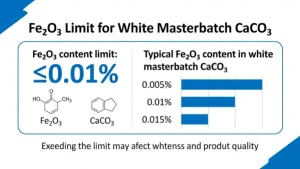
| Ultra-high-purity / Specialty grade | ≤ 0.01% (100 ppm) | Optical-grade films, medical-grade plastics, and premium white masterbatches with strict non-yellowing and long-term weather resistance requirements |
Key Notes
-
Industry Consensus: There is no single mandatory global standard for this specific application, but the above limits are widely adopted by mainstream CaCO₃ suppliers (e.g., Omya, Imerys) and masterbatch manufacturers worldwide.
-
WhitenessCorrelation: Fe₂O₃ is the primary impurity causing yellowing of CaCO₃. For white masterbatch requiring ≥95% whiteness of CaCO₃, Fe₂O₃ must be controlled below 0.05%; for ≥97% whiteness, Fe₂O₃ must be below 0.02%.
-
Processing Impact: Higher processing temperatures (e.g., for engineering plastics) demand stricter Fe₂O₃ limits, as iron oxides accelerate thermal degradation and yellowing of the polymer matrix during extrusion.
-
Regulatory Compliance: For food-contact or medical-grade white masterbatch, Fe₂O₃ limits are often paired with heavy metal restrictions under regulations like FDA 21 CFR, EU REACH, and national food safety standards.