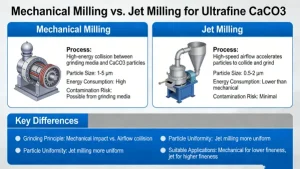
For ultrafine CaCO3 (typically <5 μm), jet milling delivers cleaner, narrower PSD, better shape control, and lower contamination but costs more and has lower throughput. Mechanical milling is cheaper, higher throughput, and better for medium-fine grades but risks contamination and broader PSDs.
1. Working Principles
Mechanical Milling (e.g., ball mills, vertical mills, stirred mills)
- Uses mechanical forces (impact, compression, shear) via moving parts (rotating media, grinding discs/rollers)
- Material crushed between grinding media and chamber walls or via media collisions
- Dry or wet operation; common dry setups include ball mill + classifier or vertical mill systems
Jet Milling (Fluid Energy Milling)
- Uses high-velocity gas streams (compressed air/nitrogen/steam) to accelerate particles to supersonic speeds
- Particles collide with each other (autogenous grinding) or against fixed surfaces in a chamber
- No moving mechanical parts in the grinding zone
- Dry process only; integrated with dynamic air classifiers for precise PSD control
2. Particle Characteristics Comparison
| Parameter | Mechanical Milling | Jet Milling |
|---|---|---|
| Minimum achievable size | Limited (typically >2–5 μm for dry; <1 μm for wet) | Down to sub-micron (0.1–1 μm) easily attainable |
| Particle size distribution (PSD) | Broader (wider d10–d97 range) | Narrow, sharp-cut PSD with tight control |
| Particle shape | Irregular, angular, often flaky from shear forces | More uniform, rounded, less fractured edges |
| Contamination risk | Higher (wear from media/liners: Fe, Ni, Cr) | Very low/none (autogenous grinding) |
| Whiteness/purity retention | May decrease due to metal contamination | Preserved (no media contact) |
| Crystallinity | May reduce crystallinity with extended milling | Minimal impact on crystal structure |
3. Process Performance & Economics
| Factor | Mechanical Milling | Jet Milling |
|---|---|---|
| Energy efficiency | More efficient (output 2×+ that of jet mills for same power) | Highly energy-intensive (only ~2% energy creates new surfaces) |
| Throughput capacity | Higher (suitable for large-scale production) | Lower (limits large-scale use) |
| Capital cost | Lower (simpler design, fewer accessories) | Higher (complex system, compressors, classifiers) |
| Operational cost | Lower (less energy, simpler maintenance) | Higher (energy for compression dominates) |
| Maintenance | Higher wear parts replacement (media, liners) | Lower wear (no moving parts in grinding zone) |
| Temperature control | Heat generation from friction; may need cooling | Self-cooling via gas expansion (10–20°C operation) |
| Moisture tolerance | Better for slightly damp materials | Requires dry feed (<1–2% moisture) |
4. Applications Suitability
Best for Mechanical Milling:
- Large-scale production of medium-fine CaCO3 (d97 ≥3–5 μm)
- Cost-sensitive applications (paper filling, basic plastics)
- Where particle shape is less critical
- Wet grinding for high-purity, ultrafine grades (stirred mills)
Best for Jet Milling:
- High-value specialty applications requiring:
- Ultra-fine particle sizes (<2 μm) for advanced plastics, coatings, inks
- Strict purity standards (pharmaceuticals, food additives)
- Narrow PSD for lithium battery anodes
- Consistent particle shape for cosmetics, advanced ceramics
- Heat-sensitive materials (CaCO3 decomposes >825°C)
5. Key Selection Criteria for Ultrafine CaCO3
- Target particle size: <2 μm strongly favors jet milling; >5 μm favors mechanical milling
- Purity requirements: Critical applications (food, pharma, high-white pigments) need jet milling’s contamination-free processing
- Production scale: Large volumes (>50,000 t/year) favor mechanical systems; small batches favor jet milling
- Cost sensitivity: Low-cost fillers use mechanical; premium products justify jet milling’s higher costs
- Post-processing needs: Surface modification works better with jet-milled particles’ more uniform shape and surface area
Summary
Mechanical milling offers cost-effective, high-throughput production of medium-fine CaCO3 with broader PSD and some contamination risk. Jet milling provides superior particle quality (ultra-fine, narrow PSD, clean, uniform shape) for specialty applications but at higher energy and capital costs with lower throughput.
For most industrial ultrafine CaCO3 applications (d97=1–5 μm), a combination system (mechanical pre-milling + jet milling final stage) often optimizes cost and quality.