Ground Calcium Carbonate (GCC) powder is generally non-hazardous (UN GHS unclassified), but requires careful handling to prevent contamination, caking, dust issues, and material loss. Below is a comprehensive guide to best practices across all transport modes and stages.
1. Pre-Transport Preparation
Material Classification & Documentation
- Confirm non-hazardous status (ADR/RID/GGVS/IMDG not regulated)
- Prepare proper shipping name: “Calcium carbonate, ground powder” (CAS #471-34-1)
- Include MSDS/SDS for handling guidelines
- Label packages with content, weight, and “Non-hazardous” indicators
Material Conditioning
- Ensure powder is dry (<0.5% moisture) to prevent caking
- Screen for agglomerates before loading to maintain consistent particle size
- For ultrafine GCC (<10μm), use anti-caking agents if needed
2. Packaging Solutions
| Package Type | Best For | Key Specifications |
|---|---|---|
| 25kg PP bags | Small quantities, retail | Woven polypropylene with inner PE liner; heat-sealed or stitched closures; UV protection for outdoor storage |
| 1-ton FIBC (Bulk Bags) | Industrial bulk | UN-certified with 6:1 safety factor; coated/liner options; lifting loops tested; dust-proof closures; palletized with shrink wrap |
| Bulk containers | Long-distance, large volumes | Closed hopper trucks/railcars; food-grade liners if applicable; pressure/vacuum tight seals |
Critical Packaging Tips:
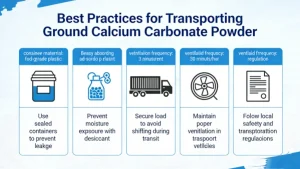
- Use multi-layer protection (inner liner + outer bag + pallet + shrink wrap)
- For ultrafine GCC, employ anti-static liners to prevent dust explosions and material adhesion
- Seal all openings with heat-sealing or double stitching; avoid staples that can damage liners
3. Transport Equipment Selection
Land Transport (Road/Rail)
- Use clean, dry, enclosed vehicles (Box truck / Boxcar) with no residue of acids, chemicals, or odors
- For bulk transport:
- Pneumatic tankers with pressure relief valves and dust collection systems
- Screw conveyors for gentle material movement, minimizing particle degradation
- Equip with long-radius bends (min 5D) to reduce pressure drop and buildup
Sea/Air Transport
- Containers must be waterproof and sealed with desiccants for ocean transport
- Air transport: Follow IATA weight limits (max 30kg per package)
- For ship bulk cargo: Protect bilge wells from powder ingress; ensure proper ventilation
4. Loading & Unloading Procedures
Safe Loading Practices
- Dust-free transfer: Use enclosed loading chutes with dust extraction systems
- For FIBCs: Use dedicated bagging stations with mechanical lifting (avoid manual lifting)
- Maintain controlled flow rate to prevent material flooding and segregation
- Evenly distribute weight in transport vehicles to avoid shifting during transit
Unloading Best Practices
- For bulk tanks: Use pneumatic discharge with proper grounding to prevent static buildup
- For bags: Use bag emptying stations with integrated dust collection
- Employ rotary valves for metered discharge; use blow-through valves for sticky grades
- Install fluidizing cones in hoppers to aid flow of cohesive GCC grades
5. Operational Best Practices
Handling Protocols
- No mixing with incompatible materials: Avoid acids, oxidizers, aluminum, ammonium salts, fluorine, magnesium
- Weather protection: Cover loads with tarpaulins during transport; avoid exposure to rain, snow, or extreme temperatures
- Gentle handling: Prohibit throwing, dropping, or walking on packages
- Use non-sparking tools to prevent static ignition risks
Environmental Controls
- Monitor humidity (<60%) and temperature (15-25°C) during transport to prevent caking
- For long transit, use temperature-controlled containers if necessary
- Ensure vehicles have proper ventilation to prevent CO₂ buildup from possible decomposition
6. Safety & Personal Protection (PPE)
- Respiratory protection: Particulate filter masks (P1/P2) with TLV 5mg/m³ compliance
- Eye protection: Safety goggles or face shields
- Skin protection: Chemical-resistant gloves and coveralls
- Handling equipment: Grounding straps for all equipment to prevent static electricity buildup
7. Pneumatic Conveying Systems (For In-Plant & Bulk Transport)
| System Type | Best For | Key Parameters |
|---|---|---|
| Dilute-phase | Short distances, free-flowing GCC | Air velocity: 15-30 m/s; pressure: 0.2-0.3 MPa; minimal particle degradation |
| Dense-phase | Long distances, fragile particles | Lower velocity (5-10 m/s); higher pressure (0.3-0.7 MPa); reduced pipe wear; better for ultrafine GCC |
| Vacuum conveying | Clean environments, small quantities | Negative pressure; dust-free operation; ideal for food/pharma applications |
System Design Tips:
- Use rigid piping for most GCC types; flexible hoses only for connection points
- Install knife gate valves above/below rotary airlock valves for leak-free operation
- Replace standard gaskets with black neoprene rubber for superior sealing
- Include filter receivers at discharge points to recover product and protect equipment
8. Risk Mitigation & Emergency Response
Common Transport Risks & Solutions
| Risk | Prevention | Mitigation |
|---|---|---|
| Dust generation | Enclosed systems; dust collection; PPE | Sweep spills into covered containers; avoid dry sweeping; use water mist if necessary |
| Caking/clumping | Dry powder; moisture barriers; anti-caking agents | Break up lumps with screens; adjust humidity controls |
| Contamination | Dedicated transport; clean equipment; proper segregation | Inspect vehicles before loading; use food-grade liners for specialty applications |
| Static buildup | Anti-static packaging; grounding; humidification | Install static dissipators; maintain 40-60% relative humidity |
Emergency Procedures
- For spills: Isolate area; wear proper PPE; collect with non-sparking tools; dispose according to local regulations
- For inhalation: Move to fresh air; administer oxygen if needed; seek medical attention
- For eye contact: Rinse with water for 15+ minutes; remove contact lenses; consult ophthalmologist
9. Post-Transport Best Practices
- Inspect delivery for damage, moisture, or contamination immediately
- Verify quantity and particle size consistency with pre-shipment samples
- Clean transport equipment thoroughly before next use to prevent cross-contamination
- Store delivered GCC in dry, well-ventilated areas away from incompatible materials
Summary of Core Practices
- Keep it dry: Moisture control is critical to prevent caking and quality loss
- Contain the dust: Use enclosed systems and proper PPE to protect workers and product
- Choose appropriate packaging: Match package type to quantity and distance
- Use dedicated equipment: Prevent cross-contamination with clean, dry vehicles
- Handle with care: Minimize particle degradation and segregation during loading/unloading
- Follow regulations: Maintain proper documentation and labeling for all shipments
By implementing these comprehensive practices, you’ll ensure ground calcium carbonate powder arrives at its destination in pristine condition, preserving its quality and value while safeguarding workers and the environment.