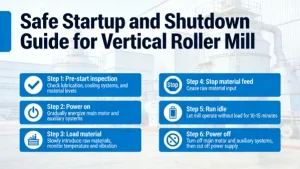
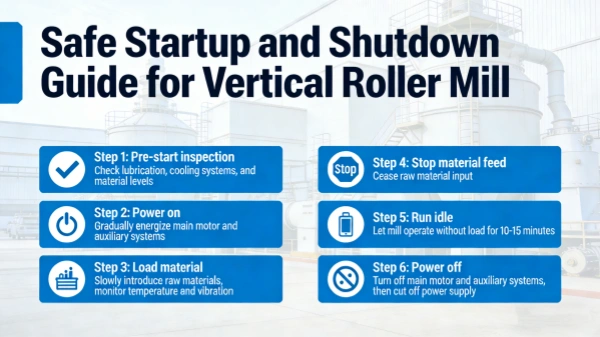
Always follow a strict sequence, verify all safety systems, and never bypass interlocks. Normal shutdown is reverse of start-up; emergency shutdown prioritizes personnel safety and equipment protection .
I. Pre-Start Safety Preparation
1. Lockout/Tagout (LOTO) Verification
- Confirm the VRM is de-energized and all energy sources are locked out/tagged out before any inspection
- Remove LOTO devices only after verifying the area is clear of personnel and tools
- Ensure proper authorization and communication protocols are followed for LOTO removal
2. Personal Protective Equipment (PPE)
| PPE Item | Purpose |
|---|---|
| Safety helmet | Head protection from falling objects |
| Safety glasses/goggles | Eye protection from dust and debris |
| Hearing protection | Noise reduction (VRMs operate at 85+ dBA) |
| Respirator | Protection from dust inhalation |
| Heat-resistant gloves | Protection from hot surfaces and hydraulic components |
| Steel-toe boots | Foot protection from heavy objects |
| High-visibility clothing | Enhanced visibility in industrial settings |
3. Pre-Start Inspection Checklist
| System | Critical Checks | Safety Implications |
|---|---|---|
| Mechanical | – Grinding rollers and table liners: No cracks, excessive wear- All bolts: Tightened to torque specs- Mill interior: Clear of foreign objects (especially metal)- Seals: Intact, no leaks | Prevents damage, excessive vibration, and unexpected material ejection |
| Lubrication | – Oil levels: Within normal range- Oil temperature: Meets minimum requirements (typically ≥49°C/120°F)- Filters: Clean, no bypass indicators active- Pumps: Functional, no leaks | Avoids bearing failure and catastrophic damage |
| Hydraulic | – Hydraulic fluid level: Correct- Pressure relief valves: Operational- Hoses: No cracks or bulges- Seals: No leaks | Prevents high-pressure fluid injection injuries and roller position control issues |
| Electrical | – All connections: Tight, no corrosion- Motor insulation: Tested and verified- Emergency stop (E-Stop) buttons: Functional and accessible- Interlocks: All active and tested | Prevents electrical shock, fire, and unexpected start-ups |
| Safety Systems | – Fire suppression: Charged and operational- Dust collection: Functional- Vibration monitors: Calibrated and active- Temperature sensors: Working properly | Early detection of hazards and protection against explosions |
| Auxiliary Equipment | – Fans (seal, process, exhaust): All functional- Separator: Rotating freely, no obstructions- Feed system: Operational, no blockages- Conveyors: Working correctly, interlocked with mill | Ensures proper operation and prevents material buildup |
4. System Preparation
- Open all necessary isolation valves (hydraulic, lubrication, air)
- Preheat lubrication and hydraulic systems if ambient temperature is low:
- Lubrication oil: Heat to ≥49°C (120°F)
- Hydraulic oil: Heat to ≥20°C (68°F)
- Test all interlocks and safety devices
- Verify the mill is in the correct starting position (rollers lifted, table empty)
II. Safe Start-Up Sequence (Detailed Steps)
Follow this strict order—auxiliary systems must be operational before the main motor :
1. Start Auxiliary Systems
- Seal air fans: Start and confirm pressure (prevents dust ingress into bearings)
- Lubrication systems:
- Start lube oil pumps
- Monitor pressure and flow rates for 3–5 minutes
- Verify oil reaches all critical components (bearings, gearboxes)
- Hydraulic systems:
- Start hydraulic power unit (HPU)
- Pressurize to standby level (rollers in lifted position)
- Check for leaks and proper pressure regulation
- Cooling systems:
- Start motor cooling fans
- Activate lubrication oil coolers
- Verify cooling water flow and temperature
- Separator preparation:
- Start separator lube pump (3 minutes before separator motor)
- Start separator cooling fan
2. Main Mill Start-Up
- Process fans: Start exhaust/recirculation fans, establish air flow through the mill
- Main motor: Start only after all auxiliaries are confirmed operational and interlocks are satisfied
- Allow 3–5 minutes of no-load operation to verify smooth running
- Monitor vibration levels (must be below 4.5 mm/s RMS)
- Check motor current: Should be at no-load level (typically 30–40% of full load)
- Material feed:
- Start feed system only after mill is running smoothly
- Begin with low feed rate (30–40% of normal capacity)
- Gradually increase feed while monitoring:
- Motor current
- Grinding pressure
- Vibration levels
- Material bed thickness
- Roller engagement:
- Lower rollers onto material bed slowly (prevents high vibration)
- Increase hydraulic pressure gradually to operating level
- Maintain stable material bed thickness (typically 25–50 mm depending on material)
3. Post-Start Verification
- Confirm all parameters are within normal operating ranges
- Check for unusual noises, vibrations, or temperature rises
- Ensure proper communication between operators and control room
- Document start-up conditions for future reference
III. Normal Operation Monitoring (Critical for Safe Shutdown)
| Parameter | Normal Range | Action if Abnormal |
|---|---|---|
| Vibration | <4.5 mm/s RMS | Reduce feed rate; if persists, shut down and inspect |
| Bearing temperature | <75°C (167°F) | Increase cooling; if >85°C, emergency shutdown |
| Motor current | Stable, within design limits | Investigate cause (material change, blockage) |
| Grinding pressure | Consistent with material type | Adjust feed rate or roller position |
| Material bed thickness | 25–50 mm (material-dependent) | Adjust feed rate or air flow |
| Oil pressure | 2–4 bar (lubrication), 100–150 bar (hydraulic) | Check filters, pumps, and valves |
| Air flow | Meets process requirements | Adjust fan speed or dampers |
IV. Safe Shutdown Procedures
1. Normal (Planned) Shutdown Sequence (Reverse of Start-Up)
- Stop material feed and allow the mill to run empty for 10–15 minutes
- This prevents material buildup and “iron-on-iron” contact
- Lift grinding rollers to disengage from the table
- Stop main motor after confirming the mill is empty
- Maintain process fans for 5–10 minutes to clear remaining dust
- Stop auxiliary systems in reverse order:
- Separator motor → Separator lube pump
- Hydraulic power unit
- Lubrication systems (keep running for 10–15 minutes after main motor stops)
- Seal air fans (last to stop)
- Close isolation valves (hydraulic, lubrication, air)
- Engage LOTO procedures to secure the mill
- Inspect the mill interior and document any issues
2. Emergency Shutdown (Abnormal Conditions)
Trigger Conditions:
- Excessive vibration (>7.1 mm/s RMS)
- Bearing temperature >85°C (185°F)
- Unusual noises or smells indicating mechanical failure
- Fire, dust explosion risk, or electrical fault
- Personnel safety threat
Emergency Shutdown Procedure:
- Press E-Stop button (local or control room)
- Immediately stop material feed
- Lift grinding rollers to prevent damage
- Stop main motor (if not already stopped by E-Stop)
- Keep process fans running for 5–10 minutes to clear dust
- Isolate energy sources and apply LOTO
- Evacuate personnel if there’s fire, explosion risk, or chemical hazard
- Investigate root cause before attempting restart
- Document the incident and corrective actions
V. Critical Safety Precautions
1. Never Bypass Safety Interlocks
- Interlocks prevent:
- Main motor starting without lubrication/hydraulic pressure
- Feed starting without mill rotation
- Roller engagement without material bed
- Bypassing interlocks is a direct safety violation that can cause severe injury or death
2. Hydraulic System Safety
- High-pressure hydraulic fluid (100–150 bar) can penetrate skin
- Use proper tools and PPE when working on hydraulic components
- Always relieve pressure before disconnecting hydraulic lines
- Inspect hoses regularly for wear and replace before failure
3. Mill Interior Access
- Never enter a VRM without:
- Full LOTO on all energy sources
- Confined space entry permit
- Ventilation and air monitoring
- Two-way communication with an attendant
- Emergency rescue equipment on standby
- Rotate the table manually to verify it cannot move unexpectedly
4. Dust and Explosion Prevention
- Ensure dust collection systems are operational during all phases
- Avoid ignition sources near the mill (especially when processing combustible materials)
- Test for explosive dust concentrations before start-up
- Keep the area clean and free of accumulated dust
5. Training and Competence
- Only trained, authorized personnel should operate or maintain VRMs
- Conduct regular safety training and refreshers
- Maintain detailed operating procedures specific to your VRM model
- Document all start-up, shutdown, and incident data
VI. Summary of Key Sequences
Safe Start-Up Order:
- PPE and LOTO preparation → 2. Pre-start inspection → 3. Auxiliary systems (seal fans, lube, hydraulic) → 4. Process fans → 5. Main motor (no-load) → 6. Material feed (gradual) → 7. Roller engagement (gradual) → 8. Monitor and adjust parameters
Safe Shutdown Order:
- Stop feed → 2. Run empty (10–15 min) → 3. Lift rollers → 4. Stop main motor → 5. Continue fans (5–10 min) → 6. Stop auxiliaries (reverse start-up) → 7. LOTO and secure → 8. Inspect and document
Final Safety Rule: When in doubt, stop the operation and consult the manufacturer’s manual or a qualified supervisor before proceeding.